






Ten years ago, almost nobody outside Silicon Valley could tell you what Nvidia did. It made graphics cards for video games. That was the whole pitch.
Today, Nvidia is the most valuable company on the planet, and arguably the most important one too. It sits at the center of the AI boom, supplying the chips that train and run nearly every major AI model in existence. Its market cap is $5.4 trillion. Its stock is up 977 per cent in five years. And now, Wall Street is starting to ask a question that would have sounded absurd not long ago: could Nvidia become the world's first $10 trillion company?
Mathematically, it does not need a miracle to get there. It needs about two more years of doing what it is already doing.
Also Read | Layoffs Are Rising In Tech, But These Skills Are Helping People Unlock Better Pay
The Revenue Story Nobody Saw Coming
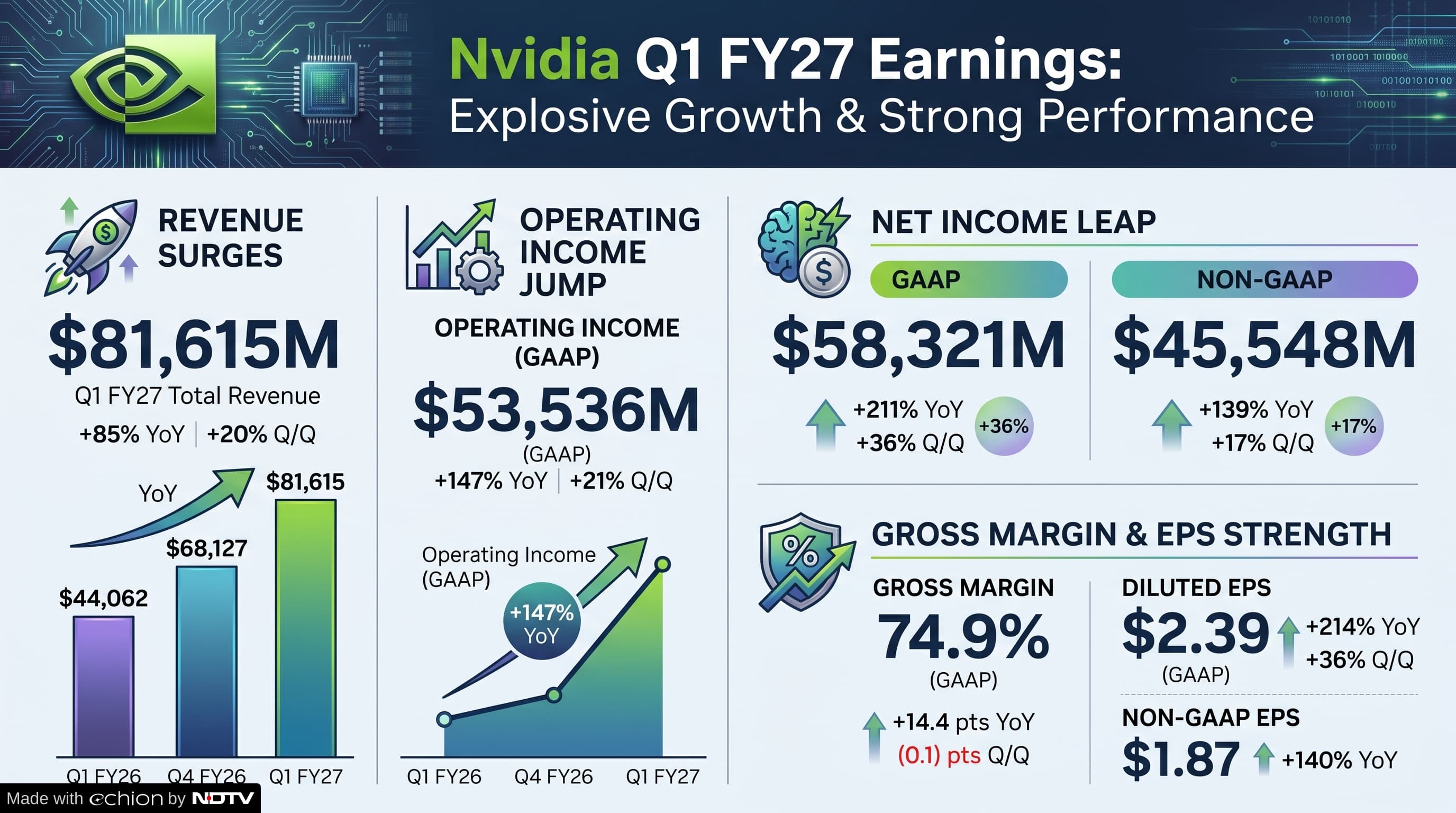
Nvidia's most recent quarter brought in roughly $81 billion in revenue, up 85 per cent from a year earlier. Annualise that, and you get a run rate closing in on $330 billion a year. The company has guided for around $91 billion in the current quarter. Keep that growth rate going, and Nvidia's revenue could approach $630 billion within the next fiscal year.
For context, Amazon led the Fortune 500 by revenue this year at $714 billion. But Amazon is growing at roughly 19 per cent annually. Nvidia is growing more than four times faster off a much smaller base. Give it two or three more years at anything close to its current pace, and it could sit at the very top of that list.
What $10 Trillion Would Actually Represent
Crossing $10 trillion would not just be a headline number. It would mark a shift in how the entire global economy is organised.
Abhishek Bhilwaria, Partner at BhilwariaFinserv, told NDTV, "Nvidia hitting the $10 trillion mark would signify the complete anchoring of the global economy to artificial intelligence infrastructure." When one hardware and software ecosystem becomes the foundation for global computing itself, Bhilwaria argues, the usual valuation playbook stops applying. We would be in genuinely new territory for how markets price a company.
It is a bold claim. It is also hard to dismiss, given how far Nvidia has already come. To reach $10 trillion from here, the stock does not need anything close to the run it has already had. It just needs the AI buildout to keep going roughly the way it has been going.
This week, Nvidia unveiled a $500 billion financing deal with Wall Street heavyweights including Apollo, KKR, Brookfield, BlackRock, and Goldman Sachs, letting tech companies lease its chips instead of buying them outright. It is a bold move. It is also where the "defying the laws of finance" part of this story really begins.
Betting Against A Basic Law of Finance
Technology has a habit of losing value fast. That is not an opinion. It is one of the oldest rules in finance. Wall Street's new bet with Nvidia essentially wagers that AI chips can defy that rule, at least for a while.
Unlike a rental car or a leased jet, a graphics processing unit does not have an obvious backup buyer if a customer defaults. Its value depends entirely on how fast the technology moves and how hungry the market stays. That is precisely why many lenders currently insist that chip-backed loans get paid off within three to five years. Past that point, the underlying hardware may be worth very little.
There is also a timing mismatch built into the whole model. Companies leasing Nvidia's chips still have to build the data centers to house them. That means the revenue these firms expect to earn lags well behind what they are spending upfront.
Huang's Counterargument: Chips Are Aging Better Than Expected
Nvidia chief Jensen Huang argues that Nvidia's older chips are holding their value far longer than most forecasts assumed, thanks to relentless demand for computing power. Even the company's six-year-old A100 chips, Huang has noted, are still in active use well beyond their originally projected lifespan. Rental pricing on newer chips, he says, has actually gone up recently rather than down.
Part of that staying power comes from software, not hardware. Nvidia keeps updating its CUDA platform, the software layer that lets GPUs originally built for graphics handle AI workloads instead. The ongoing support effectively extends the useful life of chips that would otherwise become obsolete. To sweeten the deal further, Nvidia is guaranteeing that its chips retain at least 25 per cent of their value through the life of each lease.
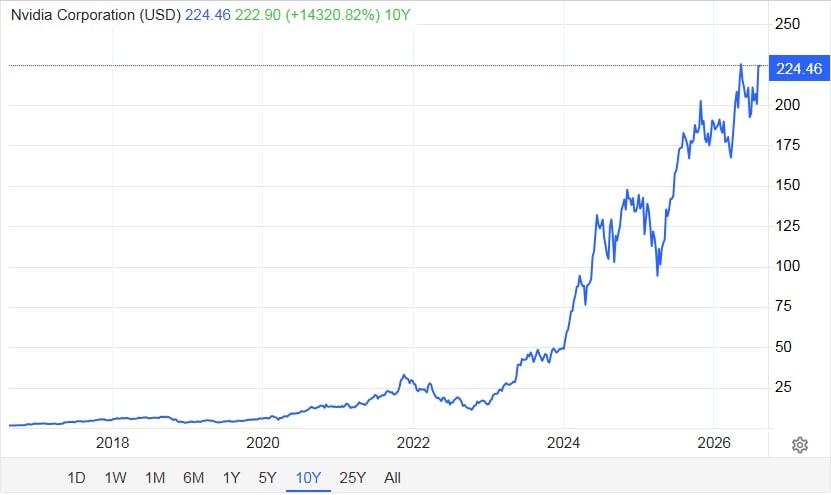
Photo Credit: TradingEconomics
Nvidia Is Becoming AI Industry's Banker
Nvidia is no longer just a chip supplier. It is becoming something closer to the financial backbone of the entire AI industry.
The company has struck deals giving it financial relationships or equity stakes in Anthropic, OpenAI, Intel, CoreWeave, Nokia, Synopsys, Marvell, and roughly half a dozen other firms. Many of these relationships involve direct investment or loans designed to help partners scale faster. Some of the money from the new $500 billion facility is expected to flow right back to Nvidia as revenue, since it will largely fund purchases of Nvidia's own hardware.
Microsoft mattered enormously in the late 20th century. Google's search engine changed how the world found information. Apple built an empire on a single flagship product. Nvidia may be doing something different: becoming the financial and technical foundation that the entire AI economy sits on top of.
So, Can Nvidia Actually Hit $10 Trillion?
The revenue math checks out. The stock's five-year run shows the market is willing to pay up for growth like this. And the $500 billion financing deal gives Nvidia a structural advantage: it locks in long-term demand for its chips while shifting much of the financial risk onto some of the deepest-pocketed institutions in the world.
But the risks are real too. Overbuilding is possible. AI models could become more efficient and need fewer chips. And an entire new asset class is being built on the assumption that semiconductor value holds up in a way it never has before in the history of technology.
Bhilwaria's framing captures the stakes well: this is not just about one company's stock price. It is about whether the global economy is willing to treat AI infrastructure as a durable, investable asset class, the way it once did with real estate or energy. If that bet pays off, Nvidia will not just be the world's most valuable company. It will be something the market has never really had to price before.
Track Latest News Live on NDTV.com and get news updates from India and around the world

