AI Courses Are India's New Craze. But Are They Helping Students Land Jobs?
National Technology Day: From campuses to workplaces, Indians are racing to learn AI for jobs, fuelling a nationwide surge in practical AI courses.
National Technology Day: For a growing number of young Indians, artificial intelligence is no longer just a technology story. It is becoming a career survival story.
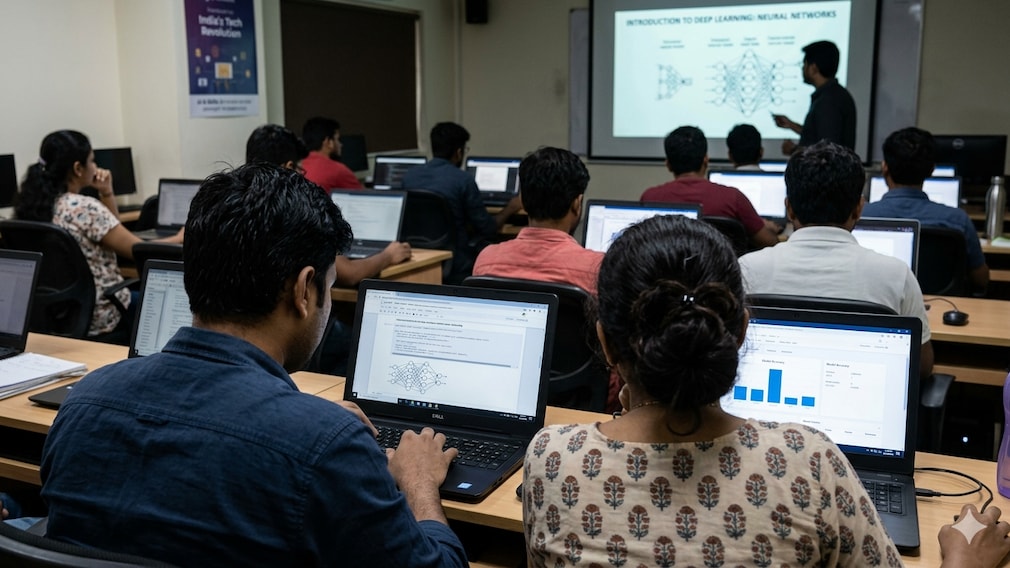
College students are practising AI-powered mock interviews before placements. Mid-career professionals are enrolling in Generative AI bootcamps after office hours. Commerce graduates are learning prompt engineering. HR aspirants are taking AI assessments to improve hiring skills. Even school students are now being introduced to AI and computational thinking.
India is in the middle of a full-scale AI learning rush.
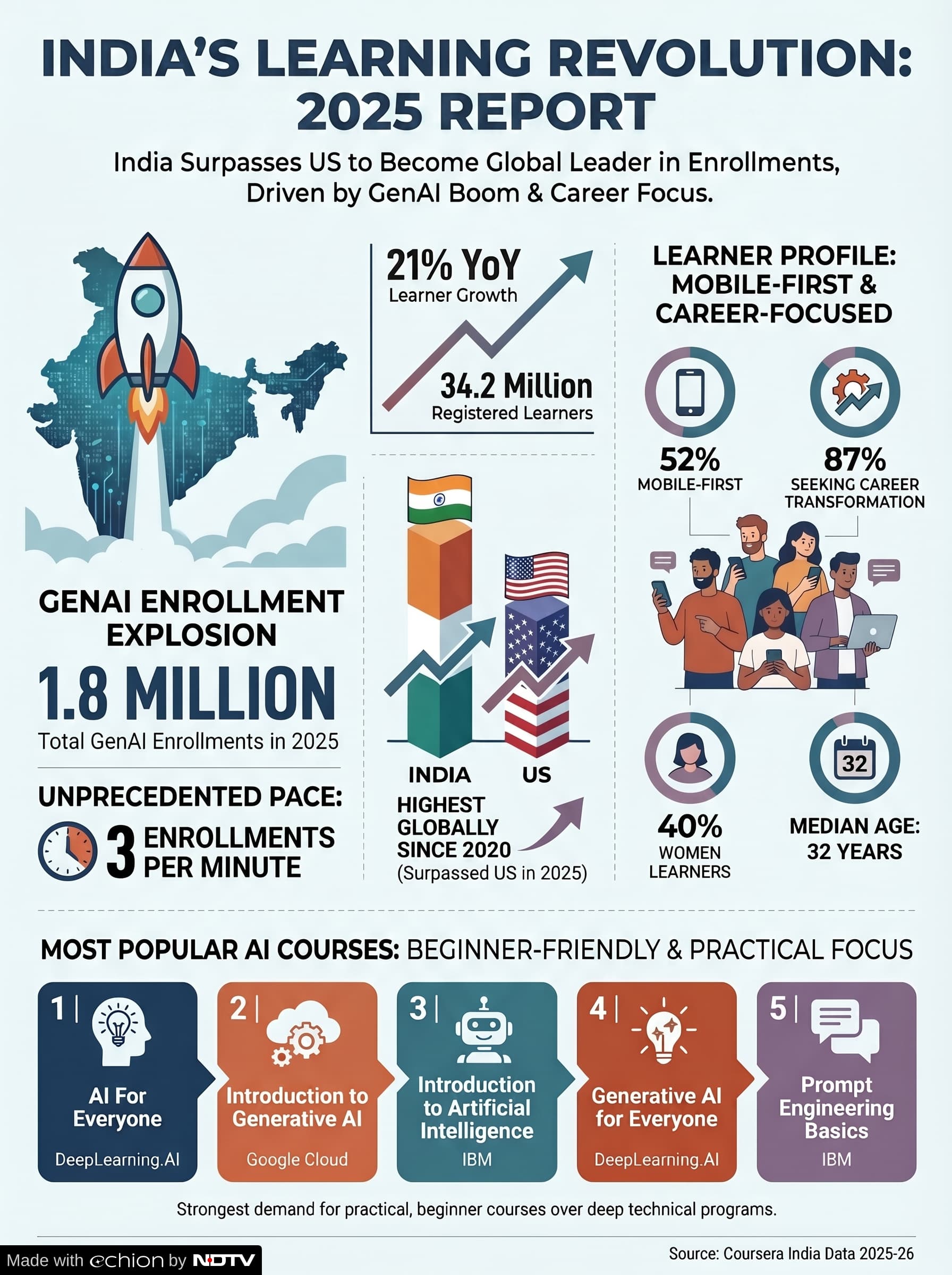
The numbers underline just how massive this shift has become. India now has 34.2 million learners on Coursera, making it the platform's second-largest market globally -- larger than all of Europe combined. The country recorded a 21 per cent year-on-year growth in learners. In fact, Indian learners are enrolling in Generative AI courses at the rate of three enrollments every minute, up sharply from one every four minutes in 2023.
Across campuses and workplaces, AI is increasingly being viewed not as an optional skill, but as a baseline expectation for employability.
"We're seeing a decisive shift from curiosity-driven learning to career-critical adoption," says Ashootosh Chand, Partner, Grant Thornton Bharat. "AI is moving fast from 'nice to have' to a foundational workplace skill, much like Excel or coding once did."
That sentiment now cuts across professions. The AI classroom is no longer dominated by engineers alone. "Students across management, commerce, both tier-2 and tier-3 colleges are now exploring AI because they perceive it as a core career skill," says Ankit Aggarwal, Founder and CEO of Unstop.
Similarly, Prateek Shukla, co-founder and CEO, Masai School, says, "We are seeing nearly 20-30 per cent of recent enrollments coming from non-technical backgrounds." "Learners are no longer viewing AI as a niche technical skill but as a practical capability that can improve productivity and decision-making at work," he adds.
India's New Career Insurance
Much of the AI learning boom is being powered by a simple belief: the future job market may reward people who know how to work with AI -- and punish those who do not.
This anxiety is visible in the experiences of students themselves. For 23-year-old Suhani Singh, interviews had become emotionally exhausting.
"I used to get nervous, blank out while answering, and sometimes even mess up questions I actually knew," she says. She recently started using AI-powered mock interview tools on Unstop.
"The whole experience feels surprisingly real," she says. "After doing a few rounds, I genuinely started feeling more confident while speaking and answering questions."
In Kolkata, 23-year-old Rani Manna says repeated placement failures pushed her toward AI-based assessments and interview simulations.
"I kept failing in both rounds -- first the assessment round and then the interview round. It was honestly getting frustrating and stressful," she says. "Practicing regularly on this platform is helping me feel more prepared and confident now."
The stories capture a larger shift taking place in India's skilling ecosystem: students are moving away from passive video learning toward simulation-led, outcome-oriented preparation.
"One major trend is the shift from passive learning to application-based learning," says Ankit Aggarwal. "Students now increasingly prefer simulations, hackathons, and AI-based assessments that actually help them benchmark real-world readiness instead of just earning certificates."
The Numbers Behind India's AI Learning Boom
Industry experts say this reflects how AI adoption is evolving in India. Learners are not necessarily trying to become AI researchers; many simply want to become more employable in AI-influenced workplaces.
From Coding Skill To Workplace Skill
One of the clearest trends emerging from the AI boom is the widening scope of learners. AI education is increasingly blending with traditional professions rather than replacing them.
Chand says the strongest demand is now coming from students combining domain expertise with AI literacy. "The biggest advantage lies with students who combine domain knowledge with AI literacy -- for example, finance plus AI or marketing plus AI," he says. "That combination is far more future-proof than studying AI in isolation."
Shukla believes this is fundamentally changing how students think about careers. "The job market is changing faster than ever," he says. "Future-readiness today is not just about having knowledge, it's about being able to adapt, build, and create impact from day one."
This is also changing what companies expect from candidates. Employers increasingly want people who can use AI tools inside workflows, automate repetitive work, analyse information faster, and improve decision-making -- not just people who can explain AI concepts theoretically.
The 'Readiness Gap' Nobody Wants To Talk About
Yet, even as enrollments explode, industry leaders say India still faces a serious employability problem. The concern is not whether students are learning AI. The concern is whether they are learning it well enough.
"The job market is not rewarding people who merely understand what AI is," says Chand. "It's rewarding those who can use AI to solve real problems."
Aggarwal points to what he calls a "readiness gap" in India's talent ecosystem. "Most courses offer a false sense of security," he says, citing the Unstop Talent Report 2026, which found that only 36 per cent of HR leaders consider candidates 'Day One' ready.
That gap is forcing recruiters to increasingly value demonstrable skills over certificates alone. "The real trend," Aggarwal says, "is the shift from legacy hiring infrastructure to prioritising those who demonstrate applied learning over mere certification."
This is precisely why project-based learning, mock assessments, hackathons, and portfolio building are becoming central to AI education.
The Rise Of The AI Course Economy
The AI rush has also created one of India's fastest-growing education businesses. Today, students can choose from thousands of AI programs -- ranging from free YouTube tutorials and MOOCs to IIT-backed executive certifications costing lakhs of rupees.
What AI Courses Cost In India
| Course Type | Typical Duration | Approximate Fee |
| Introductory MOOCs | 2-6 weeks | Rs 0-5,000 |
| Online certification programs | 2-6 months | Rs 10,000-60,000 |
| Advanced bootcamps | 6-12 months | Rs 75,000-3 lakh+ |
| IIT-backed executive AI certifications | Several months | Around Rs 1.95 lakh+ |
| BTech AI degree programs | 4 years | Rs 1.5-3.5 lakh annually |
(Based on expert estimates and industry inputs)
The market is now crowded with edtech platforms, universities, bootcamps, government-backed initiatives, and corporate upskilling programs competing for learners. But the explosion in demand has also produced another problem: an oversupply of low-quality courses.
India's AI Learning Market Has A Trust Problem
Almost every expert interviewed for this story warned about misleading or superficial AI programs. "As demand has grown, the market has been flooded with low-quality, buzzword-driven courses," says Chand.
"Many offerings simply repackage free content or promise unrealistic outcomes like 'become an AI expert in two weeks.'" Praveen Singh, CEO of learning app Aasoka, believes the sheer volume of available content makes course selection more difficult for learners.
"There are a large number of AI courses available today, which actually gives students more choice than ever before," he says. "But the key is to choose a course that matches the learner's level and includes practical exposure."
Aggarwal says another growing issue is that learners often confuse casual AI usage with actual capability. "Watching tutorials or using AI platforms casually does not automatically translate into workplace readiness," he says.
That distinction is becoming increasingly important as AI tools evolve rapidly and course content becomes outdated within months.
Even Schools Are Now Entering The AI Era
The AI push is also moving beyond colleges and professional education. Singh points out that CBSE has already introduced AI and computational thinking for students from Classes 3 to 8.
"A few years ago, it felt like a specialised subject," he says. "Now it's being introduced in simpler, more relatable ways." The shift signals how deeply AI is expected to integrate into future workplaces and daily life.
Instead of treating AI as an advanced specialization, schools are beginning to position it as a foundational digital skill - similar to coding or internet literacy.
Women Are Quietly Powering India's AI Boom
Another significant trend is the rising participation of women in AI learning. According to Coursera's Gender Gap in AI report, women now account for 33.5 per cent of GenAI enrollments in India, up from 31.2 per cent a year earlier. More notably, women complete GenAI courses at rates 3 per cent higher than men.
Application-focused courses appear to be driving much of this growth. One AI content creation course from Adobe recorded nearly 48 per cent female enrollment.
Experts say the flexibility of online learning and the rise of non-coding AI tools may help widen participation in technology-linked careers.
What Students Should Actually Look For
Experts say students should now evaluate AI programs less like academic courses and more like career investments. Shukla says learners must ask practical questions before enrolling.
"Is the teaching live or pre-recorded? Do they get both theory and real-world application? Is there personalised mentorship and doubt-solving?" he says.
"Everyone wants outcomes, but outcomes only come to those who commit to the process -- and the right program makes that process easier."
Across interviews, five themes emerged repeatedly:-
| Key Factor | Why Experts Say It Matters |
| Hands-on projects | Helps learners demonstrate capability |
| Updated curriculum | AI tools evolve rapidly |
| Industry application | Bridges theory and work |
| Mentorship & feedback | Improves retention and understanding |
| Career alignment | Prevents random certificate chasing |
More Than A Trend
India's AI learning boom is often described as an education trend. But it increasingly looks like something bigger. It is becoming a behavioural shift in how Indians think about work, ambition, and economic security. A decade ago, coding became the gateway to opportunity for millions of Indians. Today, AI literacy is beginning to occupy a similar psychological space.
And unlike earlier technology waves, this one is spreading far beyond engineering campuses. The irony, perhaps, is that the most valuable outcome of the AI boom may not be AI expertise itself. It may simply be creating a workforce that is more adaptable, more willing to learn continuously, and more comfortable working alongside technology.
-
Gyanesh Kumar Has An Immunity Pin. Why A Petition Says He Can't Use It

The Opposition wants the Chief Election Commissioner prosecuted for alleged manipulation of voter rolls, but a 2023 law stands in the way. A petition in the Supreme Court now says the law has a gap.
-
Opinion | Is The World Staring At A Big Stock Market Crash - And Recession? 5 Uneasy Signs
On Wednesday, the US bond market recorded its worst day since Trump's "Liberation Day" tariffs rattled markets in April 2025. The 30-year US Treasury yield topped 5.43%, putting it on track for its highest close since 2004.
-
Form 6 For New Voters: When A Small Change Triggered A Big Row
In July 2026, the online version of Form 6 on the ECI's ECINet portal was modified to include a new declaration.
-
Opinion | Saudi Arabia's China Turn Has Begun - After Learning Much The Hard Way
Leaning on China just makes sense for the Saudis right now. The question is, can its other great 'ally' stomach it?
-
Opinion | Bihar Assault, Hisar Marriage Ban: Who'll Stop The Guardians Of Indian 'Culture'?
Why exactly does the sight of a young couple seeking a bit of alone time somewhere tend to particularly provoke a certain kind of Indian men?
-
Opinion | The Trump-Xi Summit, And India's Many Worries Of Its Own
Washington and Beijing may have chosen coexistence over confrontation. For India, that could be both a relief and a warning.
-
Opinion | China Claims It Has Cut Troops At The Indian Border. But The Math Doesn't Add Up
The reduction likely has more to do with the deployment along the LAC than the total strength active in the region
-
Opinion | China Is No Longer Waiting For Trump To Set The Rules. And He Knows It
America's old diplomatic tricks with China won't work any longer. Because China has changed, and so has its ambitions.
-
Opinion | As UN Interviews Its Next Chief, The Interviewers Have Some Explaining To Do
On the panel sit governments whose wars, vetoes, and unpaid dues have helped make the organisation ineffective.