





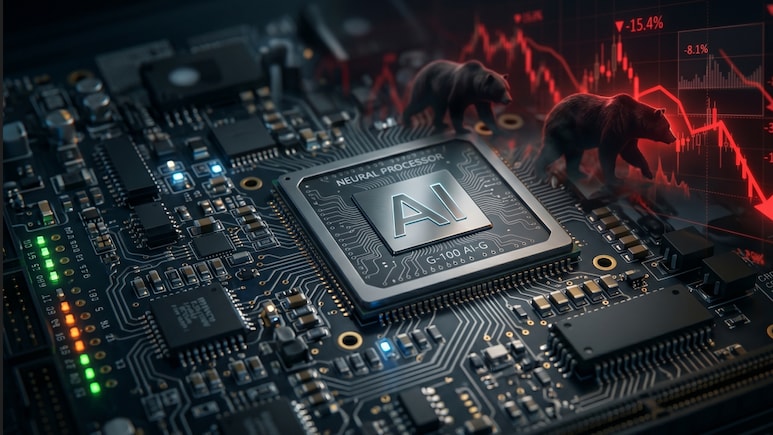
- Indian IT stocks do not automatically offer direct exposure to the global AI revolution
- Global AI leaders control chips, cloud, and models; Indian IT firms mainly offer services
- Foreign investor selling in India reflects global trends, but domestic flows cushion impact
The artificial intelligence (AI) boom has become one of the biggest themes driving global markets. But investors betting on Indian technology stocks simply because AI is in focus could be making a costly mistake.
According to Prashant Mishra, Founder and CEO of Agnam Advisors, "We have already missed the early AI bus... One of the biggest misconceptions in the market today is the belief that buying Indian IT stocks automatically provides exposure to the AI revolution."
In a detailed assessment of markets, Mishra said that while India has strong long-term growth drivers, investors need to look beyond headlines and focus on where value is actually being created.
Global AI winners, he points out, are largely companies that control critical parts of the AI ecosystem. These include semiconductor designers, chip manufacturers, cloud infrastructure providers, data centre operators and foundation model developers.
Companies such as Nvidia, Microsoft, Amazon, Alphabet and Meta are benefiting because they own essential pieces of the AI value chain. India's technology sector, however, operates very differently.
"Most large Indian IT companies are still fundamentally services businesses," Mishra notes. Their revenues are largely tied to helping clients build and manage technology systems rather than owning AI infrastructure itself.
Mishra says investors should focus on companies that are successfully moving into AI implementation, product engineering and higher-value consulting work. He highlights firms such as Persistent Systems, LTIMindtree, Mphasis and Tata Elxsi as examples of companies attempting that transition.
"The mistake investors are making is assuming that buying Indian IT automatically gives them AI exposure. It doesn't," he says. Mishra believes India still lacks several critical components of the global AI ecosystem.
The country does not yet have listed companies manufacturing advanced semiconductors. Nor does it have domestic equivalents of major cloud platforms such as AWS, Azure or Google Cloud. India also lacks publicly listed firms developing globally competitive foundation AI models similar to those being built by leading US players.
However, this does not mean India is absent from the AI story.
Mishra notes that thousands of Indian engineers contribute to chip design through the local engineering centres of global companies such as Qualcomm, AMD, Intel and Texas Instruments.
But, he cautions, strong engineering talent does not automatically translate into investable listed opportunities.
Why FII Selling Should Not Trigger Panic
Foreign investor selling has dominated market conversations for months. Yet Mishra believes the broader context is often overlooked.
According to him, much of the recent selling has been driven by global factors including elevated US bond yields, a stronger dollar, geopolitical tensions and concerns about global economic growth.
India's relatively rich valuations have also made it a natural market for profit-booking.
At the same time, Mishra says India's capital markets have undergone a structural shift.
Domestic mutual funds, pension funds, insurers and retail investors investing through systematic investment plans (SIPs) now provide a significant counterbalance to foreign flows.
"A decade ago, sustained FII selling could trigger sharp and prolonged market declines. Today, domestic flows provide a significant cushion," he says.
While foreign investors continue to influence sentiment and short-term market direction, India's dependence on overseas capital has reduced considerably.
As a result, Mishra believes investors should view FII-led corrections as potential opportunities rather than reasons to panic.
'India's Chip Ambitions Real, But Patience Is Key'
India's semiconductor push has generated enormous excitement among investors. Mishra agrees the opportunity is significant but warns against unrealistic expectations.
He credits the government's semiconductor push, particularly through the India Semiconductor Mission, for creating momentum around projects involving companies such as Micron Technology, Tata Electronics and Renesas Electronics.
However, he stresses that investors need to understand the distinction between chip design, semiconductor packaging and advanced fabrication.
India already has a strong position in chip design. Manufacturing, however, remains at a much earlier stage.
Most current projects focus on assembly, testing and packaging. While these businesses are important for employment and supply-chain resilience, they are very different from advanced semiconductor fabrication, where the highest technological barriers and margins exist.
"Taiwan, South Korea and the United States built their semiconductor ecosystems over decades," Mishra says. "Expecting India to develop globally competitive advanced-node manufacturing within a few years would be unrealistic."
His view is that India can emerge as a significant player in assembly, testing, packaging and mature-node manufacturing over the next decade, while advanced fabrication remains a longer-term goal.
Diversification Matters More Than Market Predictions
If there is one theme that runs through Mishra's market outlook, it is diversification.
He argues that too many investors are concentrating their portfolios around a single idea - whether it is AI, defence, gold, small caps or US technology.
"Markets have a way of punishing concentrated bets," he says.
For equities, Mishra remains constructive on sectors linked to India's domestic investment cycle. Defence, power equipment, transmission infrastructure, industrial manufacturing and select renewable energy businesses continue to benefit from government spending and private-sector capital expenditure.
At the same time, he advises greater caution in traditional IT services, some consumer-facing sectors and parts of banking where expectations may have run ahead of fundamentals.
On debt, Mishra believes investors should focus on high-quality corporate bonds, banking and PSU debt funds, short-to-medium duration strategies and target-maturity funds rather than making aggressive long-duration bets.
Gold, meanwhile, deserves a permanent place in portfolios.
"I don't view gold as a return-maximisation asset. I view it as financial insurance," he says, recommending a strategic allocation of roughly 8-12 per cent.
Inflation Under Control, But Risks Remain
India's inflation outlook has improved significantly over the past year, helped by lower food inflation, easing commodity prices and prudent monetary policy.
But Mishra warns against assuming inflation risks have disappeared.
Food prices remain vulnerable to weather disruptions, while energy prices continue to depend heavily on geopolitical developments.
His base case is that inflation remains manageable but settles closer to the RBI's comfort zone rather than the unusually low readings seen recently.
This, he says, reinforces the need for diversified portfolios rather than making investment decisions based on a single macroeconomic assumption.
Why Wall Street Still Matters To India
Mishra also believes Indian investors cannot afford to ignore developments in the US market.
While US equities remain supported by strong earnings growth from technology giants and enthusiasm around AI, he sees several risks that deserve attention.
Among them are concentration risk, elevated valuations, competition from higher bond yields and concerns around America's fiscal position.
A correction in US markets, he says, would not remain confined to Wall Street.
It could affect foreign investor flows into India, strengthen the dollar, weaken the rupee and increase market volatility.
For that reason, Mishra advocates maintaining diversified international exposure through broad-based global funds rather than making concentrated bets on a handful of expensive themes.
Despite discussing AI, inflation, semiconductors, foreign flows and US market valuations, Mishra ultimately returns to a single concern.
"The biggest risk today isn't technology stocks, AI or even geopolitics," he says. "It's concentration."
For investors chasing the market's hottest themes, that warning may be the most important takeaway of all.
Track Latest News Live on NDTV.com and get news updates from India and around the world

