





Investors are set to pour more money into defence, energy and technology stocks as the Middle East war forces governments to prioritise security and become more self reliant.
Wall Street has for years rewarded companies at the vanguard of globalisation, while many countries neglected critical infrastructure, supply chains and resources. That era is now over, according to investors, who say the Iran conflict is accelerating economic changes prompted by the coronavirus pandemic, Russia's invasion of Ukraine and America's trade war. Follow Live Updates
"I suspect a lot of people are still in denial that the world has changed," said John Wyn-Evans, head of market analysis at Rathbones Group Plc. "Covid-19 and Russia-Ukraine were wake-up calls, but we seem to have hit the snooze button. The alarm has gone off again now."
Also Read | Layoffs Are Rising In Tech, But These Skills Are Helping People Unlock Better Pay
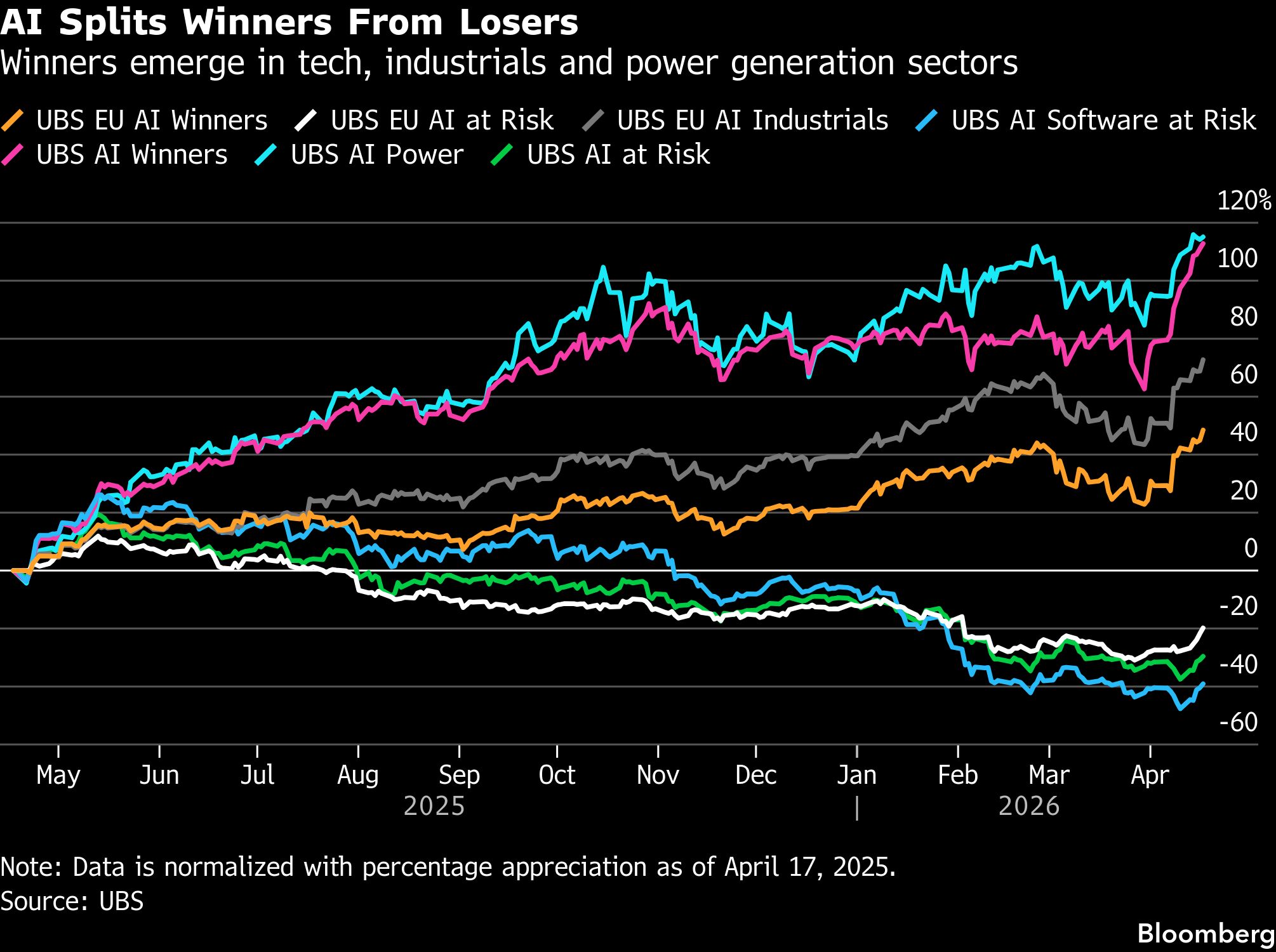
The war has increased demand for the dollar and US assets, but stock pickers are also hunting for companies that will play key roles in the move toward more secure supply chains and benefit from investment in artificial intelligence, green energy and defense. So far in 2026, energy, materials, utilities and industrials are the top-performing sectors in the MSCI World Index.
"It's a structural reset in how the global system works," said Sahil Mahtani, director at Ninety One Plc. "Globalisation isn't ending - but it's no longer happening on easy mode. The assumptions that defined the last 30 years are now being challenged all at once."
European Push
The next draft of globalisation will be written at different speeds, depending on geography, the amount of capital available and the level of urgency shown by national governments. Analysts say Europe is setting the pace.
"Changes in the global order are encouraging Europe to become more self‑reliant in strategic priority areas such as defense and energy," said Sanjiv Tumkur, head of equities at Rathbones Group Plc.
The MSCI Europe Aerospace and Defense Index, which includes heavyweights Rheinmetall AG, Leonardo SpA and Rolls-Royce Holdings, has gained roughly 35 per cent over the past year. Tumkur said that with Europe preparing for next‑generation warfare, government contracts are likely to flow to companies like BAE Systems Plc and Thales SA, which have exposure to electronic warfare and air defense.
Smaller defense tech stocks have surged, too. Exail Technologies SA, a French manufacturer of mine-hunting sea drones, has rallied some 600 per cent since the start of 2025.
Germany is the linchpin. Europe's largest economy is ramping up military spending in response to Russian aggression, and the importance of its $590 billion infrastructure program "cannot be overstated," according Hugh Gimber, global market strategist at JPMorgan Asset Management.
"If Europe was determined to reduce its dependency on other nations coming into 2026, that determination will only have been strengthened by the events in the Middle East over recent weeks," said Gimber.
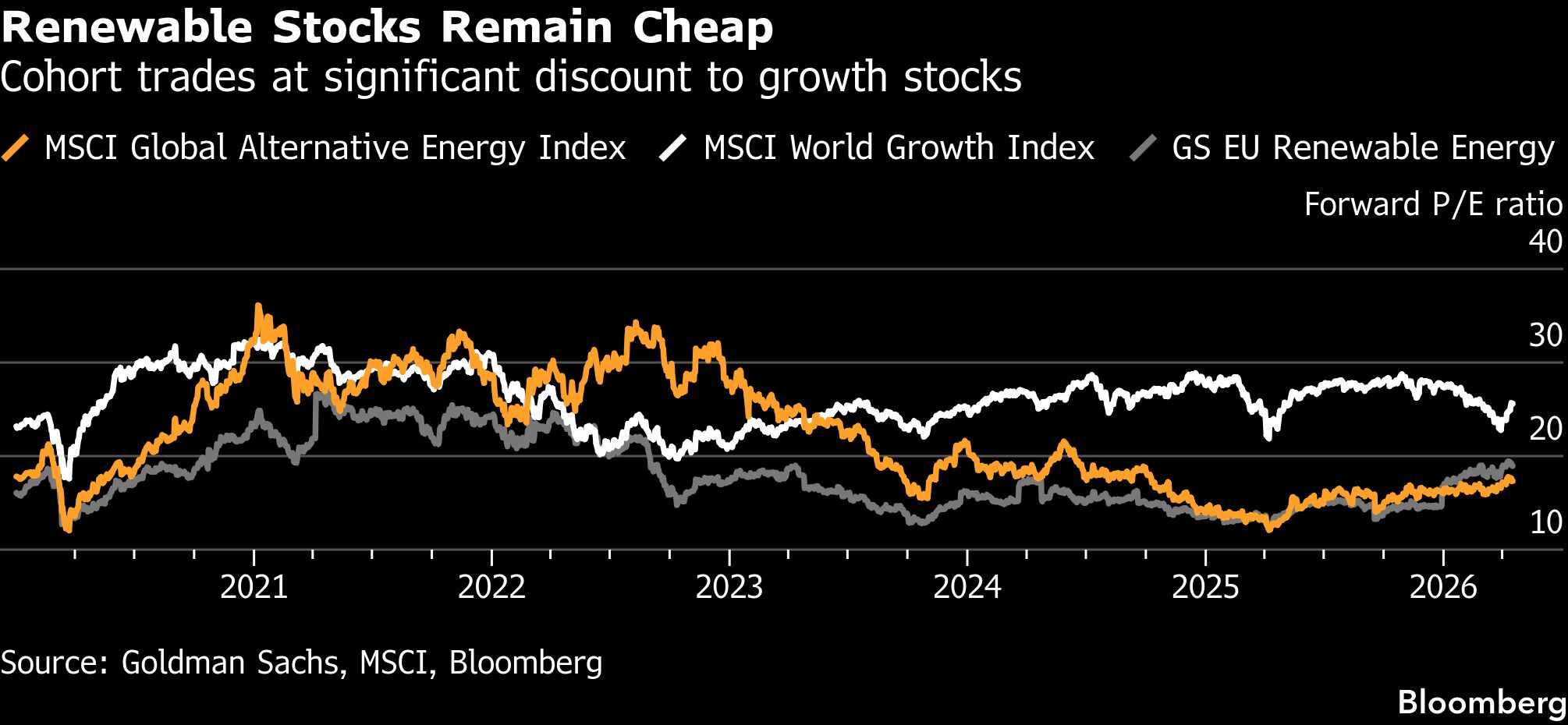
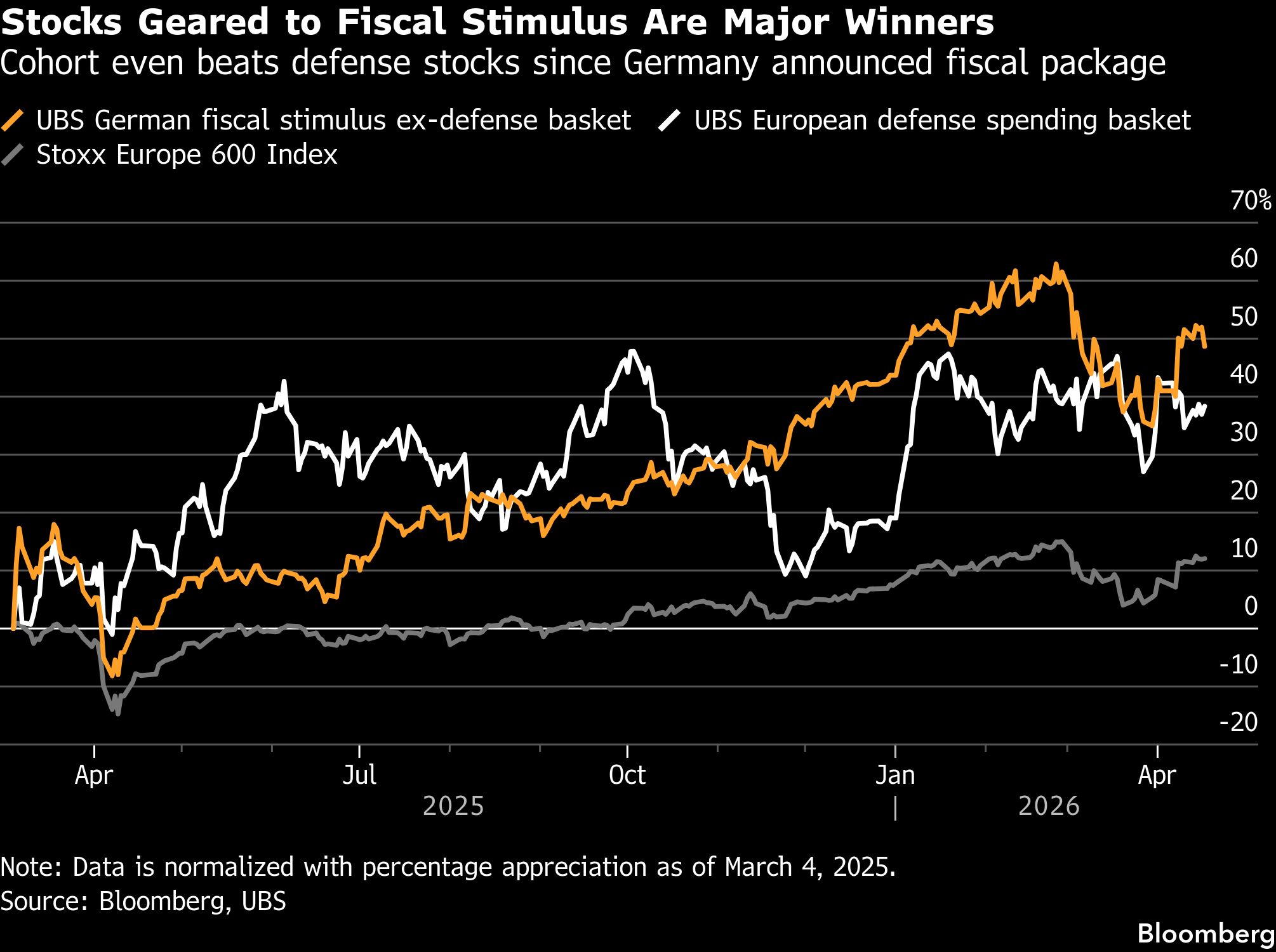
A UBS Group AG basket that tracks non-defense stocks exposed to rising government investment has rallied nearly 50% since Germany's stimulus plan took shape in March 2025. At the same time, EU investment in green energy and critical infrastructure propelled a gain of roughly 75 per cent in a Goldman Sachs Group Inc. renewable energy basket.
The focus on renewables, grid modernisation, battery storage and hydrogen will benefit the likes of Vestas Wind Systems A/S, National Grid Plc and SSE Plc, according to Tumkur.
"For advanced economies, their investment as a share of income has been low for decades now," said Christian Keller, head of economic research at Barclays Plc. "The West in particular invested very little, that is changing now."
"Countries need to build," he said.
Rise Of The 'Old Economy'
In the US, where the stock market has been driven by technology giants, the need for self reliance is bringing the so-called old economy to the fore.
Paul Eitelman, global chief investment strategist at Russell Investments, noted the US is "probably a little bit further along" than others when it comes to achieving strategic self reliance.
"We've made significant progress towards achieving energy security and independence," Eitelman said. "But as the world becomes more fragmented, those themes are just as relevant today as they were in decades past."
Traders have become more enamored with old-economy companies, which do things like transport goods and provide raw inputs. That's triggered a change in leadership on the S&P 500, with energy, materials and industrials stocks now heading the pack.
President Donald Trump's return to the White House and his push to increase self reliance is another factor. The One Big Beautiful Bill Act that he championed is expected to offer a tailwind to made-in-America manufacturing.
The rally in this corner of the market is also being fueled by US efforts to maintain an edge on AI. Companies including GE Vernova Inc., Vertiv Holdings Co. and Eaton Corp. stand to benefit from the push to build data centers, for example. Last week, Madison Air Solutions Corp., which sells cooling products for data centers, had the biggest US IPO by an industrial company since 1999.
The emphasis on resilience means "there will be a race to secure resources," said Sameer Samana, head of global equities and real assets at Wells Fargo Investment Institute. "So one implication is that investors should have full allocations to commodities in their portfolios."
Samana said that the largest tech companies will likely be supported by the US government. As a result, he recommends investors pick their spots to add exposure to tech and ancillary sectors that will be going "along for the ride."
Asia's Resilience Path
Traders are snapping up Asian stocks with strong export prospects as foreign governments push for greater resilience in energy and defense.
"The first line of beneficiaries sit in those tied to Europe's push for self-sufficiency, but the longer-term structural story may be about Asia's own push for resilience," said Charu Chanana, chief investment strategist at Saxo Markets.
"Export linkages to Europe are more visible and easier to monetize while many Asian countries own self-reliance push is still much earlier in the cycle and slower-moving, so the earnings impact is further out," she added.
One example is the world's largest battery maker, Contemporary Amperex Technology Co Ltd., which has seen its Hong Kong-listed shares gain around 40 per cent since the start of the Iran war. South Korean defense manufacturer Hanwha Aerospace Co. is another strong performer, with shares trading near a record after rallying about 50 per cent this year.
Korean and Japanese defense manufacturers are meanwhile benefiting from rising domestic spending and export prospects, according to analysts.
"We're seeing rapid increase in allocations to Korean defense equipment manufacturers and Korean industrials," said Manishi Raychaudhuri, CEO at Emmer Capital Partners. "Large European defense spenders - notably Poland - now import more from Korea than from the USA."
Looking ahead, the big question is whether the war in the Middle East turns out to be a true tipping point for globalisation.
"It looks like we're moving away from peak globalisation," said Eitelman of Russell Investments. "I wouldn't say it's over. The evidence so far looks like a reconfiguration of global supply chains rather than an outright push towards deglobalisation."
(This story has not been edited by NDTV staff and is auto-generated from a syndicated feed.)
Track Latest News Live on NDTV.com and get news updates from India and around the world

