





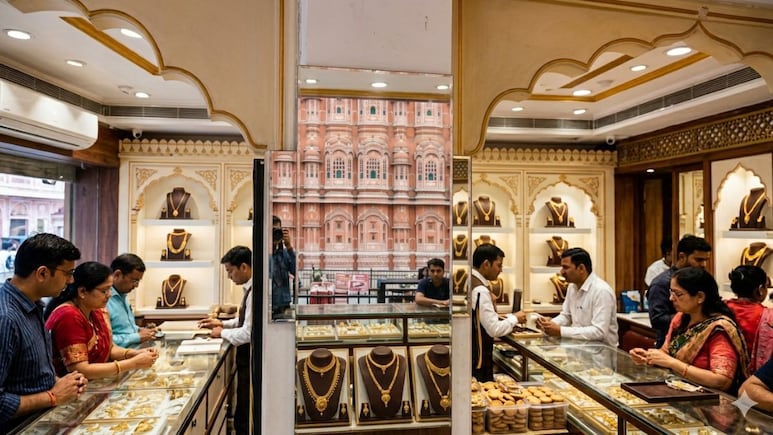
One of India's most auspicious days to buy gold turned unexpectedly subdued this year. Record prices of the yellow metal dampened jewellery purchases on Akshaya Tritiya. Meanwhile, a section of buyers quietly shifted toward gold coins and other investment formats (like ETFs).
Gold buying on the festival -- second only to Dhanteras in cultural significance -- typically draws families to jewellery stores in large numbers. However, this time, footfalls were relatively lower.
Surendra Mehta, national secretary at the India Bullion and Jewellers Association, told Reuters that the demand was lower than usual across most of the country, barring pockets in southern states. Follow Live Updates
Notably, gold futures in India closed at Rs 1,54,609 per 10 grams on Friday -- nearly 63 per cent higher than levels seen during last year's Akshaya Tritiya. While global prices have cooled from their January peak of $5,594.82 an ounce to around $4,861, they remain historically elevated, keeping many buyers cautious.
'Buyers Now Wait For Price Drop, Not Festivals'
Retail behaviour also showed a visible shift. In comparison to ornate jewellery, buyers preferred gold coins, which are easier to liquidate and free of making charges. Jewellers, for their part, offered discounts on crafting fees to attract hesitant customers.
Data compiled by the World Gold Council shows this evolving pattern more clearly. India's jewellery demand in 2025 fell 24 per cent year-on-year, while investment demand rose 17 per cent to its highest level since 2013.
According to bullion dealers, gold purchases are no longer clustered around festivals. Instead, price-sensitive buyers now wait for dips and buy through the year.
The muted festival demand may be less about sentiment and more about a structural change in how Indians approach gold. From being a once-a-year ritual purchase, gold is increasingly treated as a portfolio asset -- bought selectively, often digitally, and with an eye on allocation rather than occasion, they added.
Is It The Right Time To Buy Gold?
"Akshaya Tritiya often leads to over-allocation to gold, which is usually the wrong starting point," said Paramdeep Singh, founder of Long Tail Ventures. At current levels, he argues, gold is best kept to 5-10 per cent of a portfolio as a hedge rather than treated as an "investment engine", with SIPs in equities forming the core for long-term compounding. For younger investors, he recommends Gold ETFs or digital gold over jewellery, which "locks in costs and limits flexibility".
Saurabh Bansal, founder of Finatwork Investment Advisor and a SEBI-registered RIA, echoes the need for discipline. Buying gold for Akshaya Tritiya may carry emotional value, he said, but investment decisions should be guided by asset allocation rather than recent price swings. "If gold already forms a meaningful part of the portfolio, incremental buying may not be necessary," he said.
Bansal adds that while jewellery remains relevant for cultural reasons, digital gold and Gold ETFs offer a more efficient route for investment, particularly for younger investors concerned with liquidity, storage and purity.
Track Latest News Live on NDTV.com and get news updates from India and around the world

