





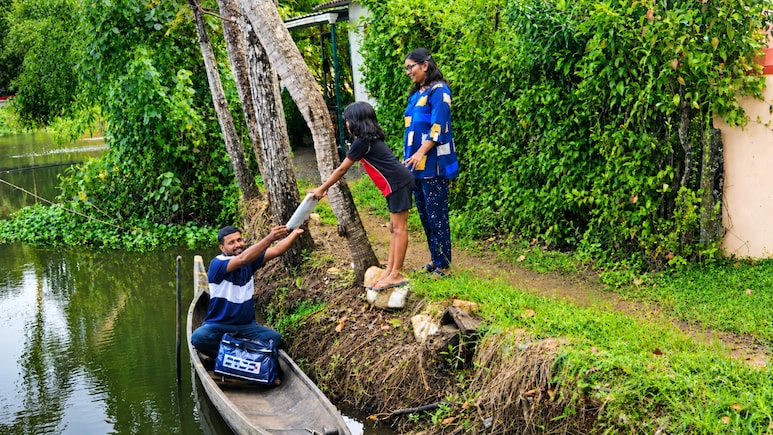
India's digital economy has reached communities that logistics networks still struggle to serve. Millions of consumers in riverine, island, and backwater regions can shop online, but receiving those deliveries remains a challenge. As digital commerce expands across the country, the question for logistics providers is no longer whether demand exists, but how effectively it can be reached.
The opportunity is significant. The Indian logistics industry is forecasted to grow up to $281.74 billion by 2026, and rural internet users have exceeded 427.7 million during the FY 2025-26. However, there are areas within the country where access to logistics remains difficult owing to geographic barriers.
New Perspective For Last Mile Logistics
India is experiencing significant progress in rural connectivity with 99 per cent of eligible habitations connected via PMGSY-I. But road connectivity does not necessarily mean delivery accessibility. The last mile from a logistics hub to the customer can still be costly, time-consuming, and operationally difficult in dispersed settlements and water-bound areas.
For logistics companies, the challenge today is not simply extending reach, but making it meaningful. Networks that developed around highways and urban corridors often fail where rivers, canals and backwaters are major transport routes. The next phase of logistics growth will depend on solutions that adapt to local geography rather than forcing geography to adapt to existing networks.
Looking Beyond Roads
India's inland waterway network is gaining momentum. Out of the 111 National Waterways that cover over 20,000 km, 32 waterways that cover over 5,100 km were functional by March 2026. The movement of goods through these waterways was in excess of 198 million tons by February.
Even as bulk cargo accounts for much of the increase, the next big step will be consumer logistics. The government's goal of increasing the share of freight on waterways from about 2 per cent to 5 per cent by 2030 can be achieved by schemes like PM Gati Shakti and Jalvahak.
Lessons From Local Innovation
The Vallam Express initiative in Kerala's Alappuzha region offers a compelling example. Serving 14 villages and nearly two lakh residents, it combines organised logistics with local boat operators who know routes inaccessible by road.
"In a market as diverse as India, scale in logistics does not always come from standardisation. India's geographies, infrastructure, communities and ways of living vary significantly, and the strength of a network lies in its ability to recognise these nuances and adapt without compromising reliability. The larger opportunity for Indian logistics is to move from a one-size-fits-all notion of scale towards a more adaptive network model that combines multiple modes, local ecosystems and modern logistics capabilities to respond to the realities of each market. The future will not belong to the networks with the most standardised infrastructure, but to those capable of orchestrating what already exists around them to create consistent customer experiences," Abhishek Chakraborty, CEO, DTDC Express, told NDTV.
Accessibility: The Next Phase Of Growth
Antim Suman, Co-founder & COO of Edgistify, told NDTV, "Ask any last-mile rider what slows them down: it's never the highway, always the city traffic. Waterways won't replace doorstep delivery, but they can revolutionise it from upstream."
Suman adds, "Inland water transport is up to 60 per cent cheaper than road transport, and every barge deployed takes heavy trucks off congested streets. The real game-changer is urban water terminals doubling as fulfillment hubs. Floating inventory closer to local demand shrinks the last-mile distance before a rider even turns the key. Waterways won't bring parcels to your door, but they can make that final trip dramatically shorter."
Waterways will not replace roads; they will complement them where water is already a practical transport corridor. The opportunity lies in integrating roads, jetties, aggregation points, technology and local delivery networks.
India's logistics future will be defined not by one mode, but by how intelligently they work together. The real measure of reach will be accessibility, not infrastructure alone.
Track Latest News Live on NDTV.com and get news updates from India and around the world

