






Imagine opening a shopping app on your iPhone and seeing a flight for Rs 18,500. Your friend, using an Android phone sitting right next to you, sees the same ticket for Rs 17,200.
Neither of you knows why.
There is no sale. No coupon. No explanation.
Also Read | Layoffs Are Rising In Tech, But These Skills Are Helping People Unlock Better Pay
Welcome to what experts are calling the "Invisible AI Tax" -- a world where algorithms may quietly decide how much you pay based not just on demand, but on who they think you are.
The idea sounds unsettling. But regulators across the world are now investigating whether artificial intelligence is moving beyond recommending products to actually deciding what price each customer is willing to accept.
Price Isn't Just About The Product Anymore
For decades, businesses have relied on dynamic pricing. Airlines, hotels and cab aggregators routinely raise prices when demand spikes.
But AI has taken this a step further.
Today's algorithms can analyse dozens of signals in real time. Your location. Your browsing history. Previous purchases. Device type. Shopping frequency. Even how urgently you appear to need a product.
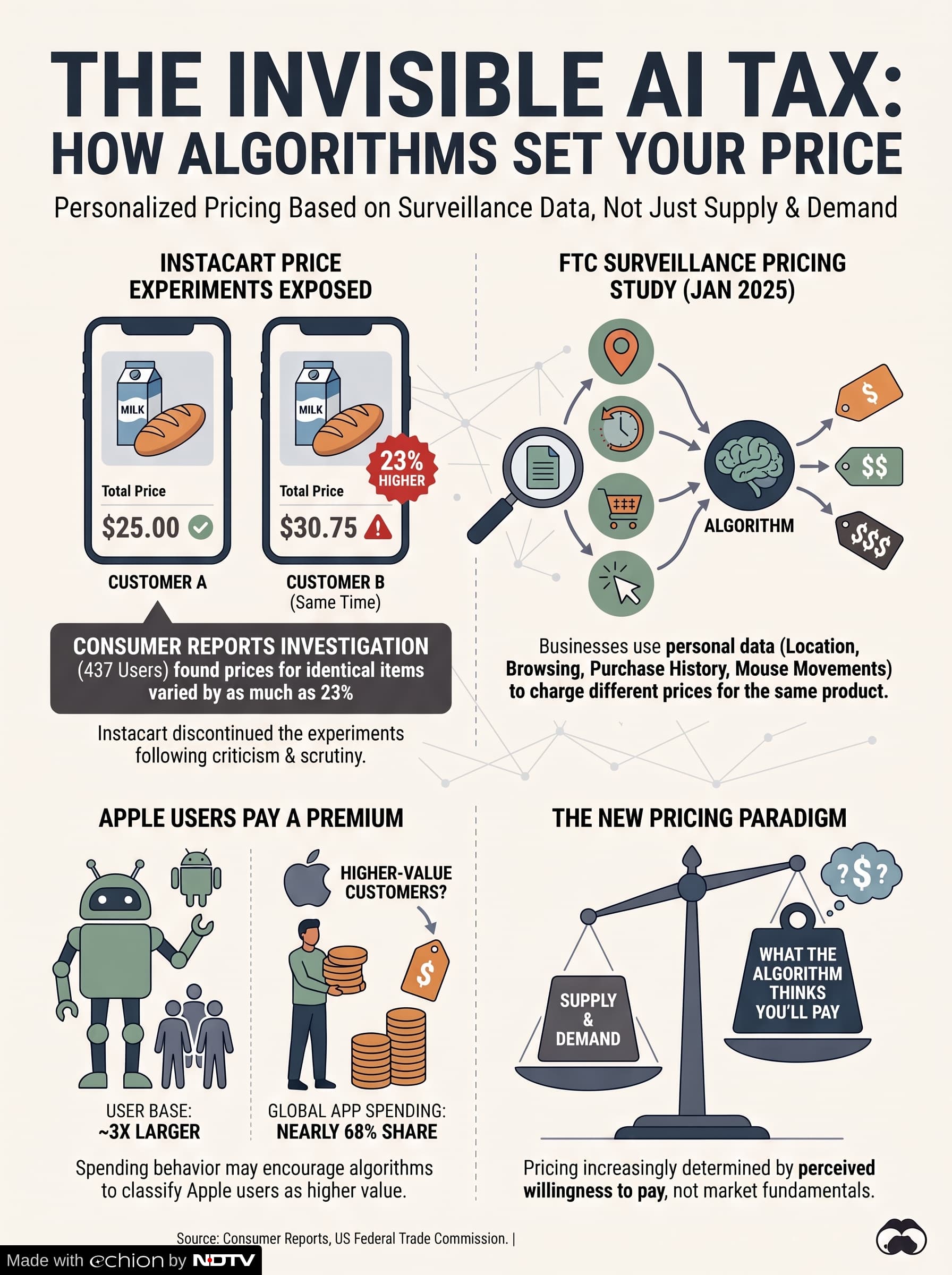
According to the US Federal Trade Commission (FTC), companies can use personal information ranging from location and shopping history to browsing patterns and even mouse movements to personalise prices and promotions. The agency says consumers often have little visibility into how these systems work, prompting growing concerns over "surveillance pricing".
Rajesh Chhabra, General Manager, APAC, Large Markets, Acronis, believes this marks a fundamental shift in digital commerce. "The core issue around the so-called Invisible AI Tax is the fact that pricing now isn't determined merely by demand or supply but increasingly by what the algorithm thinks the consumer is prepared to pay."
According to Chhabra, applications can infer purchasing power using the device being used, browsing habits, buying history, location and even urgency. "This is why the claims of higher prices or higher fares for iPhone customers make sense - the device itself could become the determinant of the consumer's buying power, along with frequent orders and expensive purchases."
Why iPhone Users Often Enter The Debate
The allegation that iPhone users are shown higher prices isn't new.
In India, the issue grabbed headlines after several users claimed they were quoted higher cab fares on iPhones than on Android devices for identical routes.
Those complaints prompted the Central Consumer Protection Authority (CCPA) to issue notices to ride-hailing platforms Ola and Uber in January 2025. Both companies denied using phone models to determine fares and said pricing remains uniform across devices.
Sarika Grover, Co-Founder of LoansJagat, says the debate reflects a larger concern about AI-driven profiling.
"The FTC surveillance pricing study done in January 2025 shows how businesses use people's personal data including location, browsing history, purchase history and even mouse movements in order to charge different prices on the same products to various consumers," she says.
Grover also points out that iOS users account for nearly 68 per cent of global app consumer spending despite Android having a user base roughly three times larger. That spending behaviour alone may encourage algorithms to classify Apple users as higher-value customers.
AI Is Building A Digital Version Of You
The Invisible AI Tax isn't really about your phone.
It's about your digital identity.
Every click, every search, every abandoned cart and every premium purchase adds another layer to your consumer profile.
Diwakar Chittora, Founder & CEO of Intellipaat, says AI is becoming increasingly capable of understanding not just what people want, but how much they are willing to spend.
"Dynamic pricing has existed for years, but AI is making it far more sophisticated by analyzing browsing patterns, purchase history, location, device usage, and customer intent in real time."
He says the next phase of AI goes beyond recommendations.
"Your AI assistant, chatbot, and connected devices are gradually building a behavioural profile of who you are. They may not know everything about you, but they understand your preferences, urgency, spending habits, and even your willingness to pay."
According to Chittora, AI will increasingly decide which premium products, subscription plans and expensive offerings consumers are shown based on predicted spending behaviour.
He adds that while this creates better personalisation for businesses, it also raises serious questions about fairness.
"AI should be used to improve customer value, not exploit customer behaviour. Organisations that combine intelligent personalisation with ethical AI practices and clear governance will earn long-term trust."
Evidence Is Beginning To Emerge
The concerns are no longer hypothetical.
A Consumer Reports investigation involving 437 Instacart users found that prices for identical grocery items varied by as much as 23 per cent between customers shopping at the same time. The findings triggered widespread criticism, regulatory scrutiny and eventually led Instacart to discontinue the pricing experiments.
Meanwhile, New York introduced the Algorithmic Pricing Disclosure Act, which took effect in November 2025. The law requires businesses to clearly disclose when consumers' personal data influences pricing decisions.
India currently has no comparable disclosure requirement.
The Real Problem Is Secrecy
Experts say personalised pricing isn't necessarily illegal. The bigger concern is that consumers don't know when it is happening.
Rajesh Chhabra says transparency is what separates acceptable pricing strategies from practices that damage trust.
"What matters here is not dynamic pricing as such, but opaque pricing." He adds that when consumers cannot tell whether they are paying more because of demand, loyalty, purchase history or simply the phone they own, confidence in digital platforms begins to erode.
"With AI becoming more pervasive in the commercial landscape, companies will face increasing challenges of distinguishing optimisation from discrimination."
How Consumers Can Protect Themselves
While regulation is still evolving, experts say consumers can take a few practical steps to avoid becoming easy targets for algorithmic profiling.
Sarika Grover recommends:
- Use Incognito Mode while searching for flights or hotels.
- Clear cookies before making expensive purchases.
- Compare prices across different devices and accounts.
- Check prices on multiple booking platforms instead of relying on one app.
Rajesh Chhabra offers similar advice.
"Compare prices on different devices and accounts, use multiple channels and don't put all the eggs in one basket when booking via convenience applications. Treat flights and hotels like your Uber ride and Airbnb stay."
Track Latest News Live on NDTV.com and get news updates from India and around the world

