





8th Pay Commission: For years, Pay Commission discussions in India followed a familiar script. Employees waited for one thing - salary hikes. How much will basic pay increase? What will happen to Dearness Allowance (DA)? Will the fitment factor rise?
But this time, the conversation is changing.
As consultations around the 8th Pay Commission gather pace across the country, a much bigger issue has quietly moved to the centre of the debate -- retirement security.
Also Read | Layoffs Are Rising In Tech, But These Skills Are Helping People Unlock Better Pay
-

-
 "Keep Learning New Skills": Andrew Ng On 'AI Jobapocalypse' Fear
 -
 Nikhil Kamath Recalls Satya Nadella's Remark: 'I Don't Touch An Indian Product' In The US
 -
 NDTV World Summit 2026: What Nikhil Kamath Said On Inheritance Tax
 -
 Mohini Dey Says She Carries Her Roots Wherever She Goes: 'I Am A Bengali Girl'
 -
 Nikhil Kamath Shows 'Delay Gratification' Tattoo, Reveals Mantra Behind It
 -
 Mohini Dey On Music, Family, Losing Her Father & Being Born In India | NDTV World Summit
 -
 NDTV World Summit 2026: What Nikhil Kamath Said On Inheritance Tax
 -
 Nikhil Kamath Warns 2027 Could Be Tough For Startups Amid AI Bubble Fears
 -
 Not Another News Platform: What Nikhil Kamath Wants To Build Next
 -
 Nikhil Kamath Tells NDTV One Thing India Can Learn From China At NDTV World Summit
And now, a new proposal is beginning to generate serious discussion among employee bodies and pensioner groups: giving central government employees the freedom to choose their pension structure.
If this gets approved, employees may be allowed to pick between the Old Pension Scheme (OPS), the National Pension System (NPS), and the Unified Pension Scheme (UPS), depending on what suits their financial goals best.
8th Pay Commission: Pension Flexibility
While there is no official notification yet, employee representatives say conversations around "pension flexibility" have become increasingly active in recent weeks.
If discussions continue positively, employee bodies believe some movement could happen within the next two to four months. This is particularly significant as pension concerns have emerged as one of the biggest flashpoints during the 8th Pay Commission consultations.
For many employees, the issue is no longer just about earning more during service. It is about surviving comfortably after retirement.
The debate largely revolves around three pension systems.
The Old Pension Scheme remains the most emotionally resonant among employees because it guarantees a fixed pension linked to the last drawn salary and Dearness Allowance. It offers predictability. Employees know what they will receive after retirement.
The National Pension System, on the other hand, works very differently. Employees contribute a part of their salary during service. The government contributes separately. The pension amount eventually depends on the accumulated corpus and market-linked returns.
However, the market linkage is precisely what worries many employees.
Supporters of OPS argue that retirement income should not fluctuate with financial markets. They say employees who spend decades in government service deserve certainty, not unpredictability.
The Unified Pension Scheme, introduced more recently, attempts to bridge the gap between the two systems. It retains the contribution-based structure of NPS while offering certain assured pension protections.
But even UPS has not fully settled employee anxieties.
"A large number of employees continue to compare OPS, NPS and UPS and have different preferences based on their personal circumstances," the union representative said. "The demand is that employees should be given the freedom to choose the pension structure that suits them best."
That idea is now slowly gaining traction during Pay Commission consultations.
Supporters of the proposal argue that one pension system cannot fit everyone. Some employees may prioritise guaranteed income after retirement. Others may prefer flexibility and market-linked growth. Younger employees may have different risk appetites compared to older staff nearing retirement.
Employee unions say the current system leaves little room for individual choice.
8th Pay Commission: Employee Bodies Cite Inflation
At present, central government employees recruited after January 1, 2004, are largely covered under NPS. There is no provision allowing employees to freely switch between OPS, NPS and UPS.
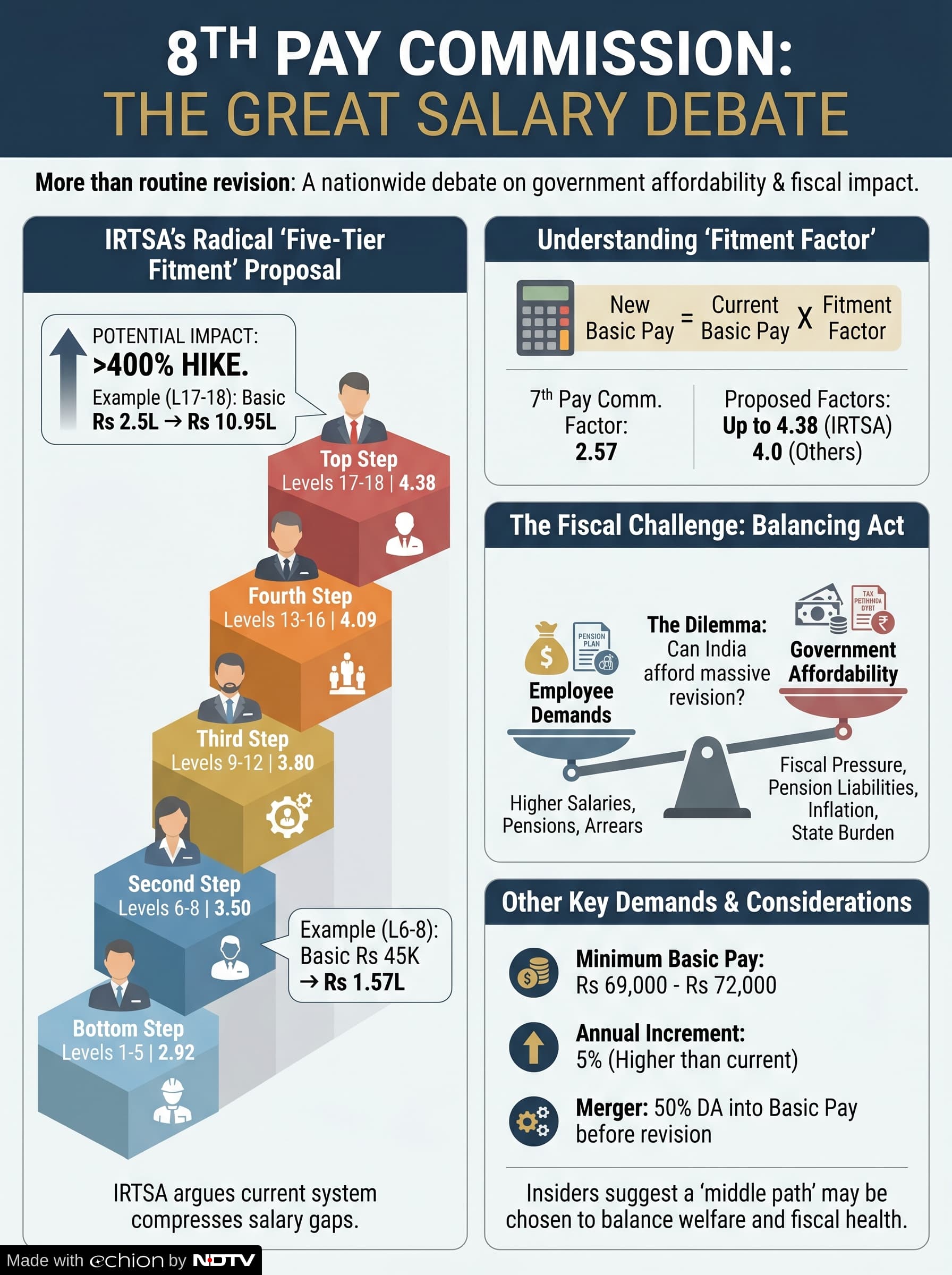
Any change would require a major policy decision by the government. Still, the discussions reflect a broader shift taking place inside the 8th Pay Commission itself. And inflation is playing a major role in that shift.
Employee bodies argue that the cost of retirement today looks very different from what it did two decades ago. Medical expenses have surged. Education costs remain high. Food inflation continues to pressure household budgets.
That concern has also spilled over into another major debate inside the 8th Pay Commission - the "family unit" formula used to calculate salaries.
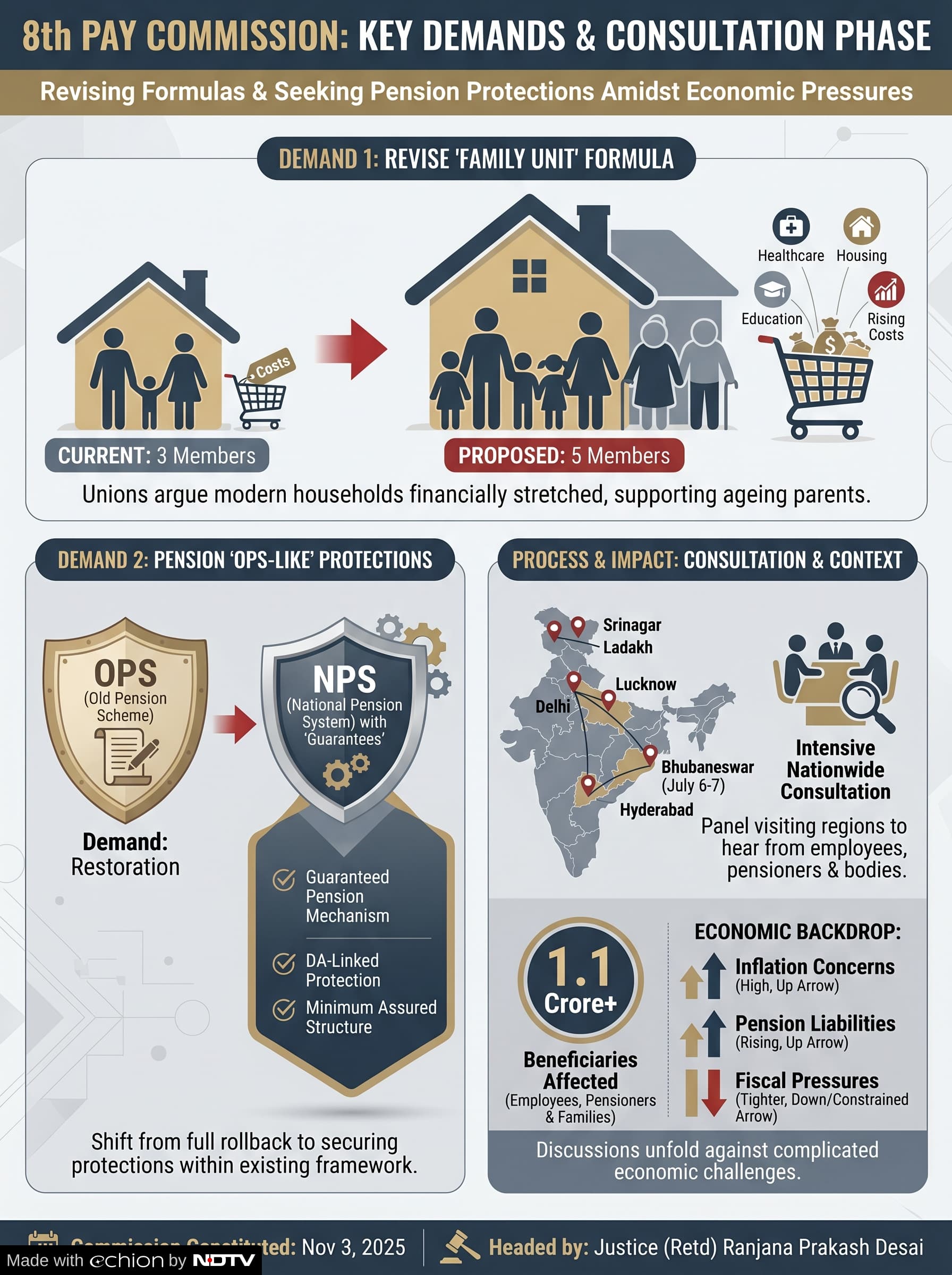
The formula may sound technical, but it directly affects how much government employees ultimately earn. Under the existing system, a family is broadly treated as a three-unit household while estimating minimum living expenses.
Employee unions now argue that this assumption no longer reflects the realities of modern Indian families.
8th Pay Commission: Family Unit Calculation
During recent discussions with the Pay Commission, the National Council of Joint Consultative Machinery (NC-JCM) proposed expanding the family unit calculation to five units.
Under the suggested formula, the employee and spouse would count as one unit each, two children as 0.8 units each, and dependent parents together as another 0.8 unit.
The reasoning is simple: employees are increasingly supporting not just spouses and children, but also ageing parents.
The employee side of the NC-JCM has argued that existing laws, including the Maintenance and Welfare of Parents and Senior Citizens Act and the Social Security Code, already recognise dependent parents as part of the family structure.
This change could significantly alter salary calculations under the 8th Pay Commission. "The minimum pay computed by the Staff Side National Council (JCM) is Rs 69,000 for a 5-unit family. Accordingly, the fitment formula for the existing employees and pensioners will be 3.833," the memorandum submitted by the employee side stated.
If accepted, the proposal could influence minimum basic pay, pensions, allowances and overall compensation structures.
But even here, the underlying issue remains the same -- financial security. The anxiety is particularly visible among employees considering voluntary retirement.
Employee representatives say another proposal under discussion involves allowing employees opting for voluntary retirement to receive assured pension benefits immediately after retirement under applicable pension structures.
Under OPS, employees who took voluntary retirement after completing qualifying service generally continued receiving pension protection without major complications.
But under contribution-based systems like NPS, retirement benefits depend heavily on corpus accumulation and retirement conditions. That can create uncertainty for employees leaving service early.
The demand reflects a growing belief among employee bodies that retirement protection should not weaken simply because someone chooses voluntary retirement after long years of service.
8th Pay Commission: Centre Walks A Tight Rope
For the government, balancing these demands will not be easy.
India's pension burden is already a politically sensitive issue. OPS-style guarantees create long-term fiscal commitments for governments. Several states have witnessed heated political debates over restoring OPS in recent years.
At the same time, employees argue that retirement security cannot be left entirely to market outcomes.
This tension now sits at the heart of the 8th Pay Commission consultations.
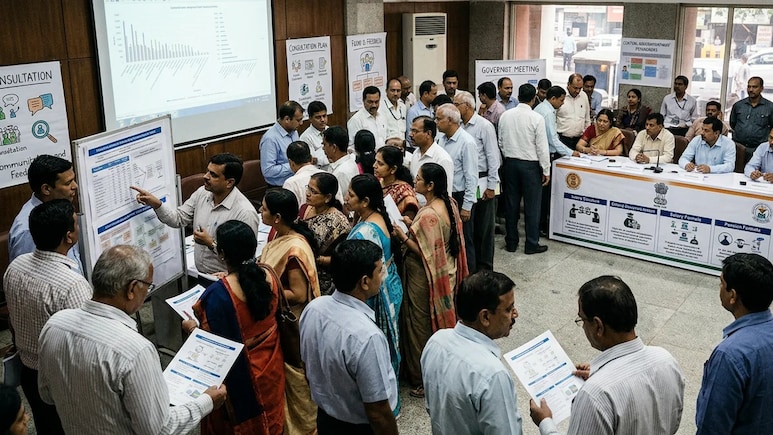
The Commission has already started meetings with employee unions, pensioner bodies and associations across multiple regions. More consultations are expected in the coming months.
Track Latest News Live on NDTV.com and get news updates from India and around the world

