





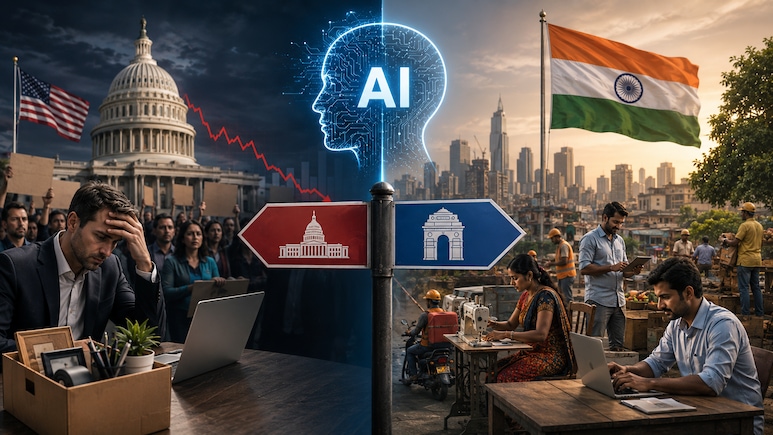
- Political strategist Rob Flaherty highlighted AI's potential to become a major political issue
- Goldman Sachs and IMF reports warn AI could impact hundreds of millions of jobs globally through automation
- AI disruption may hit middle-layer white-collar jobs hardest, while physical labor jobs remain relatively safe
A few months back, Democratic strategist Rob Flaherty - who served as Kamala Harris' deputy campaign manager during the 2024 US presidential election campaign - made an observation that has lingered in both political and tech circles. As AI systems rapidly improve, he argued, worker displacement and the anxiety surrounding it could soon turn AI into a defining political battleground in the United States.
His larger point was that politicians in Washington may still be underestimating how deeply ordinary voters are beginning to worry about AI. A widely cited 2023 report by Goldman Sachs estimated that generative AI could expose roughly 300 million full-time jobs globally to some degree of automation. Earlier this year, the International Monetary Fund (IMF) said nearly 40% of jobs worldwide could be affected by AI in some form.
That does not necessarily mean all those "affected" jobs will disappear. In many cases, AI is expected to automate specific tasks rather than fully replace workers. Some jobs would be replaced, while others would be complemented, the IMF said.
But the scale of potential disruption, especially across white-collar professions has intensified debate around how labour markets, wages and employment may evolve over the next decade which raises interesting questions for India too.
Will AI trigger the same kind of political anxiety here? Or will India's economic structure make the story play out differently?
Political analyst and psephologist Jai Mrug, and economist Abhirup Sarkar believe the impact of AI is unlikely to be uniform across countries, or even across different layers of society.
According to Mrug, AI disruption is unlikely to hit every layer of the workforce equally. In fact, he believes many hardcore physical jobs at the lower end of the economic ladder may remain relatively insulated for now.
"At the bottom would be hardcore physical jobs," he told NDTV, pointing to manufacturing shop floors and other labour-intensive sectors where physical presence and manual execution still matter. "Then you have white-collar functions like audit and IT services," which can actually be completed, with AI keeping both the employer and employee happy.
His argument is that the real pressure from AI may initially fall more heavily on knowledge-based and middle-layer white-collar work, which does not constitute a large part of India's voter base. Unlike earlier waves of automation, the pressure now appears to be moving upward. In the United States, the first major wave of globalisation hollowed out manufacturing as jobs shifted to China and parts of Southeast Asia. The second wave saw IT and services work increasingly offshored. "Now this wave is cannibalising the top," Mrug said.
For years, automation fears mostly centred around repetitive or lower-skilled work. AI, however, appears clearly capable of affecting higher-paying knowledge jobs too, particularly analytical and middle-management roles once considered relatively protected. Mrug believes this could gradually hollow out the middle of the economy in the US.
At one end may remain elite, highly specialised roles requiring original intellectual property (IP), strategic thinking and deep expertise. At the other end, many physical service jobs such as bartenders, car washers, delivery workers and similar professions may continue to survive because they still depend heavily on human interaction and physical presence. In a service-heavy economy like the United States, that anxiety may inevitably spill into politics, Mrug observed.
How AI Anxiety Could Spill Into Politics
Sarkar believes that in America, this shift is almost certain to become a voter issue. "In America it will definitely become a political issue," he said, pointing to the scale of expected job cuts and cost reductions many companies are now openly discussing as they accelerate AI adoption. Large American firms increasingly view AI not just as a productivity tool, but as a way to significantly reduce workforce costs over time. The shift is also becoming visible in corporate behaviour as executives across industries - from consulting and finance to technology and customer support - have openly discussed using AI to flatten teams, slow hiring or increase output with fewer workers. Several companies have already reduced recruitment for certain entry-level roles while aggressively experimenting with AI-assisted workflows internally.
When economic anxiety begins affecting not just factory workers but also white-collar professionals, middle management and even highly paid executives, the issue becomes much harder for political parties to ignore. Historically, some of the sharpest political disruptions in advanced economies have followed periods of middle-class insecurity, whether it was linked to trade, outsourcing, inflation or deindustrialisation.
The difference with AI now is that many of the people feeling exposed are educated professionals who once believed technology would threaten other workers before it threatened them. And those signs of anxiety are clearly coming to the surface now. Labour unions, Hollywood writers, teachers and even sections of the tech industry have increasingly raised concerns around automation, job erosion and the concentration of power among a handful of AI companies.
Even back in India, within elite professional circles, AI-linked restructuring is becoming harder to ignore. Mrug cited examples from his own peer group - batchmates from IIT Bombay who later became senior executives and partners at firms like Accenture. "A lot of them have lost their jobs," he said. Anxiety around AI no longer appears confined to low-income workers worried about automation. Increasingly, highly educated professionals are beginning to feel vulnerable too.
Why India May React Differently
But India, according to both Sarkar and Mrug, may experience this transition very differently. Unlike the United States, India still has a broad economic ladder with multiple intermediate layers in manufacturing, services, retail and small businesses that continue to absorb labour across income groups.
India's economic pyramid, Mrug argues, is not yet as sharply skewed. India also has another buffer which is the scale of informality. A very large share of the workforce still operates outside highly digitised corporate environments where generative AI tools can be deployed rapidly at scale. That naturally slows down immediate disruption, even if long-term risks remain real. This would make AI feel less like a direct threat, at least for now.
Sarkar points to another important factor: AI has not yet entered mass political consciousness in India. "The lower strata don't really know about AI yet," he said.
More importantly, a very large section of India's workforce still operates in sectors that are unlikely to see immediate disruption from generative AI systems. Many lower-income and informal jobs continue to depend heavily on physical labour, local services and real-world human interaction which creates an important political distinction.
In the US, anxiety is increasingly building within the middle and upper-middle classes that form a politically vocal voting bloc. In India, however, a significant share of voters falls within income categories where jobs are, at least for now, relatively insulated from AI disruption.
And that's exactly what may prevent AI from becoming an immediate election-defining issue in India in the way some American strategists fear it could become in the US. However, that in no way means that India is insulated from AI disruption. Sectors such as outsourcing, back-office services and repetitive digital workflows - areas where India built enormous scale over the past two decades - are set to get disrupted in a big way with AI.
Track Latest News Live on NDTV.com and get news updates from India and around the world

