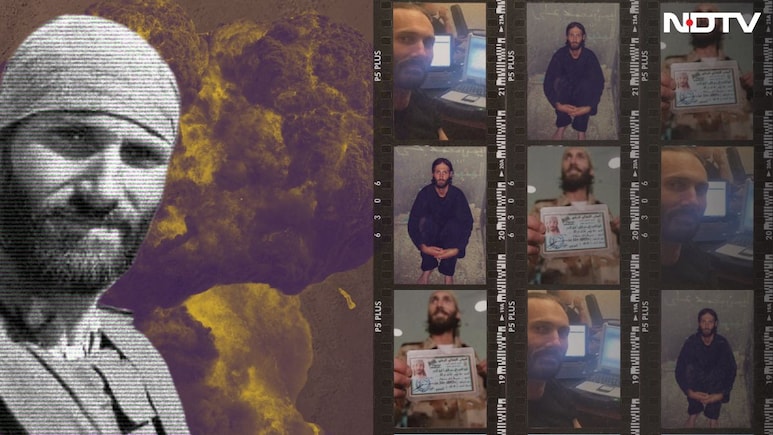
The arrest of seven foreign nationals, six Ukrainian nationals and an American, in connection with an alleged conspiracy to train ethnic armed groups in drone warfare, has highlighted the ethnic conflict in Myanmar. One of the seven, US national Matthew VanDyke, had crossed into Myanmar illegally via India to train ethnic armed groups there. He had also trained some banned groups in India too, the National Investigation Agency (NIA) has said.
The men are in NIA's custody, which has been given 11 days to investigate the matter by a Delhi court.
VanDyke has identified himself as a security analyst, documentary filmmaker, and war correspondent, but sources suggest there are more layers to the shadowy figure.
Also Read | "Want To Change Course Of History": Old Clip Of US Man Arrested In India
Focus On Myanmar
The arrests have brought the focus back on the porous Indo-Myanmar border and India's interests in the region in terms of security.
Both India and China already maintain a presence in Rakhine State -- a coastal state in Myanmar bordering Bangladesh -- India through the Sittwe Port under the Kaladan project, and China through the Kyaukphyu Port and associated oil and gas pipelines. The US also wants a foothold in Myanmar's west coast to keep an eye on China and key shipping lanes and is believed to have supported anti-junta rebels.
Indian Outreach
The Kaladan Multi-Modal Transit Transport Project, India's flagship connectivity initiative in Myanmar which connects Myanmar's Sittwe Port to the India-Myanmar border, aims to enhance road and maritime links with Southeast Asia. It will also provide an alternative access route to the northeast, contributing to economic development there.
Dr Cchavi Vasisht, Associate Fellow at the Centre for Geopolitics and Strategic Studies at the Chintan Research Foundation, said: "India's relationship with Myanmar has been a strategic tightrope walk, defined by the support to pro-democracy movement during the 1988s to a pragmatic, realpolitik engagement in the 1990s. The 1,643-km land boundary as well as maritime boundary increases India's security stakes in Myanmar... (also) denying cross-border sanctuary to insurgents from Nagaland, Manipur, and Assam who have used Myanmar's northwestern hills for decades."
Border issues and cooperation were the key topics in the meeting between Indian Ambassador to Myanmar Abhay Thakur and Myanmar's Deputy Foreign Minister held on February 11.
Also Read | 3 Ukrainians Illegally Crossed Into Myanmar. How They Were Arrested In India
"Diplomatically, India codified its approach under its previous 'Look East Policy', elevated to 'Act East' policy as well as 'Neighbourhood First' policy. And most recently also MAHASAGAR (Mutual And Holistic Advancement for Security And Growth Across Regions) policy," Vasisht added.
Strategic Security experts say India will have to ensure that Myanmar does not fall under China's exclusive control.
Ethnic Strife Fallout
Over the last five years, the domestic and political situation in Myanmar has evolved, with Ethnic Armed Organisations or EAOs consolidating their position in the Chin State of Myanmar.
Vasisht, who has also co-edited a book titled "Revisiting Myanmar" along with Brigadier Vinod Anand, said: "After the elections, the military reality on the ground is characterised by Operation "Yan Naing Min" -- a counter-offensive to regain territorial control from EAOs and PDFs (People's Defence Force)".
The military, she said, has achieved symbolic victories. For example, while Pasawng a town in Bawlakhe District, Kayah State, Myanmar was recaptured on February 15, the success was undercut on February 25, when the Thanlwin Bridge, a key transportation link in the area, was bombed a second time."
Now the fact that both state and non-state actors are using lethal weapons, especially cheap, Chinese-made remote-controlled drones, had added to India's security concerns.
Giving an example, Vasisht said these drones were used by the ethnic group Kachin Independence Army or KIA to attack the Myitkyina Airport on February 12 and February 20, during which a passenger aircraft was struck.
The situation poses a "direct threat to Indian border surveillance and civilian transit routes," Vasisht said.
"Ethnic armed organisations and the Peoples' Defence Force control 50 per cent of the territory... They excel in ambushes in rural areas. The military holds urban cores but is overstretched," she added.
Also Read | Big Details Emerge After US Mercenary Matthew VanDyke's Arrest In India
"The changed dynamics of power in bordering areas, especially Arakans and Chins, makes it imperative for India to increase its engagement with the local ethnic groups in bordering areas," Vashisht said.
India, she added, has "ceded considerable influence in this regard, allowing China to gain ground through deeper outreach in the past decades... This would also create leverage in future federal political structure as well as build goodwill among the people".
Arrests No Surprise
The arrest of the foreign nationals should not come as a surprise, even though the movement of mercenaries in the region has been a security issue for decades.
"Indian forces, both army and Assam Rifles, have engaged with Myanmar military to curb insurgent activities in India's northeast and across the border. The NIA probe is in line with that. Legally, UAPA is invoked for alleged conduct involving training armed groups, drone smuggling from Europe via Indian territory, and using tourist visas to conduct paramilitary operations. That is not a grey area. It is a fundamental violation of Indian sovereignty.
Therefore, not a shift but reinforcement of India's position," Vasisht added.
According to strategic experts, this incident is definitely part of the larger strategy that India has adopted since the 1990s.
"India has always said it will not allow its territory to be used against any neighbouring country. And it is also not that western network is not known and not targeted before. The Western-aligned network, as well as the Pakistan-backed or China-backed one are all well known," Vasisht added.
"The Bay of Bengal is a strategic location. China's CMEC (state-owned China Machinery Engineering Corporation) gives it access to the Indian Ocean, bypassing the Malacca Strait. Myanmar's western coast that is Rakhine State, the Coco Islands, sits precisely at the junction of the Bay of Bengal. Since the investigation is underway, I would be careful on commenting how far the involvement has been there, but there is a history which clearly tells us that India's northeast has been vulnerable to outside influence - be it China or western influence - therefore it is important to act and investigate it very closely to protect our own territory and sovereignty," Vasisht said when asked about the impact of the arrest on geopolitics in the region.
Track Latest News Live on NDTV.com and get news updates from India and around the world


