




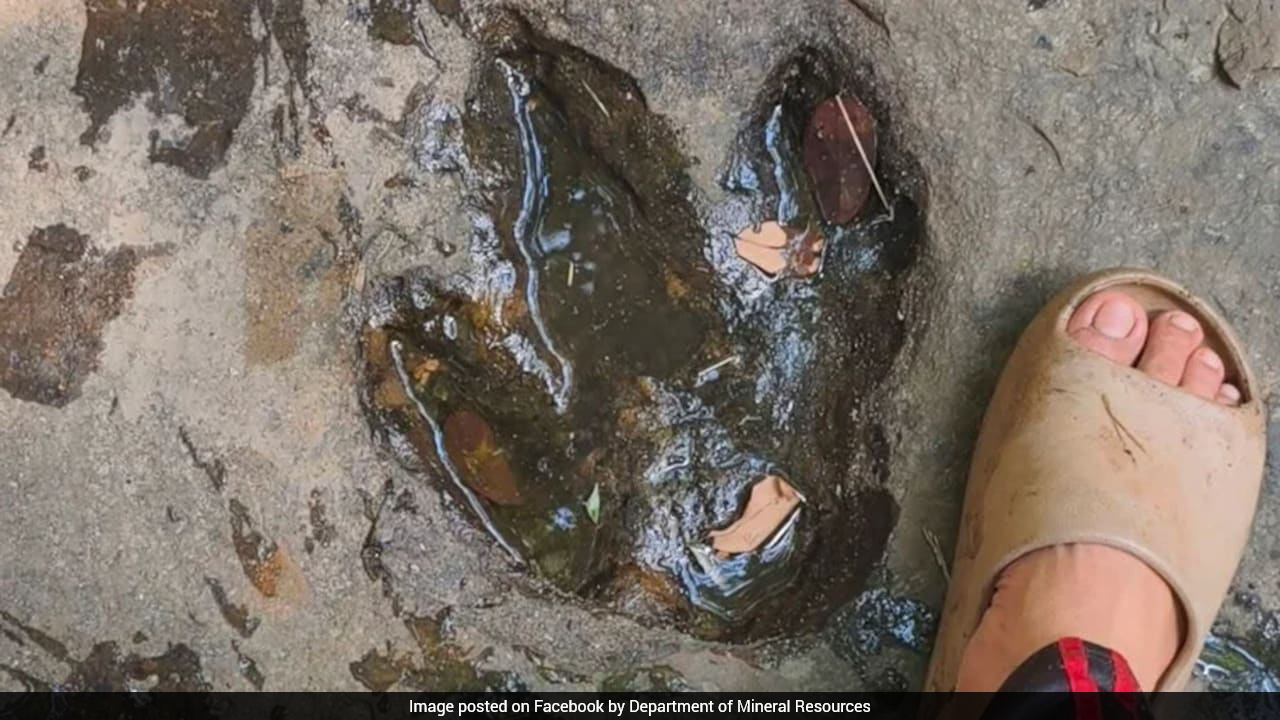
A tourist's photograph has helped experts confirm the discovery of six dinosaur footprints believed to be around 120 million years old in northeastern Thailand. The fossilised footprints were found along a nature trail at Phu Phrabat National Park in Udon Thani province, as per Bangkok Post.
Thailand's Department of Mineral Resources confirmed the discovery on October 20, identifying the impressions as footprints left by a theropod, a group of two-legged dinosaurs that included carnivorous species. Authorities have temporarily restricted access to the site to protect the fossils while experts examine the area.
According to The Thaiger, the discovery began when 32-year-old Thai tourist Pichai Prathetsena spotted unusual marks near a stream while visiting the national park with his family. The stream was relatively dry, exposing rocks bearing the impressions. Prathetsena photographed the marks and shared the picture in a Facebook group on October 18, asking members whether they resembled dinosaur footprints. He did not report the find to park officials at the time because his family was in a hurry.
The Department of Mineral Resources responded to his post and said it would investigate. Park rangers visited the site on October 19 to examine and measure the impressions. A team of experts subsequently confirmed that the marks were genuine fossilised footprints.
"The find includes a single trail with a total of six prints on the Phu Phan formation, dating back approximately 120 million years to the Early Cretaceous period," Thailand's Department of Public Relations says.
Each footprint measures approximately 29 cm in length and 26 cm in width. Based on their dimensions, researchers estimate that the dinosaur stood about 1.42 metres tall at the hip and measured around 6.3 metres in length. Its estimated size is comparable to that of Siamotyrannus isanensis, an extinct theropod previously discovered in Thailand from the same geological period.
Authorities are now considering measures to establish a protected zone around the site to prevent damage from visitors and natural erosion. The Department of Mineral Resources has proposed working with the Department of National Parks, Wildlife and Plant Conservation and the Fine Arts Department to safeguard the discovery.
Geologists are examining the area, while officials have prohibited unauthorised access and urged the public not to dig, disturb or move any evidence. Measures to prevent water erosion are also being considered.
The site could eventually be developed into an educational attraction for scientific research and tourism, subject to further assessments. The proposed protection measures would be implemented under Thailand's Fossil Protection Act 2008.
According to the Bangkok Post, the discovery also highlights how dinosaur footprints can survive for millions of years. Such trace fossils form when an animal leaves an impression in soft ground or sediment, which is later covered by additional layers and gradually hardens into rock.
Unlike skeletal fossils, footprints can offer clues about how prehistoric animals moved and behaved. Researchers can study their stride length, gait and movement patterns, and sometimes use trackways to investigate whether animals travelled together or moved independently.
Track Latest News Live on NDTV.com and get news updates from India and around the world

