





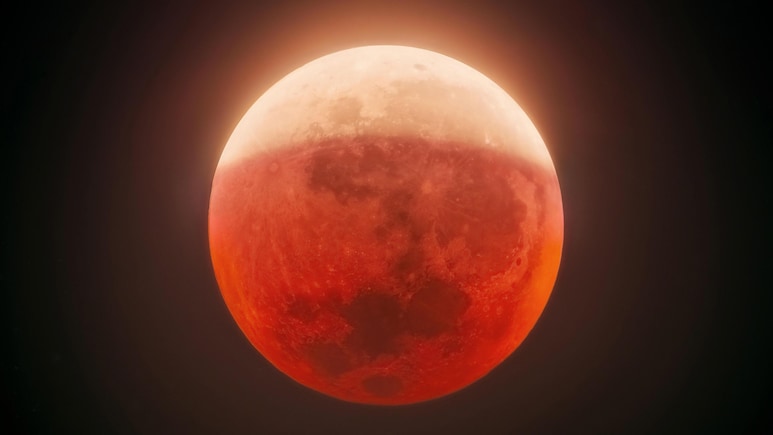
A striking partial lunar eclipse will unfold overnight on August 27-28, with nearly the entire moon passing through Earth's darkest shadow. According to Space.com, the eclipse will darken 96% of the full "Sturgeon Moon" as it will be submerged in Earth's dark inner shadow (umbra). This leaves only a tiny sliver lit by direct sunlight, while the rest glows a deep reddish-copper colour. The eclipse will happen during the day, so most of India will not be able to see it.
The eclipse will reach its peak at 12:12 am EDT on August 28, when 96.2% of the lunar surface is expected to be covered by Earth's umbral shadow. With only a thin section of the Moon remaining directly illuminated by the Sun, the eclipsed portion could take on a reddish-orange tint, creating what may look like an almost total blood moon.
A partial lunar eclipse darkens the full Moon on Aug. 27. About 96% of the Moon slips into Earth's shadow, turning most of it red as our atmosphere filters sunlight. Begins 10:34pm ET Aug. 27, peaks 12:12am ET Aug. 28. What to look for: https://t.co/D8Gf0gpxCH 🌙
— NASA Solar System (@NASASolarSystem) August 26, 2026
🎬: NASA's… pic.twitter.com/ISsQqCnvI9
As per NASA, a lunar eclipse occurs when Earth moves between the Sun and Moon, casting its shadow across the lunar surface. During a partial eclipse, the three bodies are not perfectly aligned, so only part of the Moon enters the umbra, the darkest portion of Earth's shadow. The remainder passes through the lighter penumbra.
Where Will the Lunar Eclipse Be Visible?
The event will be visible from much of North and South America, Europe and Africa, although the view will vary depending on location and weather conditions.
The Americas will offer some of the best viewing opportunities because the eclipse's peak will occur during nighttime there. In Europe, the event will take place in the early hours of August 28, with the moon setting before the eclipse is completely over.
In London, for instance, maximum eclipse will occur at 5:12 am BST, just over an hour before moonset. Parts of Spain may also have limited visibility because the Moon will be low on the horizon as dawn breaks, as per Time and Date.
A partial lunar eclipse will pass over the Americas—and parts of Europe and Africa—tomorrow night! It will reach its peak around 12:12am ET (0412 UTC) on Thursday, Aug. 28.
— NASA (@NASA) August 26, 2026
More info: https://t.co/deDCMRSq74 pic.twitter.com/2EFqh7jZFn
Check Timings
The eclipse will begin at 9:23 pm EDT on August 27, when the Moon enters the penumbra. The partial phase will start at 10:33 pm, as the umbral shadow begins moving across the Moon, Wired reported.
Maximum eclipse will occur at 12:12 am EDT on August 28, with 96.2% of the lunar surface inside the umbra. The partial phase will end at 1:51 am, followed by the conclusion of the penumbral eclipse at 3:01 am.
How to view the lunar eclipse
Unlike a solar eclipse, a lunar eclipse can be viewed safely with the naked eye, so no special eye protection is required. For a better view, skywatchers can use binoculars or a telescope to follow the shadow as it moves across the Moon's surface.
Finding a location away from bright city lights and with a clear, unobstructed view of the sky can also improve visibility. However, even people in urban areas should be able to see the eclipse if weather conditions cooperate.
Those using a telescope may get a particularly detailed view of the boundary between the illuminated and shadowed portions of the Moon, including the way Earth's shadow gradually moves across lunar craters and mountains.
Track Latest News Live on NDTV.com and get news updates from India and around the world

