





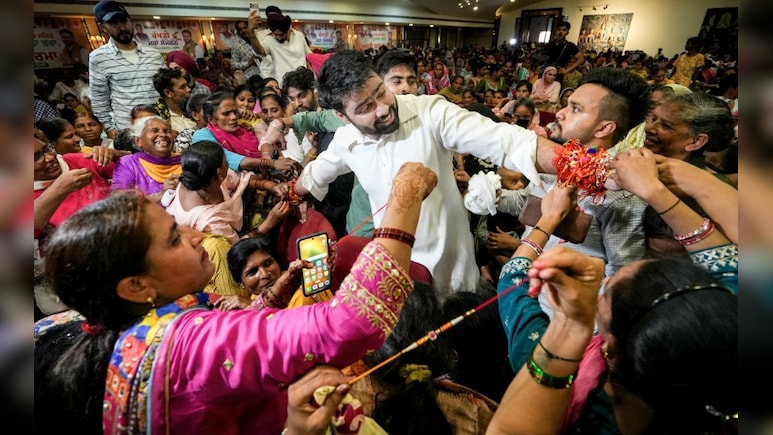
The Election Commission has not sounded the bugle yet. But the battle for Punjab 2027 has already begun. The only difference is that this battle has not yet reached the voter's doorstep. For the moment, it is being fought inside the political parties themselves.
But there is something interesting about this early activity. At this stage, Punjab's political parties are not only trying to convince voters. They are first trying to energise, discipline and, in some cases, reunite their own workers.
Senior national leaders are now travelling through Punjab, booth committees are being activated, rallies are returning and organisational meetings are becoming increasingly frequent. The election may still be some distance away, but the campaign before the campaign is already underway.
That may well be the first real battle of Punjab 2027.
For the Bhartiya Janta Party (BJP), the message has been particularly clear. BJP national general secretary (organisation) BL Santhosh spent two days travelling across Punjab, holding zonal meetings in Patiala, Bathinda, Ludhiana, Jalandhar and Amritsar. The party says it is preparing to contest all 117 Assembly seats on its own. More importantly, the exercise has gone down to the booth level, with the BJP working on a much deeper organisational structure across Punjab.
That is politically significant.
For decades, the BJP's political presence in Punjab was closely linked with the Shiromani Akali Dal- Badal. Its strength was concentrated mainly in urban constituencies while the Akalis carried much of the rural and panthic burden of the alliance. If the BJP really intends to fight all 117 seats, it will have to build an organisation in areas where it once relied heavily on its partner.
So Santhosh's Punjab tour was not simply a visit by a senior national leader. It was a message to the cadre: prepare as if there is no ally to carry you.
Yet speculation about a possible BJP-SAD understanding continues despite the public talk of going solo. That creates the BJP's first internal test: can its cadre genuinely prepare for a solo fight while the possibility of an alliance remains part of Punjab's political conversation?
Indian National Congress has almost the opposite problem. It already has an organisation, senior leaders with substantial local bases and a sizeable traditional vote. Its challenge is whether those leaders can work together.
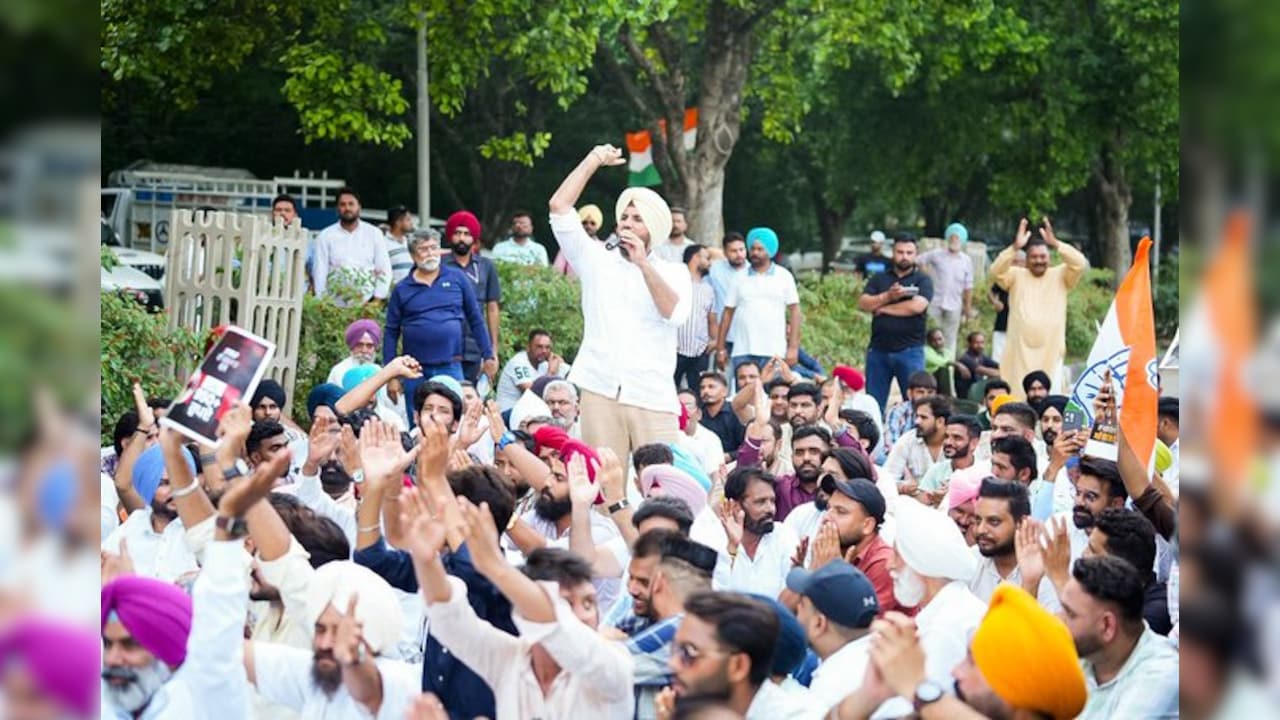
Punjab Congress chief Amrinder Raja Warring at a protest in Chandigarh
Punjab Congress in-charge Bhupesh Baghel has toured districts and met party workers as part of an organisational mobilisation exercise. Now a larger political journey is being planned, with Rahul Gandhi expected to participate in a statewide bus yatra. According to the tentative plan, he would first pay obeisance at Sri Darbar Sahib (the Golden Temple) in Amritsar before joining a journey whose initial stretch would move from Amritsar towards Hussainiwala.
On paper, it is an outreach to Punjab. Politically, however, it may first be an outreach within the Congress itself.
The proposed yatra would put senior leaders, including Partap Singh Bajwa, Charanjit Singh Channi and state Congress president Amrinder Singh Raja Warring, on the same platform at a time when factional differences have repeatedly made news.
This gives Congress an unusual campaign challenge: before asking Punjab to trust it with power again, it has to show that its own leaders can trust one another.
Rahul Gandhi may therefore find that his first task in Punjab is not defeating AAP, BJP or the Akalis. It is making sure Congress does not spend its energy fighting Congress.
Aam Adami Party's (AAP) situation is different because it is the party in government. In 2022, it rode a powerful wave of change and won 92 of the 117 seats. In 2027, it will seek votes not as an outsider promising change, but as an incumbent defending its record.
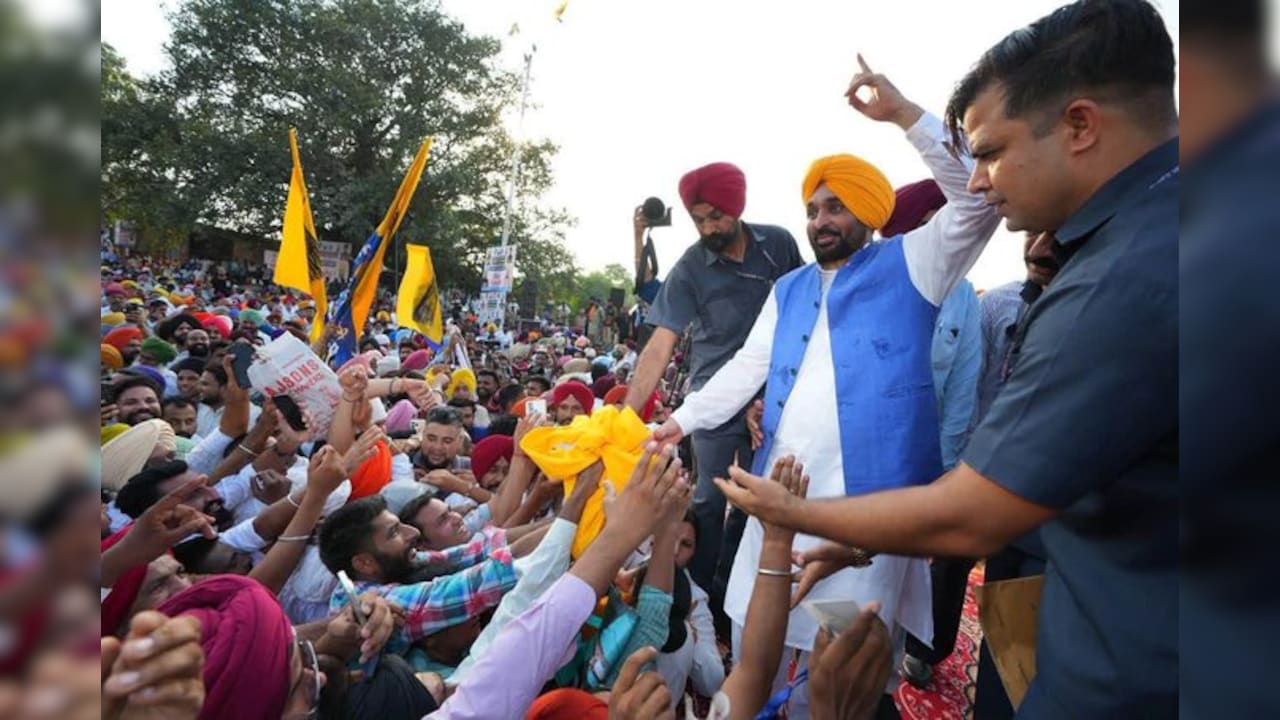
Chief Minister Bhagwant Mann at a rally
Punjab in-charge Manish Sisodia has been holding district-level organisational meetings, while booth in-charge meetings are planned across all 117 constituencies. The stated purpose is to strengthen the organisation and take the Mann government's schemes and achievements directly to households.
Chief Minister Bhagwant Mann also remains highly visible. The state government is preparing a major state-level function for Rakhar Punnia at Raiya near Baba Bakala on August 28, an occasion that traditionally attracts enormous religious as well as political attention.
AAP therefore has to convert governance into political communication. Government schemes may deliver benefits, but elections are also fought on perception. Party workers will have to explain what has been delivered, answer dissatisfaction and reconnect with voters who may no longer carry the same excitement they had in 2022.
Then there is the Shiromani Akali Dal.
For SAD, 2027 is not merely another election. It is a struggle to recover political space after years of electoral decline. Its "Punjab Bachao" rallies have entered another phase, with rallies and political conferences planned across the state during August and September.
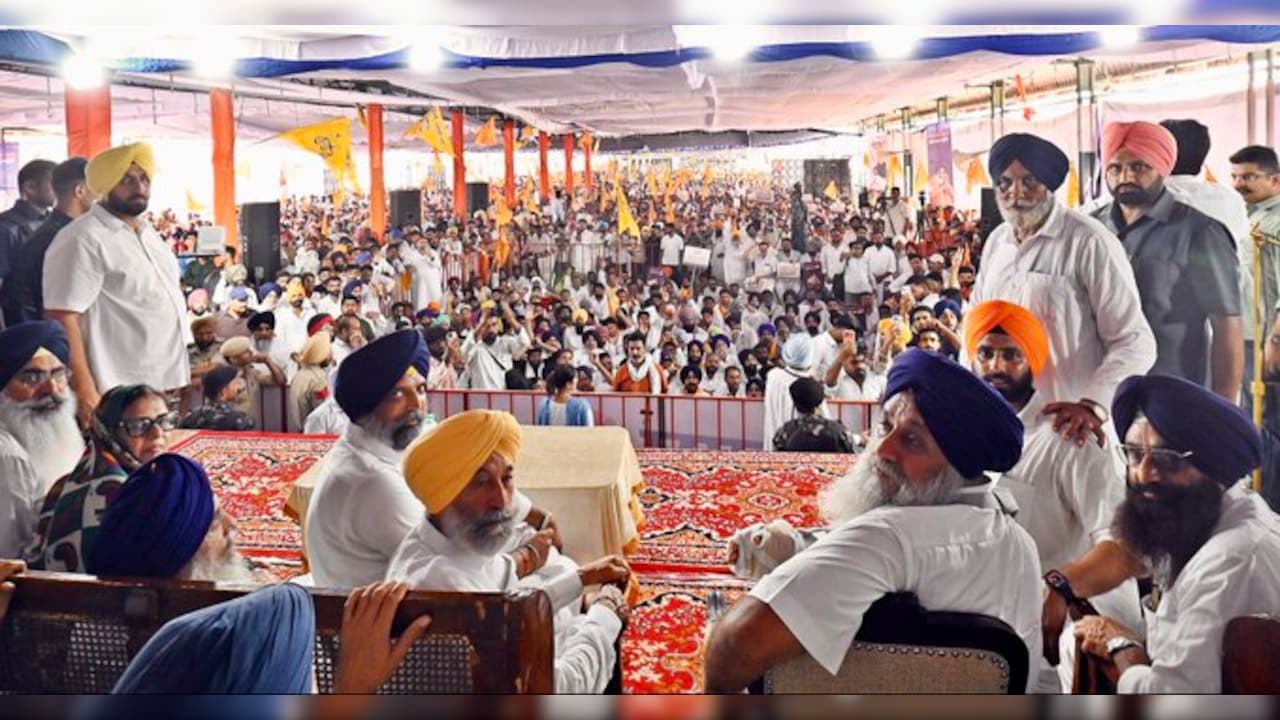
Sukhbir Badal at a rally
Sukhbir Singh Badal, after recovering from the recent attack in Nanded, has returned to active politics. On Wednesday, he addressed the Punjab Bachao Rally at Malout and is also scheduled to address the party's political conference at Baba Bakala.
The Akalis are trying to revive something they once possessed more strongly than perhaps any other Punjab party: a deeply rooted cadre network.
But that network has been weakened by defeats, internal divisions and the emergence of new panthic competitors. Akali Dal (Waris Punjab De), which is also preparing for a "Panth Bachao, Punjab Bachao" conference at Baba Bakala, is one example of how the panthic political space is no longer automatically SAD territory.
This is why Rakhar Punnia at Baba Bakala near Amritsar on August 28 deserves attention beyond the speeches that will be made there.
Different political formations are preparing to use the occasion to demonstrate their presence. BJP is trying to expand into political territory where it historically depended heavily on the Akalis. AAP will have the advantage of showcasing the government. SAD will try to demonstrate that its cadre remains alive and organised. Waris Punjab De will attempt to establish its own claim over the emerging panthic political space.
In one place, Punjab may get a preview of the coming election.
But rallies should not be confused with votes. A large crowd can be organised. A stage can be impressive. A national leader can create headlines. None of these automatically produces an electoral swing.
Cadre, however, matters.
It is the worker who carries a party's argument from a rally to a village, from a press conference to a WhatsApp group and from a leader's speech to the polling booth. In a close and multi-cornered election, a motivated local organisation can make the difference between political noise and actual votes.
And that explains the activity we are witnessing now.
The BJP is asking whether it can stand independently across Punjab. Congress is asking whether its leaders can stand together. AAP is asking whether the extraordinary energy that brought it to power can be revived after nearly five years in government. SAD is asking whether its old political family can be brought back home.
These are four very different political challenges, but all of them lead to the same point: before wooing the voter, every major party is first trying to charge its own cadre.
The voters will answer the larger question in 2027.
(Ravinder Singh Robin is a broadcast journalist with over two decades of experience in covering Punjab, Sikh affairs, border issues, India-Pakistan relations and international developments.)
Track Latest News Live on NDTV.com and get news updates from India and around the world

