




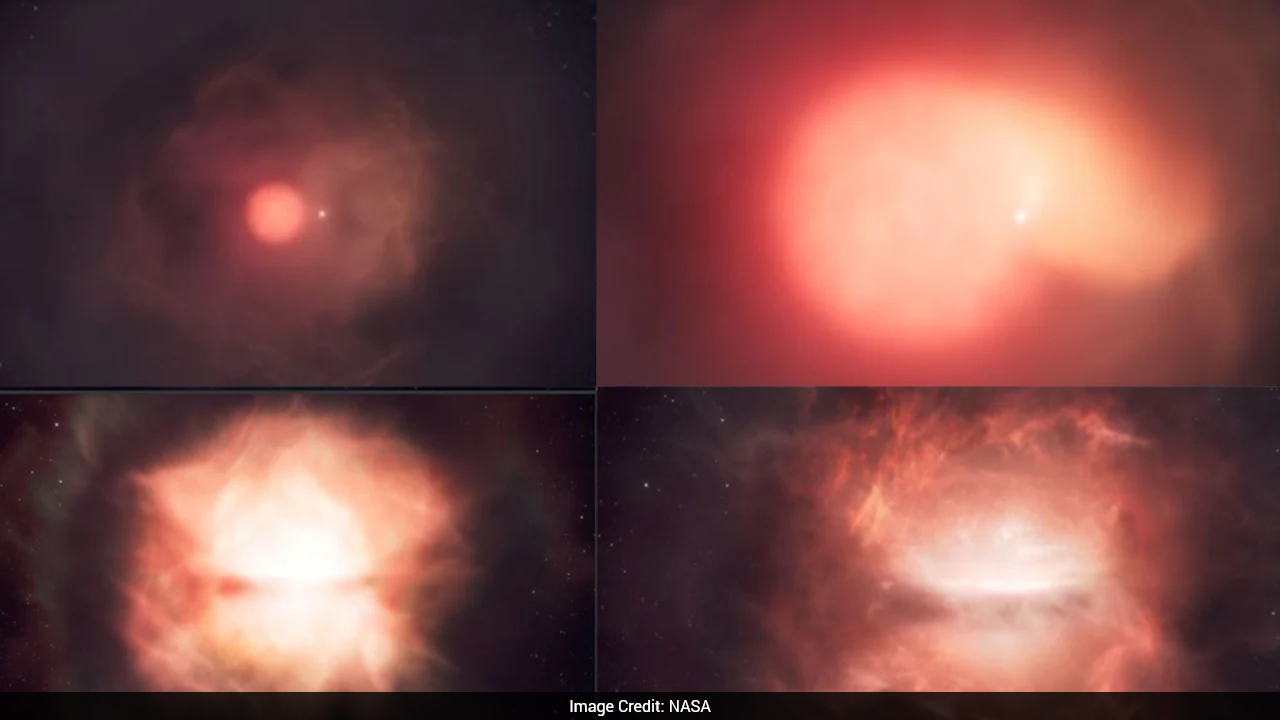
Astronomers have observed a rare event in which two stars merged to form a single star in the outskirts of the neighbouring Andromeda galaxy. The newly formed star, named Bao, was created when a smaller star spiralled into a much larger supergiant star. Researchers used observations from several telescopes, including NASA's James Webb Space Telescope, to reconstruct how the merger took place, according to NASA.
Viraj Karambelkar, the lead author of the study published in the journal Nature on Wednesday and a NASA Hubble Fellow at Columbia University, said that stellar mergers are difficult to observe in real time because they are hard to predict. The team first noticed unusual activity in 2023 and continued monitoring the star system. In 2025, the system erupted, allowing researchers to study its condition before, during and immediately after the merger.
Before the merger, the two stars had been orbiting each other as a binary pair for thousands of years. However, once the smaller star came into contact with the outer surface of the giant star, the merger took place after just seven orbits, which lasted around seven years. This was much faster than other known mergers involving two smaller stars, which took place after thousands of orbits.
Nadia Blagorodnova, an associate professor at the University of Barcelona and co-author of the study, said researchers had expected an eruption from such an extended star to take years. However, its brightness began increasing suddenly and reached its peak within a week.
Kishalay De, another co-author and an assistant professor at Columbia University, explained that the interaction between the smaller star and the outer surface of the larger star initially caused a gradual increase in brightness. As the smaller star continued orbiting, it stripped away the outer layers of the larger star, sending gas into the surrounding space.
This process is known as common envelope evolution. During this stage, the gas surrounding the two stars forms a shared outer layer. In Bao's case, the larger star engulfed its smaller companion, which spiralled towards its core while losing orbital energy because of drag.
The researchers found that the larger star, nicknamed Big Bao, was around seven times as massive as the Sun. It had a radius 350 times greater than the Sun and was approximately 18,000 times brighter.
Karel Temmink, a PhD student at Radboud University in the Netherlands who led the simulations, described the star as extremely large and said it completely outshone its smaller companion in the observations.
The smaller star, called Little Bao, was estimated to have around 0.7 times the mass of the Sun. It also had a slightly smaller radius and was fainter than its larger companion.
Initially, the researchers thought some energy might have remained for Little Bao to escape after the encounter. However, further analysis showed that the smaller star was dragged into the core of Big Bao.
The merged star is now simply called Bao. However, researchers said future observations will be needed to understand how its mass settles after the merger.
The researchers first noticed Bao in February 2023 while examining data from NASA's retired NEOWISE mission. Before 2018, the object had maintained a consistent brightness.
In September 2024, observations from the Wide-field Infrared Transient Explorer (WINTER) showed that the star was beginning to brighten and release dust.
In July 2025, NASA's SPHEREx observatory detected another unusual change during a routine survey. Bao rapidly became fainter in visible light while growing brighter in infrared light, alerting researchers to unusual activity.
The Zwicky Transient Facility detected the eruption on October 17, 2025, as the stars rapidly increased in brightness and became much hotter.
In November 2025, the team received observations from NASA's now-retired Neil Gehrels Swift Observatory and NOIRLab's Gemini North telescope in Hawaii. Webb observed Bao on December 24, 2025, through a special observation programme.
Researchers also used observations covering ultraviolet, visible and near-infrared light from several telescopes to follow the changes. The team had even published its first research paper shortly before the eruption in 2025.
The study of Bao, formally known as AT 2025abao, provides a new way to understand how binary stars merge.
Track Latest News Live on NDTV.com and get news updates from India and around the world

