





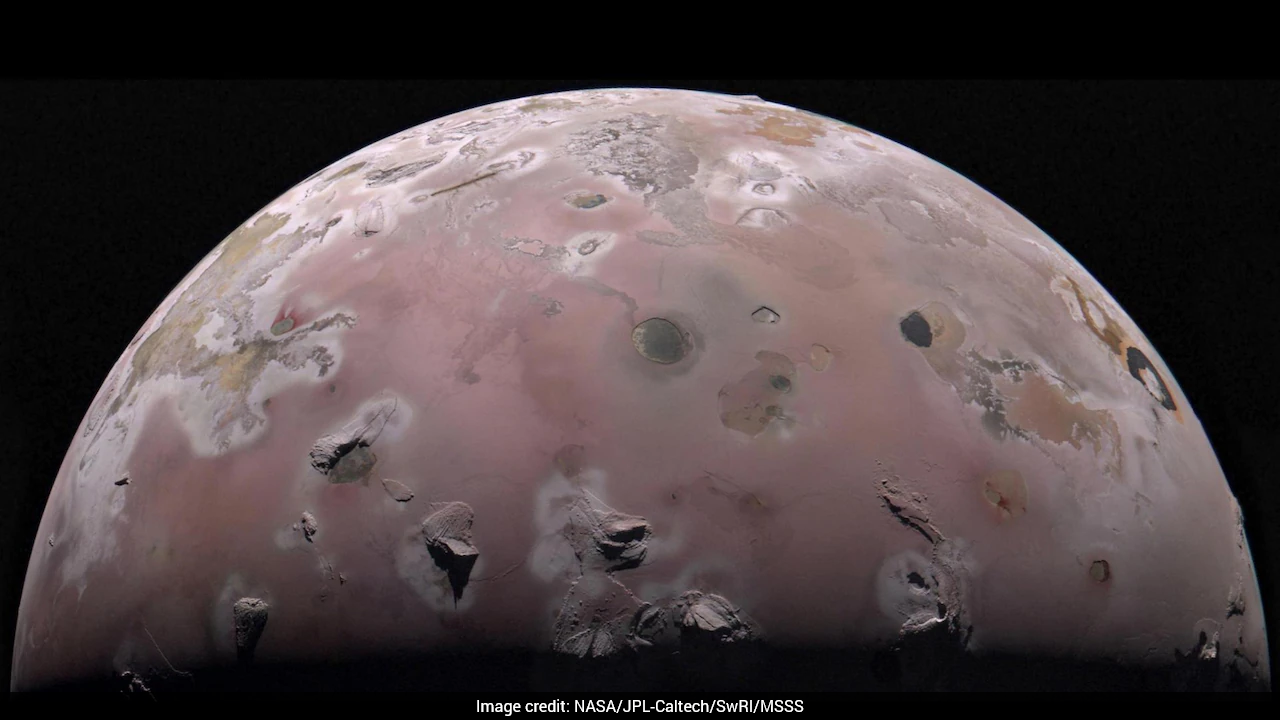
In a groundbreaking study of the solar system's most volcanically active body, NASA's Juno spacecraft has provided scientists with unprecedented thermal observations of Jupiter's moon Io. The latest findings offer a high-resolution thermal profile of the moon's turbulent, magma-covered surface, deepening our understanding of its internal heat engine.
Io, slightly larger than Earth's Moon, is locked in a relentless gravitational tug-of-war. Caught between the immense gravitational pull of giant Jupiter and its neighbouring moons, Europa and Ganymede, Io undergoes extreme tidal flexing.
As per the findings published Wednesday in the Journal of Geophysical Research: Planets, this constant push and pull generates immense internal friction and heat, turning its interior into a churning cauldron of magma that feeds hundreds of active volcanoes.
During recent flybys, Juno's Jovian Infrared Auroral Mapper (JIRAM) instrument captured incredible thermal images of Io, recording the precise heat emitted from lava lakes, fissure eruptions, and massive volcanic calderas.
Also read | 13 Children Found In 'Zombie' State After Eating 'Mushroom-Laced Edibles' At Camp In New Jersey
"The Juno Microwave Radiometer directly observed Io's heat output by looking below the surface," said Scott Bolton, study coauthor and Juno's principal investigator at Southwest Research Institute in San Antonio.
"The surprising discovery that we could see below a rocky moon's surface has important implications for studying Earth's volcanoes. Juno has taught us that if we look with an MWR-type instrument near a volcano on Earth, we might see a similar signature in the subsurface temperature gradient, providing new information on how terrestrial volcanoes work."
As per the findings, the data allowed the researchers to see several meters below the surface, revealing a significant, greater than 20 degrees C temperature increase in the upper few meters.
Also read | "Amazing Initiative": Teacher's Self-Attendance Board Wins Praise, Video Viral
According to the researchers, the observations show that Io's surface is smooth when viewed at long microwave wavelengths. "The microwave signal also reveals that the upper layer of Io's surface has a low density compared to solid rock, similar to volcanic ash or pumice," they wrote. "We detect strong endogenic heating within the upper tens of meters."
"Two possible explanations match the data: heat rising steadily through a conducting crust, or it may escape through scattered patches of thin crust above lava or hot vents covering about 10% of the surface," they added.
"Io provides a unique window into learning how tidal heating works throughout the cosmos, a fundamental process that provides energy and heat to worlds that are far from their parent star," said Shannon Brown, the paper's lead author at NASA's Jet Propulsion Laboratory in Southern California.
"This process can not only create the most volcanic body in the solar system, in the case of Io, but also fuels the subsurface oceans on the moons of giant planets, such as Europa and Ganymede. Up until this point, we could only observe the heat escaping at the surface or through eruptions. Now we can characterise how the heat is moving from the interior toward the surface."
Track Latest News Live on NDTV.com and get news updates from India and around the world

