




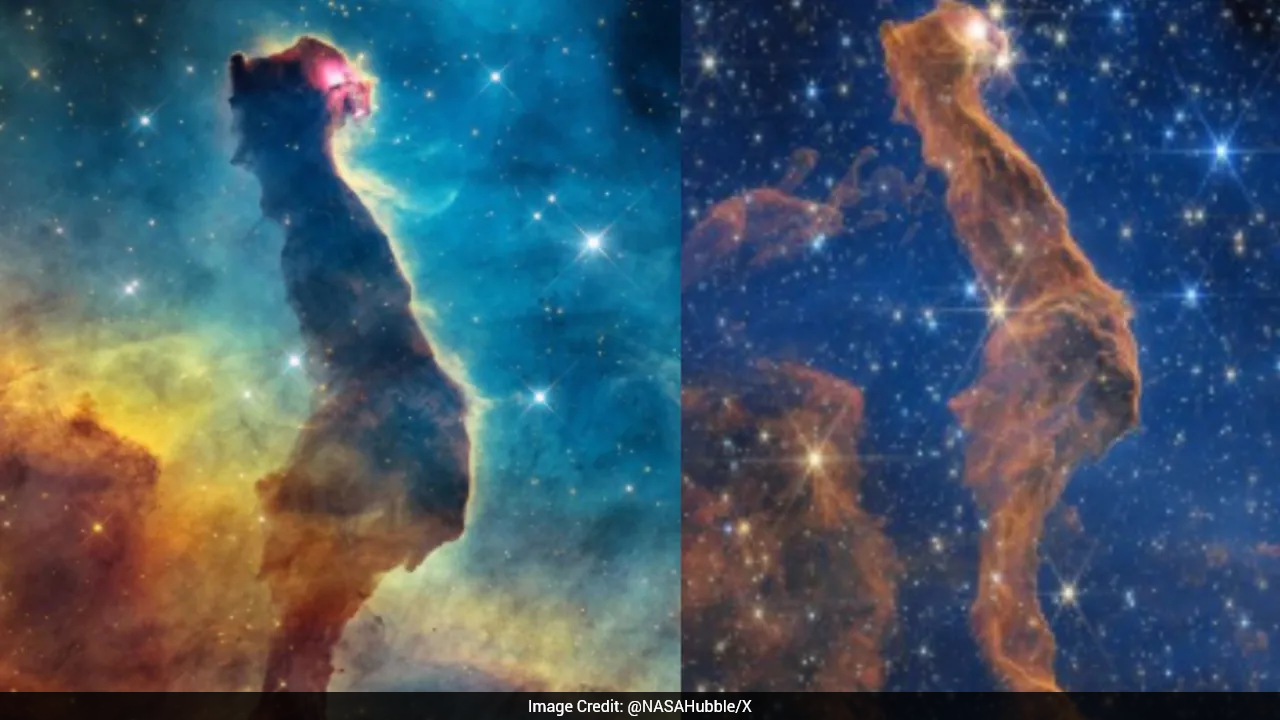
NASA's Hubble and James Webb Space Telescopes have captured detailed views of a star-forming region that resembles a cat's head. Located inside the Carina Nebula, about 7,500 light-years from Earth, the region shows clouds of gas and dust, glowing colours and stars at different stages of formation, according to NASA.
The area, known as the Cat's Head Nebula, gets its name from its shape, which resembles a cat sitting with its back towards the viewer and its head turned to the right. The images from both telescopes are helping astronomers understand how stars form and how radiation from massive stars changes the surrounding gas and dust.
How The Cat's Head Nebula Formed
The unusual shape of the nebula was likely created over time by strong ultraviolet radiation and winds from massive stars in the Carina Nebula.
These forces gradually remove gas and dust from the surrounding region. However, denser material within the cat-shaped structure can resist this process for some time.
Although the structure will eventually spread out as stars form and develop, it contains important information about the process of star formation.
Check Out The Post Here:
Cat got your telescope? 🐾 Venture into the Cat's Head Nebula, as seen by Hubble and @NASAWebb. Both telescopes observed the nebula across a wide spectrum of light, revealing complementary data on its cosmic activity: https://t.co/w98EG7IHm3 https://t.co/ODKTKgqfJL
— Hubble (@NASAHubble) October 29, 2026
Hubble's visible-light image shows a dark brown pillar of dust with a glowing red feature resembling a cat's eye. This red area may indicate a young star that is still partly covered by dust.
A hazy yellow ridge follows the right edge of the structure. This bright border is consistent with gas being lit and changed by ultraviolet radiation from nearby massive stars.
The surrounding material appears blue and cyan at the top, changing to yellow, orange and red towards the bottom. These colours show different types of gas, dust and light from nearby stars.
Hubble's filters capture light from oxygen, hydrogen and sulfur, along with starlight scattered by dust.
The James Webb Space Telescope observes the nebula in near-infrared and mid-infrared light, revealing details that are less visible in ordinary light.
In Webb's near-infrared view, parts of the dusty pillar appear more transparent, making its complex surface easier to see. Faint clouds of gas and dust can also be seen on the left side, where they are exposed to radiation from nearby massive stars.
The image also reveals many stars shown in blue and yellow. Some remain partly hidden by dust, while the cat's glowing eye remains clearly visible. Webb's sharp view even captures faint galaxies in the background.
Webb's mid-infrared image highlights detailed patterns formed by warm dust and carbon-based molecules that are affected by starlight.
Small rounded structures and thin strands of material are particularly visible to the left of the pillar. Differences in local conditions and material create changes in the colours and brightness of the nebula.
On the right side, a bright yellow source appears against reddish material. It is likely to be a young star surrounded by dust. A thin strand appears to cross the source, but the image alone cannot confirm whether the two are physically connected.
The different views from Hubble and Webb provide complementary information about the Cat's Head Nebula. Together, they help astronomers study how stars form and how radiation affects the gas and dust around them.
Track Latest News Live on NDTV.com and get news updates from India and around the world

