





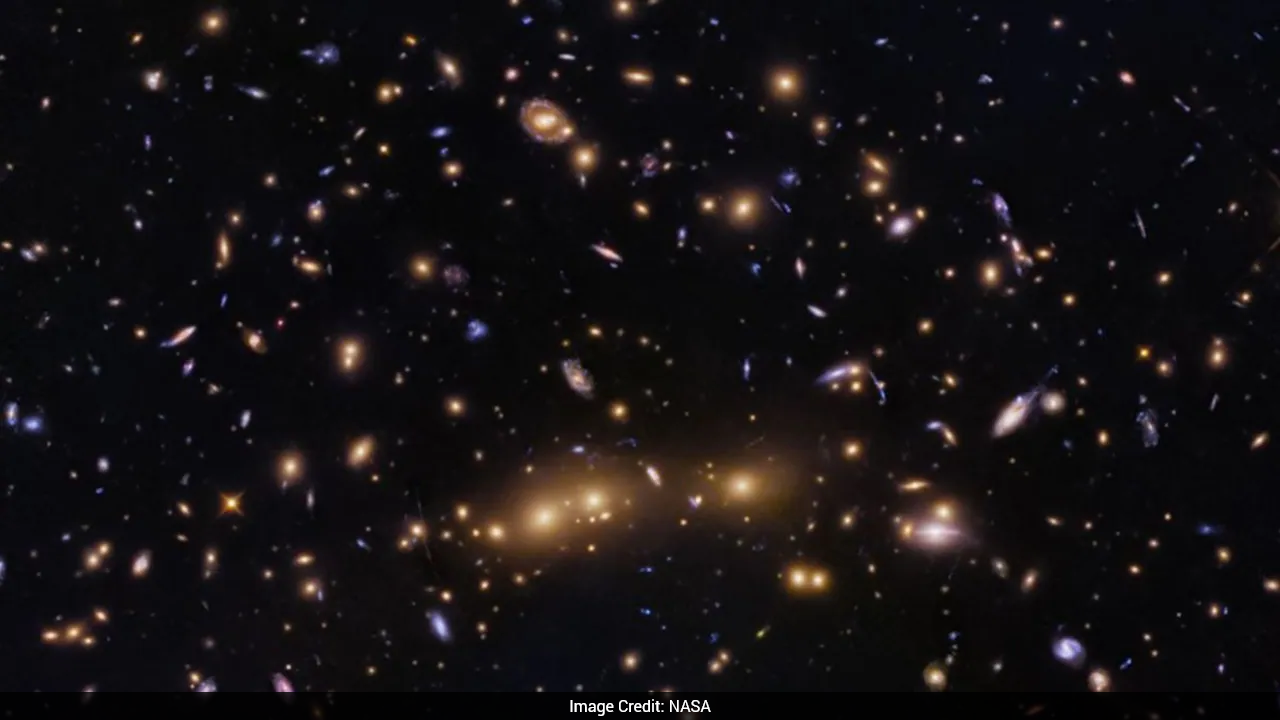
NASA has shared an image from the Hubble Space Telescope showing a massive galaxy cluster that is helping scientists better understand dark matter and the structure of the universe, reported NASA.
The image features a galaxy cluster called CL0016+1609, also known as MACS J0018.5+1626. The cluster is very bright at X-ray wavelengths and is one of the most extensively studied galaxy clusters at X-ray and radio wavelengths. X-ray observations revealed that it is made up of two galaxy clusters merging along our line of sight.
Researchers requested time to observe CL0016+1609 using Hubble's Advanced Camera for Surveys because the data would help them accurately measure the cluster's dark-matter distribution. This allows scientists to study the merger and understand the cluster's role in the large-scale structure of the universe.
Although Hubble cannot directly see dark matter, its infrared and visible light observations can detect its gravitational lensing effects on the normal matter that Hubble observes.
The image also includes observations made with Hubble's Wide Field Camera 3 as part of the RELICS (Reionization Lensing Cluster Survey) program.
The survey captured the first Hubble infrared images of 46 massive galaxy clusters and searched for distant galaxies that were gravitationally lensed by these clusters. The RELICS survey identified around 300 high-redshift candidate galaxies that were lensed by the galaxy clusters.
Track Latest News Live on NDTV.com and get news updates from India and around the world

