





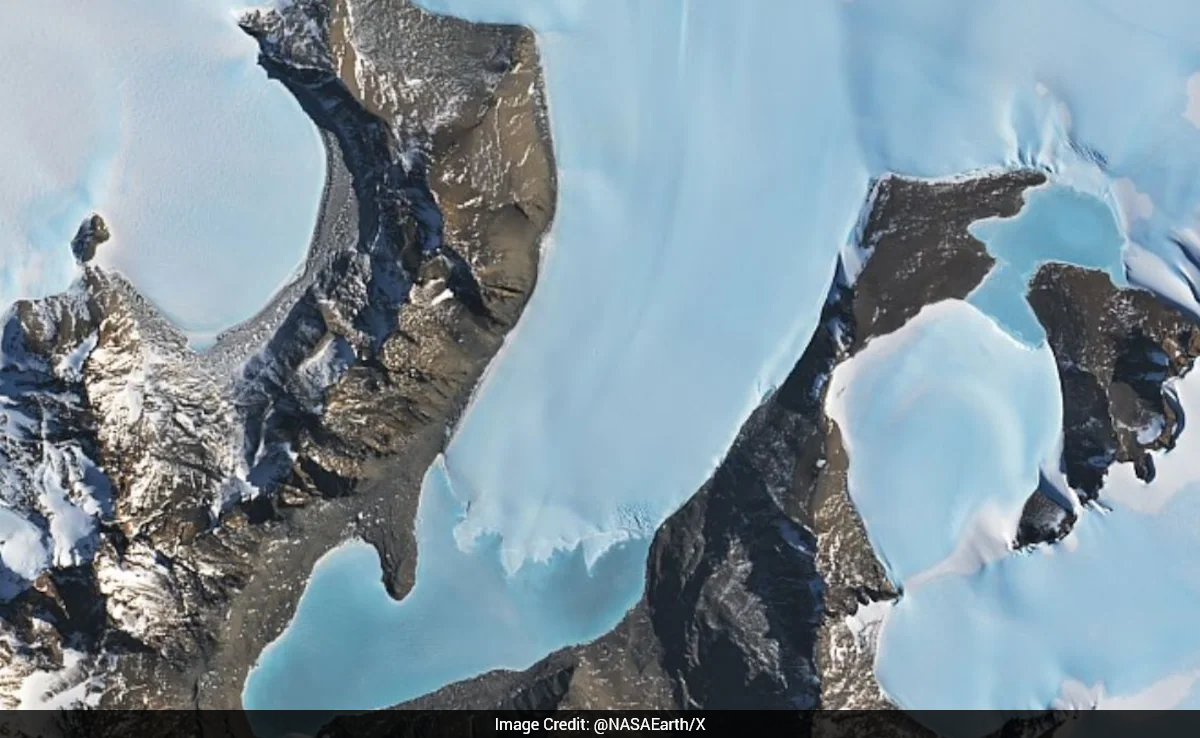
- Lake Unter-See is a large Antarctic lake with unique water chemistry and rare microbes
- The lake remains ice-covered year-round with high oxygen and low carbon dioxide levels
- Conical stromatolites growing up to half a meter provide insights into ancient microbial life
Scientists estimate that Earth has more than 100 million lakes, but some stand out because of their unusual features. One such example is Lake Unter-See in Antarctica, which is known for its unique water chemistry and rare microbial life. The lake is one of the largest and deepest surface lakes in Antarctica and has water that contains extremely high levels of dissolved oxygen, very low dissolved carbon dioxide, and a strongly alkaline pH, reported NASA.
On February 16, 2026, during the Antarctic summer, the Operational Land Imager on Landsat-9 captured an image of Lake Unter-See. Most of the lake's water comes from seasonal meltwater from the nearby Anuchin Glacier, which flows southward from the Gruber Mountains of Queen Maud Land.
Due to the extremely cold climate, Lake Unter-See remains covered in ice year-round. The average annual temperature in the region is approximately minus 10 degrees Celsius. The lake's water is trapped beneath several meters of ice. Although sunlight penetrates the ice and warms the water below, the cold surface and strong winds accelerate evaporation and sublimation, preventing significant ice melt. Scientists estimate the lake's maximum depth to be approximately 170 meters.
Unique Microbial Structures Beneath The Ice
The water chemistry of this lake is considered unique because it is one of the few permanently frozen lakes where large, conical stromatolites exist. These layered microbial structures gradually grow upward. This occurs when photosynthesizing microorganisms, particularly cyanobacteria, deposit sediment on their sticky surfaces and form mineral layers of calcium carbonate. These conical stromatolites, and other forms of microbial communities, such as pinnacles and flat structures, release oxygen that is trapped beneath the ice and increases the lake's oxygen content.
Stromatolites in Lake Unter-See were identified in 2011 by SETI geobiologist Dale Anderson and his colleagues. Scientists believe these structures provide insight into a time when life on Earth existed only in the form of microorganisms three billion years ago. These are considered modern examples of the organisms that likely created some of Earth's oldest fossils. Similar stromatolites have also been found in southwestern Greenland and Western Australia.
Some other lakes in Antarctica, such as Lake Joyce in the McMurdo Dry Valleys, also contain conical stromatolites, but they only reach a few centimeters in height. In contrast, these structures in Lake Unter-See can reach nearly half a meter in height. According to scientists, these structures are able to grow so tall because, being under permanent ice, they are protected from the effects of tides and waves. They grow in very clear water with little sediment, limited light, and are less affected by grazing organisms. The largest organisms living in this lake are tardigrades, microscopic invertebrates also known as "water bears." They have the ability to survive even in extremely harsh conditions.
Hints Of The Possibility Of Life Beyond Earth
Astrobiologists view Lake Unter-See as a natural environment that could help understand the possibility of life outside Earth. They believe that the conditions in this lake may be similar to those on moons with ice-covered oceans, such as Europa and Enceladus. Furthermore, it's possible that similar conditions once existed on Mars, which has ice caps and glaciers.
Sudden Changes In Water Level
Despite appearing stable, Lake Unter-See experiences periodic sudden changes. During a field study conducted in 2019, scientists discovered that the lake's water level had risen. Later, a team led by scientists from the University of Ottawa analyzed elevation data from NASA's ICESat-2 satellite and confirmed that the lake level had risen by approximately two meters. This increase was caused by a glacial lake outburst flood from the nearby Lake Ober-See.
Researchers at the University of Ottawa also reported that approximately 17.5 million cubic meters of meltwater entered Lake Unter-See during this outburst flood. This additional water affected the lake's pH level and added carbon dioxide-rich water, potentially increasing the lake's microbial life activity. According to scientists, such periodic floods may also biologically activate ecosystems in Antarctica where carbon dioxide is scarce and may also offer clues to the existence of glacial lakes on early Mars.
Track Latest News Live on NDTV.com and get news updates from India and around the world

