





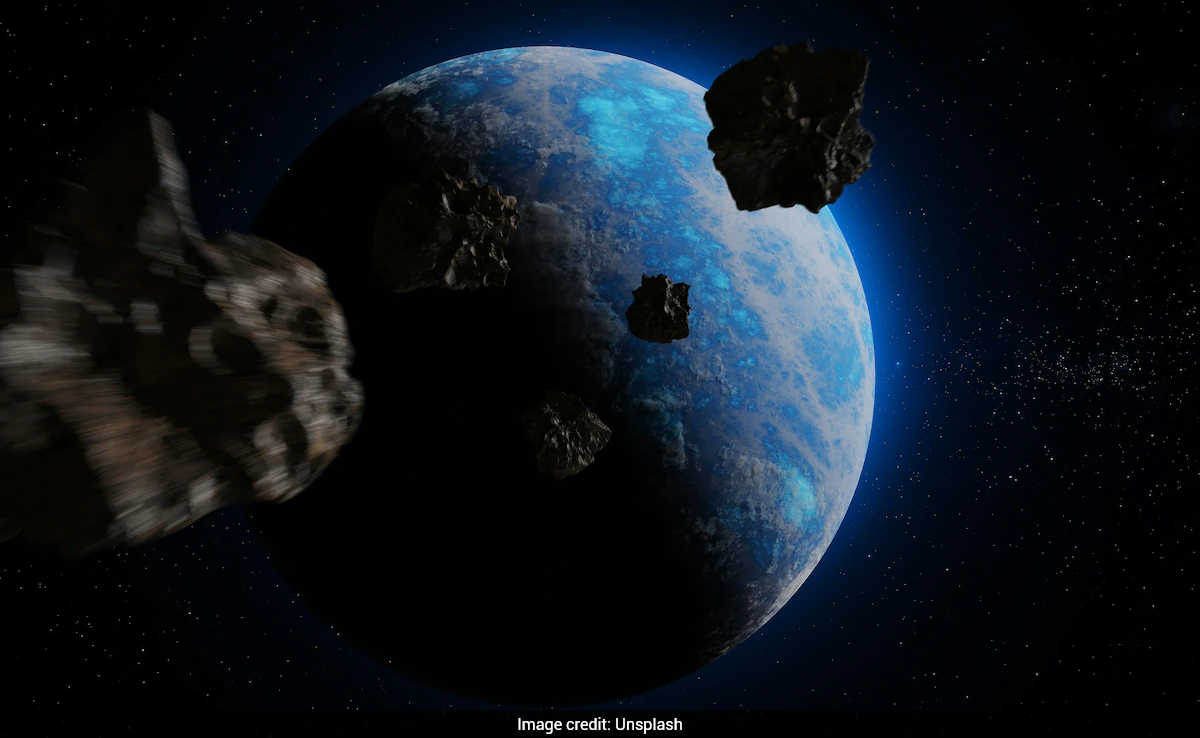
A newly discovered asteroid, 2026 JH2, is to make an exceptionally close but safe flyby of Earth on May 18. According to Space.com, the asteroid will make its closest approach to Earth at 2123 GMT on May 18. At the moment, it will pass within 56,628 miles (91,135 kilometres). The space event can be watched in real time with a livestream provided by Virtual Telescope Project, which is an online platform that offers live and high-quality astronomical observations.
The asteroid is estimated to be between 15 and 35 meters wide, or 16 to 35 meters, as per the European Space Agency (ESA). To visualise it: roughly the size of an adult blue whale.
ESA mentions that 2026 JH2 has been classified as an Apollo-type asteroid. That means its elliptical orbit around the Sun crosses Earth's orbital path.
Also read | Video: Indian Astrophotographer Captures Stunning Triangulum Galaxy From Uttarakhand Village
Watch it here:
How was it discovered?
2026 JH2 was discovered only days before its encounter, on May 10, by astronomers at the Mount Lemmon Survey in Arizona, Space.com reported.
"At the time of the observation, the object will be moving pretty fast against the stars, but our advanced telescopes will precisely track 2026 JH2 while it will be almost at its minimum distance from us, peaking in brightness, around magnitude 11.5, before it will set below our horizon," Virtual Telescope Project founder Gianluca Masi told Space.com in an email.
Also read | Mars Experienced Catastrophic Flooding 3.5 Billion Years Ago, Reshaping Planet's Surface
No threat to Earth
Despite the close pass, agencies confirmed there was zero risk of impact. NASA notes that space rocks smaller than about 25 meters would most likely burn up in Earth's atmosphere and cause little or no damage.
Track Latest News Live on NDTV.com and get news updates from India and around the world

