






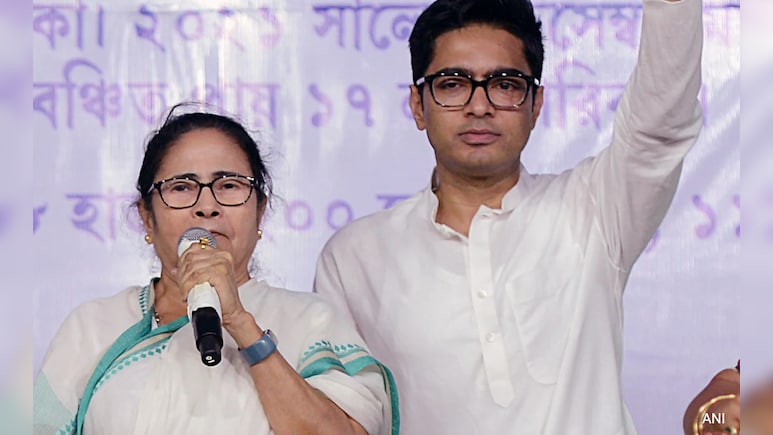
West Bengal Chief Minister Mamata Banerjee and Trinamool Congress's second-in-command Abhishek Banerjee have emerged as a coordinated political force in the 2026 election campaign. Their joint leadership marks a distinctive phase in the state's electoral politics, with a level of coordination not seen in previous elections.
While Abhishek Banerjee played an active role in the 2021 Assembly and subsequent Lok Sabha elections, the current campaign reflects an unprecedented degree of synchronisation between the two.
Aggressive opposition politics is not new to the state. Similar intensity was visible during the Left Front era under Jyoti Basu and Buddhadeb Bhattacharjee, when Mamata Banerjee led the opposition. After the Left's decline, she occupied much of the opposition space once held by the Congress, with the BJP gradually emerging as the principal challenger. Even so, the BJP's current level of political aggression is among the sharpest seen in recent decades.
Another key feature of this election is the visible role of the central establishment. Institutions such as the Election Commission have taken an active role, which the BJP argues is necessary to ensure free and fair polls in a state it claims has seen a breakdown of democratic norms. Mamata Banerjee and Abhishek Banerjee have responded with a coordinated counter-strategy.
Despite earlier differences - Abhishek advocating greater space for younger leaders and Mamata relying on the party's traditional structure - the two now appear to have reached a balance. The party reflects a mix of continuity and change, blending its old ethos with a younger leadership base.
Their campaign strategy is carefully divided. The two leaders have coordinated their tours to maximise outreach without overlap. When Mamata campaigns in North Bengal, Abhishek focuses on the South, particularly his Diamond Harbour constituency. When she returns south, their movements are recalibrated to avoid duplication. This division of labour is part of a structured plan reportedly shaped by their media team, with inputs from the consultancy I-PAC.
They have also split campaign messaging. Abhishek focuses on youth-centric issues-employment, industrial growth, and the vision of a "New Bengal"--while Mamata emphasises welfare schemes, governance, and political attacks on the BJP. While both criticise the BJP, their tone and style differ.
On certain issues, however, they speak in unison. Both have criticised the Election Commission over voter list revisions, alleging "electoral atrocities". They also repeatedly target Suvendu Adhikari-often without naming him-referring to him as a "traitor."
Nandigram remains a politically sensitive battleground. Abhishek Banerjee has taken the lead there, campaigning for the Trinamool candidate against Adhikari. Mamata Banerjee, who lost the seat in the previous election and later described the result as influenced by irregularities, has not visited the constituency so far.
Abhishek has actively campaigned in Nandigram, publicly backing the TMC's candidate-once an associate of Adhikari-and energising workers. He is also closely monitoring administrative functioning in the constituency, with the party conducting detailed, block-level electoral assessments.
Mamata Banerjee's campaign, meanwhile, remains rooted in emotional and cultural connect. She continues to focus on rural Bengal, projecting herself as a leader under attack and appealing particularly to women, including OBC, SC/ST, and Muslim communities. Abhishek, in contrast, is giving added emphasis to the Matua community.
On 24 March, the Trinamool Congress launched a major campaign phase from Pathar Pratima. Addressing a large rally, Abhishek Banerjee set a target of a 40,000-vote victory margin for party candidate Samir Kumar Jana. He highlighted development work and presented five key pledges: expansion of Lakshmir Bhandar, housing for all under Awas Yojana, accessible healthcare in every block, piped drinking water for all households, and universal old-age pensions.
He also cited data to underline government performance, including beneficiaries under Yuvashree, Lakshmir Bhandar, and Swasthya Sathi, as well as infrastructure projects like rural roads built under Pathashree. At the same time, he accused the Centre of withholding funds for housing and drinking water projects.
Mamata Banerjee's campaign style stands in contrast. Campaigning in North Bengal's Dooars region the same day, she joined Adivasi dancers en route from Chalsa to Lataguri, reflecting her emphasis on spontaneity and cultural connection.
In her speeches, she has also pushed back against caste-based politics, calling for social unity.
Together, Abhishek Banerjee's data-driven, policy-focused messaging and Mamata Banerjee's emotive, grassroots connect form a complementary strategy. Whether this will help it win West Bengal, only the election day will tell.
(The author is Contributing Editor, NDTV)
Disclaimer: These are the personal opinions of the author

