






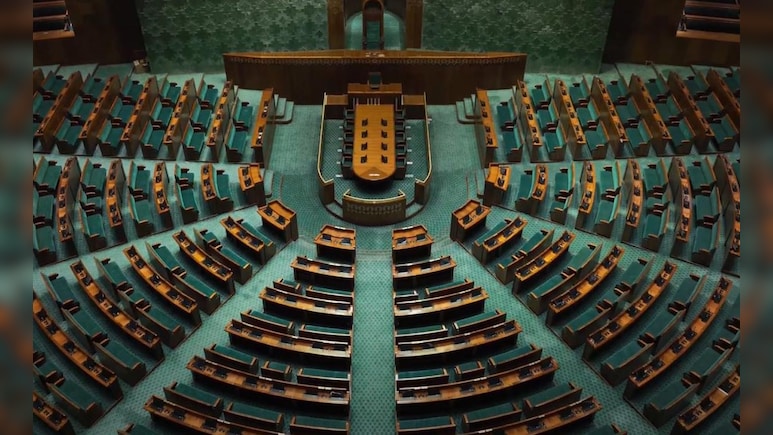
As the country gears up for the winter session of the parliament, on the heels of an important state election, one would hope that the Bharatiya Janata Party (BJP)-led Central government, in its victory, would work towards issues that are significant for its people. However, as a Member of Parliament in the Rajya Sabha, I was particularly surprised by a notification that reveals this government's priorities with startling clarity. I refer to a note on parliamentary customs and etiquette, which said that raising slogans like 'Vande Mataram' and 'Jai Hind' would not be allowed inside the Rajya Sabha.
As a member of the August house, it hurt and angered me deeply that a British-era rule, which we fought against with these very slogans, is now being replicated in Independent India's Parliament. That this government is choosing to uphold colonial practices over national sentiment is an insult not just to this Parliament but to our very freedom struggle.
Some words fade with time, and then there are words that outlive generations. 'Vande Mataram' and 'Jai Hind' belong to the latter. They are not just slogans; they are the echoes of a nation that once broke through its chains and marched towards freedom with its voice as its strongest weapon. India's fight for independence was won by the belief in non-violence and unity in our messaging, which was deeply embedded in our conviction about bowing down to our motherland and keeping her honour and freedom. These slogans symbolised that resolve and the significance of our collective belief.
Bankim Chandra Chattopadhyay's 'Vande Mataram' was the heartbeat of India's freedom movement. The Swadeshi protesters who marched with it were not simply chanting a phrase; they were expressing devotion to their motherland. The British banned it from meetings, and yet it survived on the lips of millions. Suppression only strengthened it. Every utterance of 'Vande Mataram' was itself an act of rebellion, a reminder that national pride could not be wished away through bans or restrictions.
Then came 'Jai Hind', the defiant call popularised by Netaji Subhas Chandra Bose. If 'Vande Mataram' stirred emotions like a song, 'Jai Hind' struck like a command: forward, united, and victorious. The Indian National Army marched behind it, and so did citizens across languages and religions. 'Jai Hind' did not speak for one region, one belief, or one ideology; it was the voice of an India that believed freedom was not just a dream, but her collective destiny.
But the greatest irony, one that demands to be called out, is the government's hypocrisy on what it labels the "Macaulay mindset". The Prime Minister often warns against this supposed colonial hangover. Yet, his own government is enforcing exactly the kind of constriction, sanitisation, and suppression that Thomas Macaulay expected. That is why, my party leader Uddhav Thackeray Ji's question about Macaulay's progeny having infiltrated the Bharatiya Janata Party's (BJP) idea of governance gains more relevance. Because nothing reflects a colonial mindset more starkly than banning 'Vande Mataram' and 'Jai Hind' inside India's Parliament. The spirit of Macaulay lives not in our classrooms but in this government's actions, actions that treat India's identity as something to be regulated, muted, and controlled.
What makes this even more laughable and hypocritical is that on one hand, the government wants to publicly celebrate 150 years of 'Vande Mataram', as acknowledged by even the Parliamentary Affairs Minister Kiren Rijiju after a recent all-party meeting, while on the other, it to ban its usage inside the Parliament. This government's cowardice stands unmasked by its own contradictions.
Today, these slogans are the living and breathing sense of who we are and what we stand for. At a time when national unity is often tested, and patriotism is debated, these slogans remind us of a period when being Indian meant resisting, dreaming, and standing shoulder to shoulder for something greater than all of us. Today, I hang my head in shame when I am told in India's highest chamber of governance, in its Upper House, the Rajya Sabha, that the use of these two slogans is prohibited. I am filled with a sense of outrage, and it makes my resolve harder to continue to chant these slogans for not just my own commitment to it but to espouse the sentiments of 140 crore Indians who strive every day to work for the glory of the motherland, and no one can take away that right from me.
If the government believes it can police patriotism, it should remember: the people of India have never bowed to colonial rule, and they will certainly not bow to a colonial mindset now, even if it comes dressed in sarkari and sanskari costume.
(The author is a Rajya Sabha MP and Deputy Leader of the Shiv Sena-UBT)
Disclaimer: These are the personal opinions of the author

