






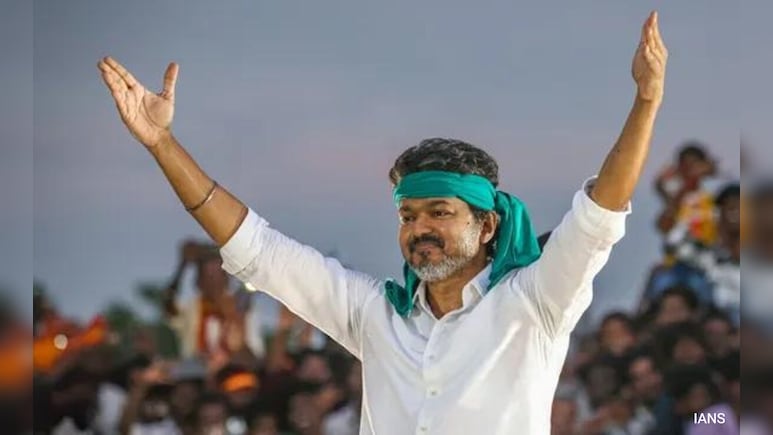
Soon after he filed his nomination from Perambur in north Chennai, 'Thalapathy' Vijay was clear about the section of the electorate that would help him change his designation from candidate to MLA - the Gen Z voter. ''Gen Z, vote for the whistle symbol. Give me a chance. It must be a whistle revolution,'' he exhorted the crowd to 'whistle podu' (blow the whistle) on April 23.
The 2026 Tamil Nadu assembly election is different not just for the presence of Vijay and his Tamilaga Vettri Kazhagam (TVK) as the X-factor. The manner in which the party has approached this election has made age an important dynamic in a state whose presiding deities at election time have always been caste and cash.
Does the use of the term 'Gen Z' matter when all leaders address the youth in general? Yes, because by using the English term 'Gen Z' in a Tamil speech, Vijay is doing a linguistic handshake with the digital native. What is conveyed is that he understands their lingo, their world of algorithms and digital trends better than the leaders of the DMK and AIADMK, who are stuck in an analogue era in the times of 5G. In a state with a tech-savvy population, this distinction matters.
From an electoral point of view as well, this distinction, though exclusionary in nature, makes political sense. Vijay is doing targeted campaigning, trying to maximise the percentage of votes that come from the under-40 demographic. With 2.2 crore out of the 5.6 crore total voters, in percentage terms, the under-40 segment translates to roughly 40 per cent of the total electorate. Usually, the male elders in the family dictate the electoral choice of the younger ones and the women. But this time, Vijay, by appealing directly to the first-time voters, the Gen-Z and the women, is validating their distinct identity. Thus, the 2026 election, by making age a critical marker, is making the younger lot active participants in the democratic process, contrary to the disdain with which the youth usually look at politicians and politics. The expectation is that this lot would be enthused enough to cast their vote and feel empowered. Not only that, communicating with this generation means the message gets amplified as the shareability quotient over different forms of social media is very high. Hence, doing politics over reels makes more sense than over wall posters.
It is important to note that Vijay is not just appealing to the younger lot; he has also presented them with choices they can relate to. A significant number of candidates are under 40, most of them first-time contestants. This shift is something the Dravidian parties have not been able to make in substantial numbers. Both the DMK and AIADMK have far too many well-entrenched district strongmen who cannot be displaced by the leadership. Like minister Durai Murugan, who is the oldest in the fray at 87. Among the exceptions are DMK's candidate in Avanashi constituency, 28-year-old Dr Gokilamani.
This move to woo the younger electorate by presenting them with fresh faces as candidates is a leaf out of NT Rama Rao's book in Andhra Pradesh in 1983, when 150 out of the 294 candidates that the actor-turned-politician fielded were first-time contestants. A majority of them were an educated lot - lawyers, doctors, teachers, engineers - and that gave hope of a new future in the Telugu state. That template of risky disruptors is being replicated in Tamil Nadu now.
But while the 'Catch them Young' is a commendable move, will the age factor succeed in being caste-neutral and cash-neutral? Will a 20-year-old brought up with the casteist pride of being a Vanniyar, a Gounder or a Thevar, connect with a system update that promises dignity through 21st-century employment opportunities? That is the challenge for parties like the TVK, and unless they address this regularly on the campaign trail, they will not succeed in making aspirational identity trump caste identity. For the age factor to play a decisive role, the under-40 electorate has to look beyond the boundaries of a Theni, a Karur, a Cuddalore, and think about participation in a global economy. They have to choose between managers of the existing caste system and disruptors of the same system.
The lure of cash is tougher to beat. The older generation looks at the cash - either given in the form of Direct Benefit Transfer from the government, or as tokens to be redeemed after polling - as ''nandri'' (moral debt). The Gen Z is being exhorted to indulge in decoupling, which means to accept the cash but be under no pressure to vote for the candidate who bribes.
But 51-year-old Vijay is not the only one who appeals to the younger lot. For the ruling DMK, 48-year-old deputy chief minister Udayanidhi Stalin - also an actor-turned-politician like Vijay - is the big bet. Udayanidhi has the advantage of being an orator who speaks colloquial Tamil, and his speeches are witty and more conversational than preachy. Likewise, the BJP has the feisty 41-year-old K Annamalai, who can pack a punch, and his engineering-IIM-IPS background makes him a role model for the educated youth who respect meritocracy. All three hold the key to making the Age factor the most important in this election. The drawback, however, for Udayanidhi and Annamalai, is that, unlike Vijay, they are not the main face of their respective parties. Therefore, their appeal gets diluted.
One thing is, however, certain. With the kind of enthusiasm seen in the younger voters, the polling percentage is certain to go up this time. If that happens, the Election Commission should send a 'Thank You' note to Vijay because he, more than anyone else, has got the younger voter invested in the democratic process.
(The author is a senior journalist)
Disclaimer: These are the personal opinions of the author

