






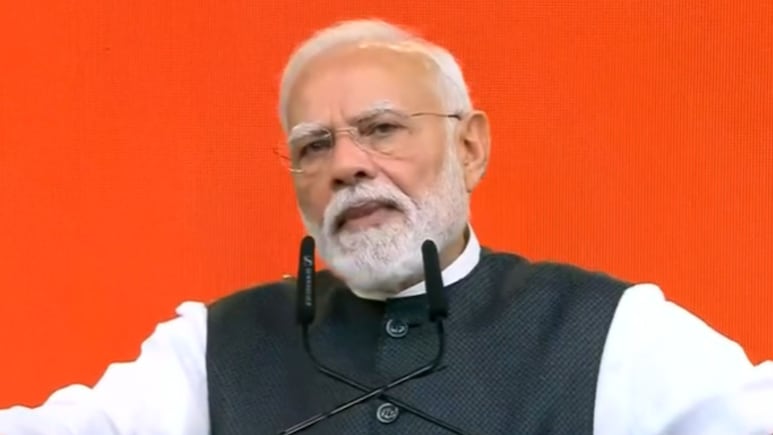
Prime Minister Narendra Modi, who turned 76 recently, completes 25 years in public service on Wednesday (October 7). The celebrations sprawled across the country, and the BJP organised a month full of events - a scale befitting a leader whose personal brand has, for over two decades, been treated as inseparable from his party's electoral fortunes. Since 2002, the BJP has not lost a single election in Gujarat (2002-2012) and national elections (2014-2024) in which Modi was the face of the campaign. What defines the Modi phenomenon? It is his ability to reinvent himself constantly.
Defining the Modi factor
The "Modi factor" is defined as the prime minister's demonstrated ability to pull in voters who don't belong to the BJP's traditional, ideologically committed base. In effect, it measures how much of the party's vote share comes not from loyalists who would vote BJP regardless of leadership, but from voters whose support hinges specifically on Modi being the face of the campaign.
Modi helped the BJP secure an estimated 20% of their votes in 2014, rising to 25% in 2019, and 27% in 2024 as per CSDS post poll survey. These voters would not have voted for the BJP if Modi were not the PM candidate. This factor isn't just limited to the BJP. Modi's appeal extends a coattail effect to NDA allies too - helping them secure an estimated 20% of their votes in 2014, rising to 25% in 2019, and 27% in 2024.
Modi factor's key role in BJP's juggernaut
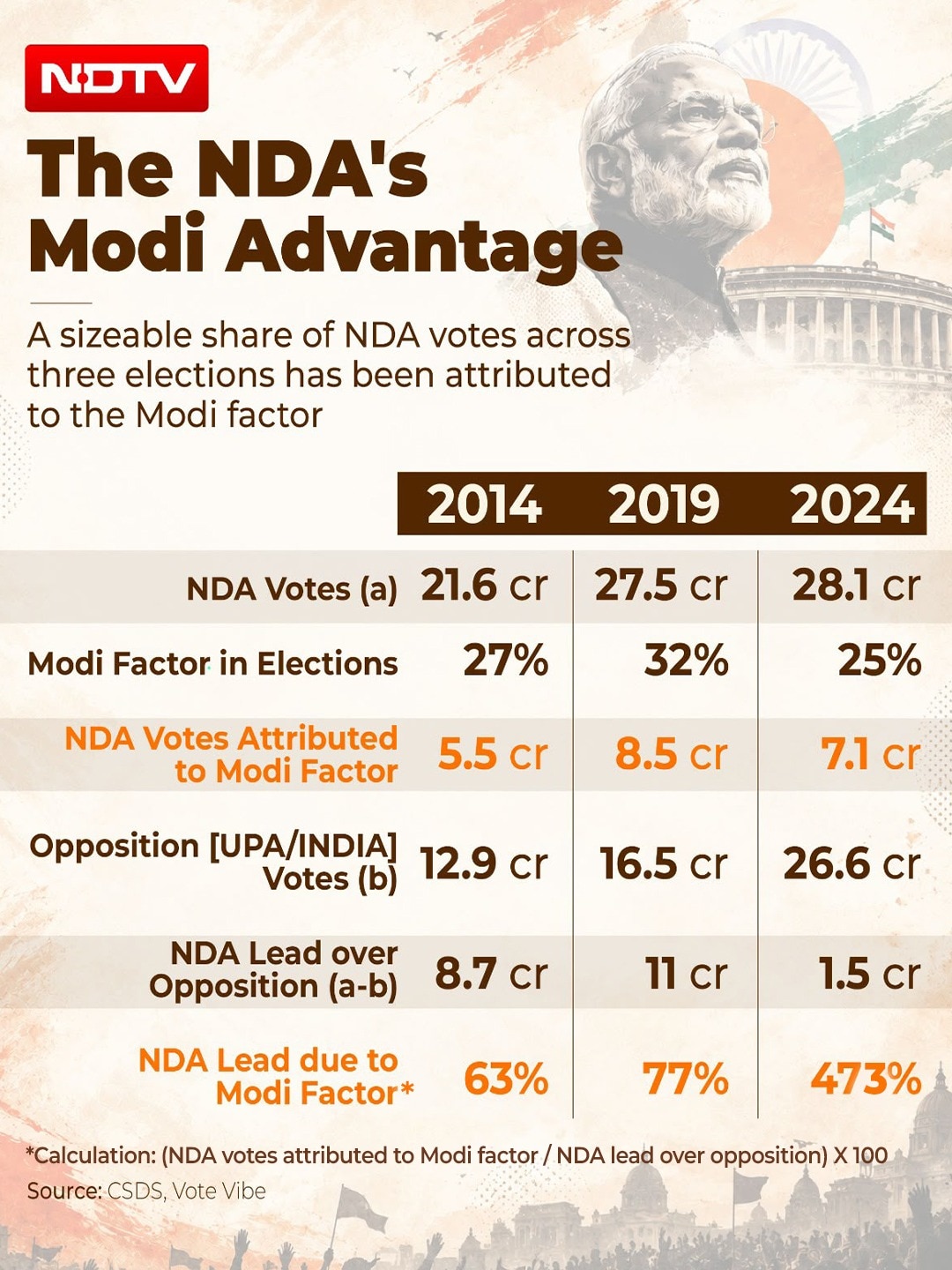
In 2014, the Modi factor delivered the NDA roughly 5.5 crore votes out of its total votes of 21.6 cr. The NDA got 8.7 crore votes more than the Congress-led UPA. That means Modi's personal contribution accounted for 63% of the NDA's winning margin - meaningful, the coalition likely would have won regardless, just by a smaller margin.
By 2019, the Modi-attributed vote total rose to about 8.5 crore, while the NDA's overall votes increased to 27.5 crores. The NDA lead over the UPA also grew to around 11 crore votes. The Modi factor's share of that lead climbed to 77% - a sign that the party's winning margin was becoming steadily more dependent on Modi's personal draw, even as the party's overall position looked stronger than ever.
The 2024 election flips the framing entirely. The Modi-attributed vote count settled at around 7.1 crore while NDA's overall votes increased marginally to 28.1 cr. However the opposition presented a united voice and INDIA bloc received 26.5 cr votes. Thus, the NDA's lead over the INDIA bloc collapsed to around 1.5 crore votes with the NDA tally falling below 300 instead of "char sau paar".
That means the Modi factor's vote total pull dwarfed the entire winning margin, representing well over 400% of the lead. In practical terms, this suggests that without the votes attributable to Modi personally, the NDA may have lost the elections to the INDIA bloc altogether. Modi was the "key differentiating factor" between the ruling coalition and the opposition.
The numbers on the BJP's own vote share tell a more nuanced story. In 2019, the party's 37.8% vote share broke down into roughly 25.7 percentage points from its core ideological base and about 12.1 points attributable to the Modi factor. By 2024, with the BJP's vote share down slightly to 36.6%, the core base actually held up - contributing around 27.4 points - while the Modi-specific contribution shrank to about 9.2 points.That's a marginal decline: the "Modi premium" fell from roughly 12% of the vote in 2019 to around 9% in 2024.
Even a slightly diminished Modi factor of 9% is still roughly four times the gap between the NDA's and the INDIA bloc's vote shares in 2024. Put simply: however much Modi's personal pull may have cooled since its peak, it remains large enough that removing it entirely would have erased the NDA's advantage over the opposition several times over.
Two trends moving in opposite directions
The real story here isn't a simple decline or a simple triumph - it's two distinct trends moving in opposite directions simultaneously. Modi's raw, personal ability to pull swing voters toward the BJP does appear to have peaked in 2019 (Balakot strikes when nationalism fervour gripped the nation) and softened since.
But the NDA's dependence on that pull has grown sharply, because the rest of the coalition's advantage over its rivals has eroded even faster. The INDIA bloc's consolidated vote total jumped dramatically compared to the UPA's showing in 2014 and 2019, closing a gap that Modi's personal appeal is now solely responsible for bridging.
VoteVibe's opinion poll tracker for four states shows the Modi factor still matters as 5%-11% voters across states show the Prime Minister's face as the main consideration of voters. The youth protests led by CJP, resignation of Dharmendra Pradhan, alleged donation theft in Ram temple, BJP's inability to pass the FCRA Bill, and introduction of the Delimitation Bill, have created a negative perception around the BJP-led central government.
Many analysts perceive this period as Modi's biggest challenge. Does the brand still hold its appeal, or is it fading? The answer may become clearer in next year's state elections.
(Amitabh Tiwari is a political strategist and commentator)
Disclaimer: These are the personal opinions of the author

