






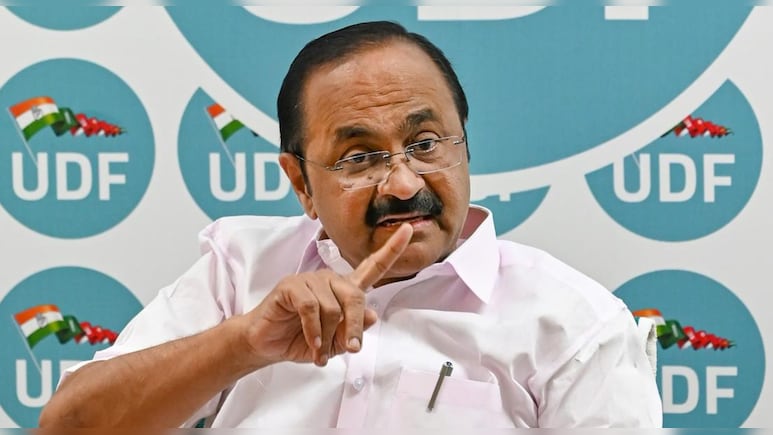
During the culmination of the massive Puduyuga Yatra - led by the then Leader of the Opposition and now Chief Minister-designate, V.D. Satheesan - Rahul Gandhi had remarked, "All these leaders dance well, but they need to dance well together." It was a pointed reminder of the necessity for unity in Kerala. Indeed, the only way the UDF could have squandered this election was through internal friction, and they all danced together to a fascinating mandate.
The "dance together" advice is still important for Satheesan, as he has been chosen as the next Kerala Chief Minister by the Congress high command and soon will be chosen by the Congress Legislative Party after a tough power-struggle dance with the High Command.
Satheesan's case was strong. He led the charge from Kerala's northern tip to its southern coast from February 6 to March 7, with the Puduyuga Yatra projecting his position as the face of the Congress campaign.
As the LoP who took the fight directly to Pinarayi Vijayan for the last five years, he made himself a clear alternative. He had, and still has, the categorical trust and support of the IUML, the UDF's most powerful ally, and is clearly the most dominant public face of the UDF.
In contrast to Satheesan's public-facing role, KC Venugopal (KCV) operated as the party's primary decision-maker. Leveraging his proximity to Rahul Gandhi, KCV acted as the master strategist, handpicking candidates and keeping the campaign on track. By choosing not to contest the assembly polls, he avoided sending mixed signals to the electorate. As the central power axis in Kerala, KCV deserves credit for maintaining party discipline and stepping back from the limelight to prevent any optics of friction.
Meanwhile, Ramesh Chennithala, the quintessential Nehru-Gandhi loyalist, served as the campaign committee chief. Though he made a pitch for the top job, many view him as past his prime following the 2021 failure. His only realistic path to the Chief Minister's post this time was as a "consensus candidate" if the rivalry between KCV and Satheesan reached a total deadlock.
The Congress High Command faced a dilemma: choose a loyalist like KCV, who would strictly follow the leadership's diktat, or appoint Satheesan, a powerful public figure who often marches - or dances - to his own beat.
The main dynamic seems to have been VDS's refusal to budge. He apparently said he will resign from the assembly and not be part of a government under anyone else. This would have been a disaster. Letting him go would have led to enormous instability and a massive public backlash - the party couldn't afford that after such a stupendous victory. The other dynamic was the categorical support of the biggest ally, the IUML, which has 22 MLAs.
In fact, the BJP has seized on the IUML's support, accusing the Congress of buckling under the pressure of the League to appoint Satheesan. While this may be a standard political allegation, it appears the BJP is deliberately framing Congress as a "minority-driven" entity, a narrative the party has peddled nationally repeatedly. By doing so, they aim to consolidate a Hindu vote bank in Kerala, seeking an opening in the vacuum left by the LDF's crushing defeat.
Leaving political allegations aside, Satheesan is widely regarded as a firmly secular ideologue who views the UDF as a broad social coalition. Unlike many of his predecessors, he has not appeased powerful communal or caste-based interest groups, such as the NSS or SNDP. While this reinforces his secular credentials, it also means he will likely face stiff opposition from these influential lobbies that are used to having a say in the state's governance.
Fearing a repeat of the leadership "civil wars" seen in Karnataka, the Congress High Command realised that sidelining Satheesan would trigger a massive public backlash and immediate instability. This decision is one for categorical clarity and dispelling any confusion. Kerala will hope this will be the case for five full years.
KCV, as a confidante of the Gandhis, was deemed easier to placate. Interestingly, his initial contention for the post suggests he had the High Command's blessing; he likely wouldn't have challenged Satheesan without a green light from Delhi.
VD Satheesan is known for a streak of authoritarianism. A wildlife enthusiast who has scaled all the peaks of the Western Ghats and a voracious reader, he is a bit of a loner who writes his own scripts. This independent "rebel" streak is precisely what worries the High Command; they are loath to lose control over Thiruvananthapuram the way they have over Bengaluru.
As Satheesan takes the oath of office, his greatest challenge will be inclusivity. To succeed, he must accommodate the loyalists of both KCV and Chennithala in key positions.
He may be the Chief Minister, but he must remain "first among equals" in a large, convoluted dance troupe. To lead Kerala, Satheesan must finally learn to dance together and to dance many tunes between Delhi and Thiruvananthapuram.
(The author is Executive Editor, NDTV)
Disclaimer: These are the personal opinions of the author

