





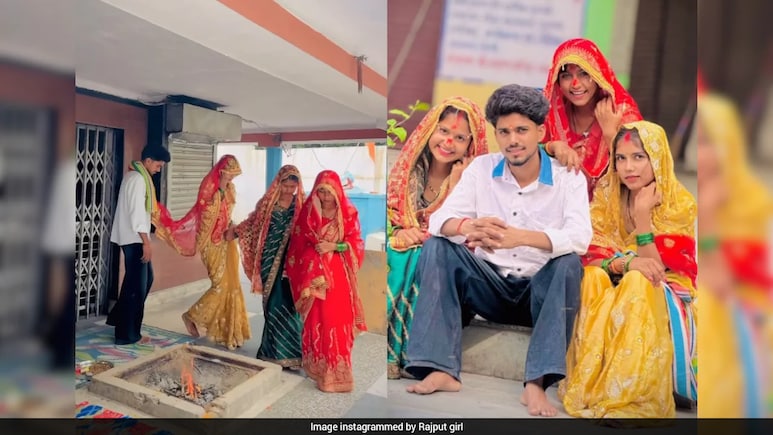
- Videos show three women marrying one man at a temple in Uttar Pradesh's Amroha district
- Temple denies knowledge of the wedding and says no staff were present during renovation
- Hindu groups question legality and rituals; others support adults' right to choose
Videos showing three women marrying the same man at a temple in Uttar Pradesh's Amroha district have gone viral on social media, triggering widespread debate over the unusual union. The clips, shared widely on Instagram and Facebook, show the women taking part in what appears to be a traditional Hindu wedding ceremony with a single groom. In the videos, the man is first seen taking seven rounds around the sacred fire and then applying sindoor (vermilion) to each bride.
Watch the video here:
Who are the people in the videos?
The women have been identified as Saroj, Savitri and Santosh from Dhoriya village in Amroha. According to reports, two of them are sisters while the third is their cousin, although several social media posts have described all three as sisters.
The groom has been identified as Vikas, also known as Vikku, who reportedly worked as the cameraman for the women's social media content. According to the group, he had been appearing as their on-screen husband in videos for the past six months.
Initially, many social media users believed the ceremony had been staged to create online content. However, the four later appeared on camera, insisting that the marriage was genuine and not made for reels.
Why did they marry the same man?
The women said they had grown up together and did not want to be separated after marriage. They claimed their family had begun making arrangements for them to marry different men, which left them upset. According to them, they decided together to marry Vikas so they could continue living as a family. They also said they are all adults and that the decision was made with mutual consent. The group appealed to social media users to stop trolling them or posting abusive comments.
"We have lived together since childhood and could not imagine living apart. When we realised that marriage would separate us, we even thought of ending our lives. Later, we decided that instead of dying, we would stay together and marry one man. We are all adults and took this decision willingly," one of the sisters said.
Saroj is reportedly pursuing a BTech degree, while Savitri and Santosh have completed Class 12.
Vikas said he agreed to the proposal because he understood how close the women were and wanted to respect their wishes.
एक दूल्हे को मिली 3 दुल्हनें!
— Farman Saifi (@FarmanSaifi1077) July 23, 2026
दुल्हन सरोज- "लोग कह रहे है कि तू इन्हें प्यार कर पायेगा या नही कर पायेगा? इसका जबाब इनसे ही सुन लो."
दूल्हा विकास- "ये लोग आपस में इतना प्यार करे है, मेरे प्यार की तो इन्हें जरूरत ही नाय है." pic.twitter.com/ZfyGRbAkim
Temple denies knowledge of wedding
The videos are said to have been filmed at the Maa Chamunda Temple in Hasanpur. However, the temple administration has denied any knowledge of the alleged wedding.
Temple authorities said renovation and beautification work was underway at the time the videos were reportedly recorded and claimed no priests or temple staff were present. They said they were unaware of any such ceremony taking place on the premises.
Videos spark legal and social debate
As the videos gained traction online, they drew mixed reactions. Several Hindu organisations questioned the legality of the reported marriage and the religious rituals shown in the clips. Others argued that if all the individuals involved are consenting adults, they should be free to make their own personal decisions.
Amid growing online criticism, the sisters posted another video to defend their marriage. Citing Hindu mythology, they asked, "King Dasharatha had three queens in ancient times. Was that considered an insult?"
What does Hindu law say?
The Hindu Marriage Act, 1955, prohibits polygamy. Section 5 of the Act states that a valid Hindu marriage can take place only if neither party has a living spouse at the time of the marriage. A Hindu man cannot legally marry more than one woman simultaneously, and a second marriage during the lifetime of the first spouse is considered void.
Such a marriage can also attract criminal liability under Section 82 of the Bharatiya Nyaya Sanhita (BNS) (formerly Section 494 of the Indian Penal Code), which deals with bigamy.
Track Latest News Live on NDTV.com and get news updates from India and around the world

