



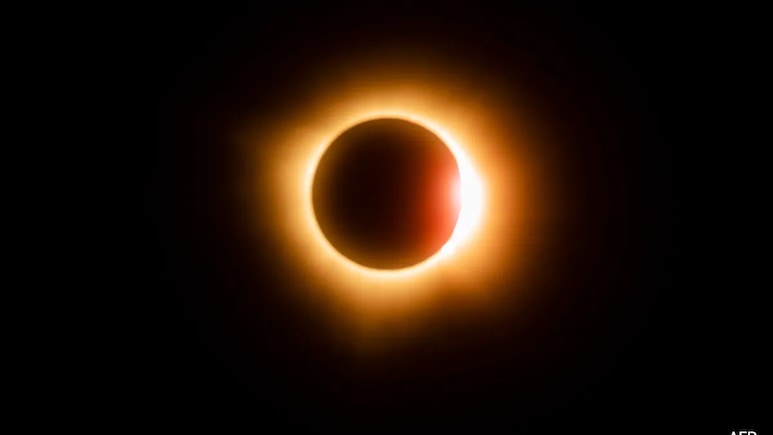
- Annular solar eclipse occurs on February 17 with the Moon near its farthest point from Earth
- The Moon appears smaller, creating a bright ring or "ring of fire" around it during the eclipse
- The eclipse will be visible only from Antarctica, southern Africa, and parts of South America
Annular Solar Eclipse Details: A cosmic drama is set to unfold this February as an annular solar eclipse, also known as the "ring of fire" eclipse, will occur. According to NASA, this phenomenon happens when the Moon passes between the Sun and Earth, but when it is at or near its farthest point from Earth. Notably, the Moon doesn't cover the Sun entirely and appears smaller because it is farther away from Earth, making the lunar body look like a dark disk on top of a larger, bright disk - creating a ring around the Moon. The date of the annular solar eclipse is February 17.
Also read | Study Reveals Micrometeoroids Are A Key Challenge For NASA's Planned Moon Base
Annular Solar Eclipse: Will It Be Visible From India?
Unfortunately, India won't be able to witness this spectacular event as it will be visible only from remote regions of Antarctica and parts of southern Africa and South America.
"It's possible that only a few people will view this eclipse from within the annular zone," Jay Anderson, who is an eclipse meteorologist, wrote on his website, Eclipsophile.com.
"It's a challenge to reach and there are only two inhabited locations within the annular shadow, neither of which is set up to welcome tourists."
Also read | What Is Antarctica's Blood Waterfall? The Mystery Of A Red Cascade Flowing From Ice
Annular Solar Eclipse: Time and Duration
The "ring of fire" will be formed for up to 2 minutes, 20 seconds, Space.com reported, further adding that 96% of the Sun's centre will be eclipsed by the Moon. The eclipse begins on Feb. 17 at 07:01 UTC, according to Forbes.
Annular Solar Eclipse: Visibility Details
Antarctica: The annular phase will be visible from research stations like Concordia and Mirny.
Southern Africa: Countries like South Africa, Tanzania, Zambia, and Zimbabwe will experience partial visibility.
South America: Parts of Argentina and Chile will also see the partial eclipse.
Annular Solar Eclipse: Safety Precautions
Use ISO 12312-2 certified eclipse glasses or indirect viewing methods to avoid eye damage.
Avoid looking directly at the sun, even during the eclipse.
Track Latest News Live on NDTV.com and get news updates from India and around the world

