





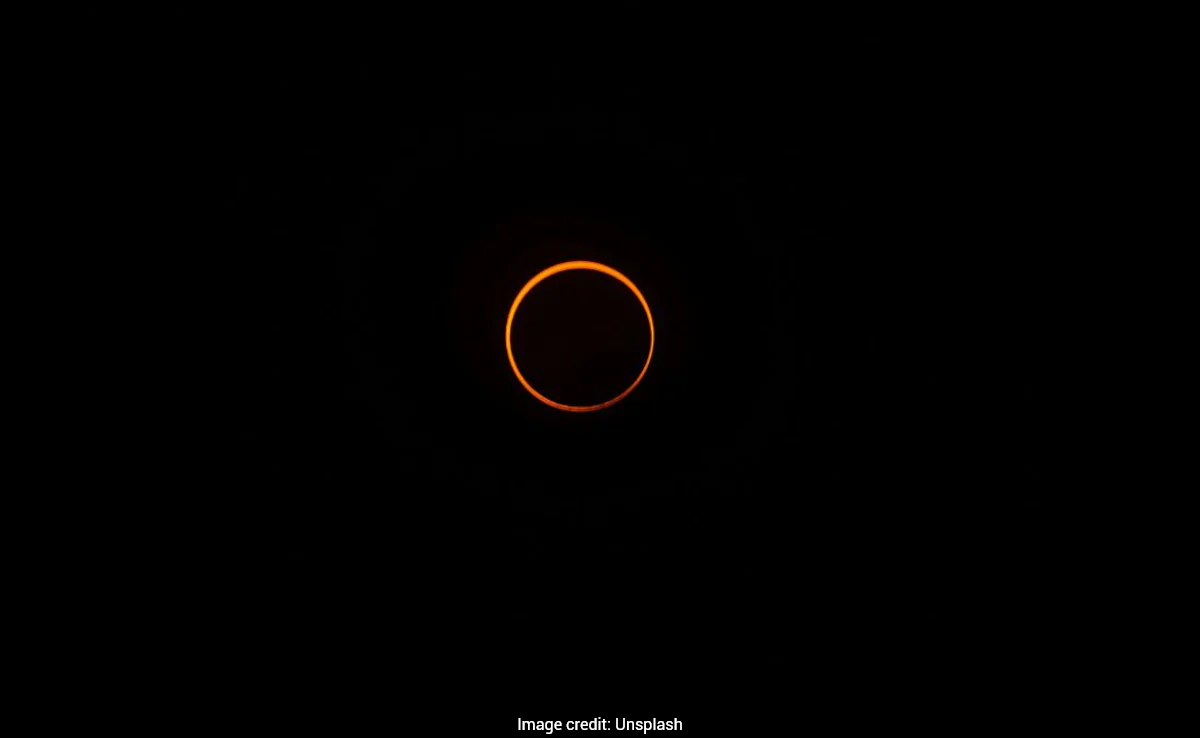
The first solar eclipse of 2026 will occur on February 17, marking a visually striking celestial event known as an annular solar eclipse, which is often referred to as the "ring of fire" eclipse.
All about annular solar eclipse
In an old post, NASA explained that this phenomenon happens when the Moon passes in front of the Sun but appears slightly smaller, leaving a glowing ring of sunlight visible around its edges.
"An annular solar eclipse happens when the Moon passes between the Sun and Earth, but when it is at or near its farthest point from Earth. Because the Moon is farther away from Earth, it appears smaller than the Sun and does not completely cover the Sun," wrote NASA.
"As a result, the Moon appears as a dark disk on top of a larger, bright disk, creating what looks like a ring around the Moon."
Also read | Scientists Analyse 12 Billion 'Signals Of Interest' In Search For Alien Intelligence
Date and Time of annular solar eclipse
The annular solar eclipse will take place on February 17, 2026. According to Space.com, the eclipse will start with its partial phase at about 09:56 UTC, reach maximum coverage at approximately 12:12 UTC, and end by about 14:27 UTC.
Will it be visible in India?
Unfortunately, the February 17 annular solar eclipse will not be visible from anywhere in India. The eclipse path will pass only over Antarctica, making it inaccessible to most of the world's population.
The path of annularity will cross Antarctica's coastal regions after starting in the southern Indian Ocean. It will end in the southern Atlantic Ocean. Some research stations in Antarctica, such as Concordia Station and Mirny Station, will witness the annular eclipse. Notably, organisations, such as NASA, often share streaming links to watch the eclipse live.
Also read | James Webb Space Telescope Finds What Killed Pablo's Galaxy: "Death By A Thousand Cuts"
Safety Precautions
While witnessing such celestial events, experts warn against direct viewing and advise using certified solar eclipse glasses for eye safety.
Track Latest News Live on NDTV.com and get news updates from India and around the world

