





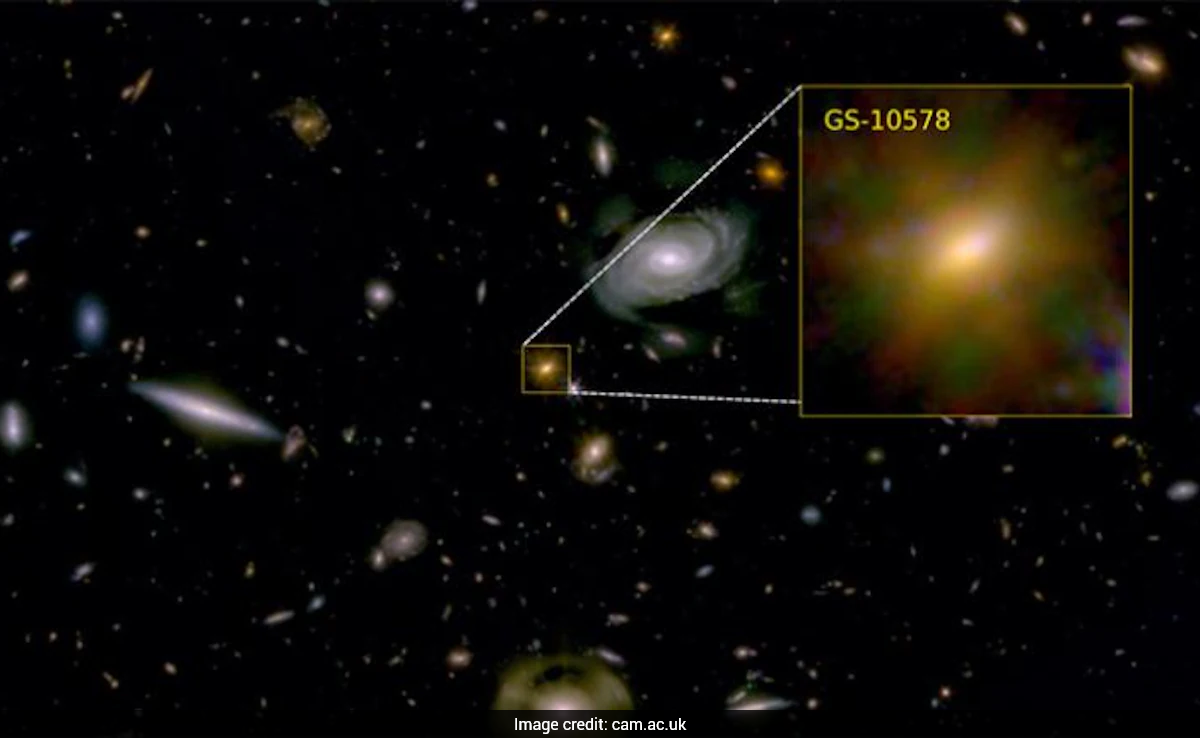
Researchers used the James Webb Space Telescope (JWST) and the Atacama Large Millimeter Array (ALMA) to reveal a shocking tale of a galaxy, GS-10578, which is affectionately nicknamed "Pablo's Galaxy". As per the findings published in the journal Nature Astronomy, the galaxy was starved to death by its central supermassive black hole.
This galaxy was a vibrant, star-forming giant around three billion years after the Big Bang, and was located 11 billion light-years away. It reportedly had a mass of 200 billion suns.
-

-
 NDTV World Summit 2026 Begins: India At The Centre Of A World Between Orders
-
 'We Like To Spread That Magic': Mohini Dey Ahead Of NDTV World Summit Performance
-
 NDTV World Summit 2026 Set To Begin: A Global Conversation On A World Between Orders
-
 NDTV's Mega 2-Day World Summit Begins With Bassist Mohini Dey's Performance
-
 World-Class Chefs, Food And Music: The Fun Side Of NDTV World Summit 2026
-
 AI, Consciousness And Dharma: Why Ancient Indian Wisdom Matters Now
-
 Who Is Rajiv Mehta? Lilavati Hospital Trustee To Speak At NDTV World Summit 2026
-
 Alain Ebobisse, Africa50 CEO, To Attend NDTV World Summit 2026. All About Him
-
 Kriti Sanon At NDTV World Summit: A Look At Her Career And Business Ventures
-
 Ex-CIA Director To Decode 'War In Times Of AI' At NDTV World Summit
The researchers have noted that the black hole at Pablo's Galaxy's heart has been slowly suffocating it, preventing fresh gas from fueling new star formation.
Also read | All About Mysterious Shockwave Around Dead Star. Here's Why Astronomers Are Puzzled
This "death by a thousand cuts" process involves the black hole pushing gas outward at incredible speeds (up to 2.2 million miles per hour), with the process depleting the galaxy's fuel reserves.
"What surprised us was how much you can learn by not seeing something," co-first author Dr Jan Scholtz from Cambridge's Cavendish Laboratory and Kavli Institute for Cosmology said as quoted in the official statement.
"Even with one of ALMA's deepest observations of this kind of galaxy, there was essentially no cold gas left. It points to a slow starvation rather than a single dramatic death blow."
The findings revealed that ALMA observations detected no carbon monoxide, indicating a severe lack of cold, star-forming gas. The galaxy loses about 60 solar masses of gas annually, potentially exhausting its fuel in 16-220 million years. Despite its demise, Pablo's Galaxy remains a calm, rotating disc, suggesting no major mergers occurred.
Also read | Negative-Energy 'Ghosts' In Space Could Point To New Laws Of Physics
"The galaxy looks like a calm, rotating disk," said co-first author Dr Francesco D'Eugenio, who is also affiliated with the Kavli Institute for Cosmology. "That tells us it didn't suffer a major, disruptive merger with another galaxy. Yet it stopped forming stars 400 million years ago, while the black hole is active yet again. So the current black hole activity and the outburst of gas we observed didn't cause the shutdown; instead, repeated episodes likely kept the fuel from coming back."
This discovery helps explain why JWST has spotted many "old-looking" galaxies in the early universe, suggesting slow starvation by supermassive black holes might be a common phenomenon.
Track Latest News Live on NDTV.com and get news updates from India and around the world

