





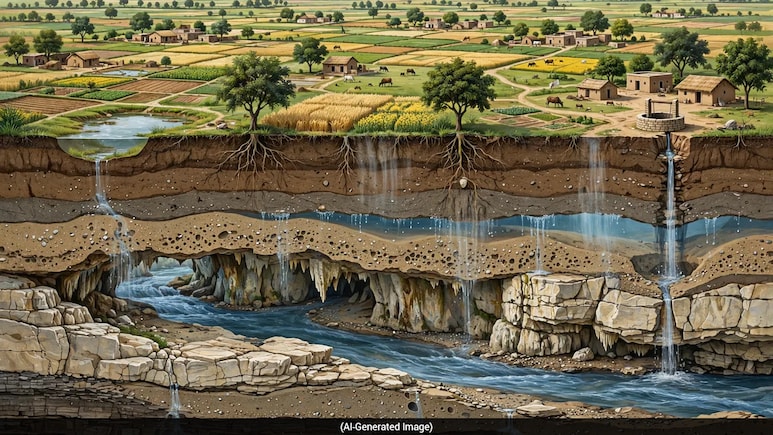
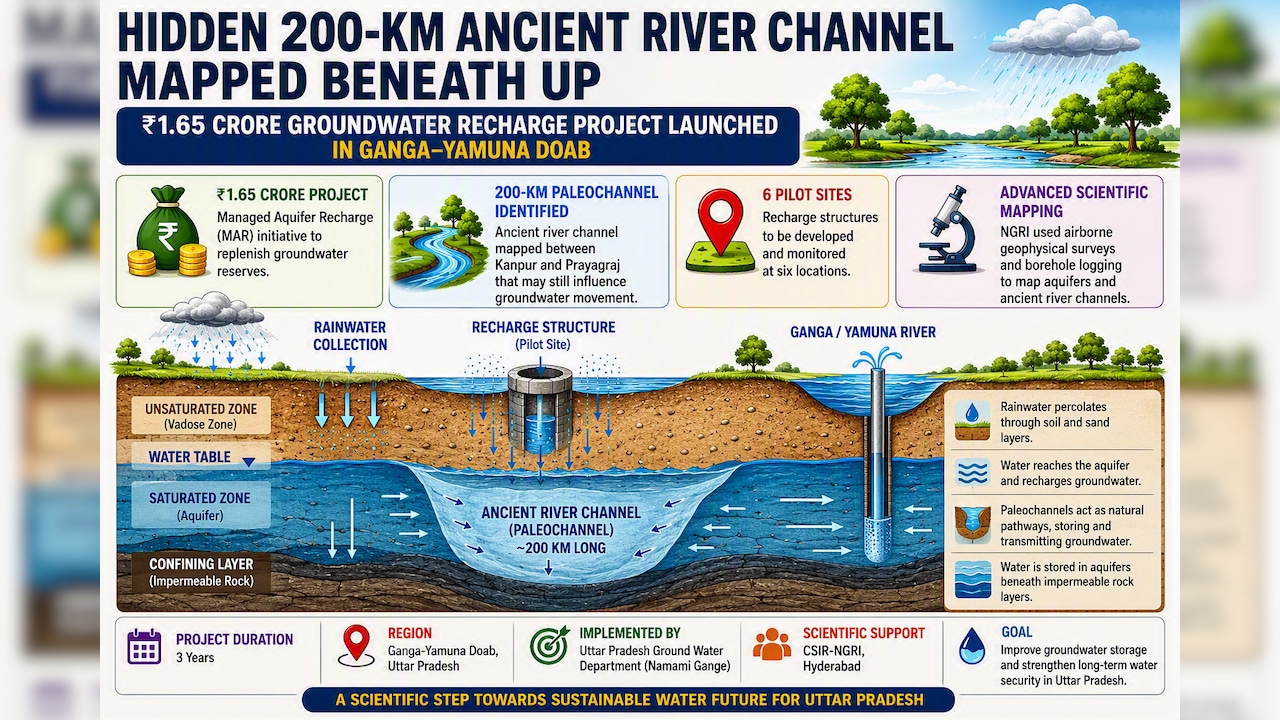
The Uttar Pradesh government has stepped up scientific efforts to boost groundwater conservation and ensure long-term water security across the state. As part of this initiative, a Managed Aquifer Recharge (MAR) project valued at Rs 1.65 crore has been launched in the Ganges-Yamuna Doab region. The three-year scheme aims to direct rainwater into underground aquifers to replenish depleted reserves.
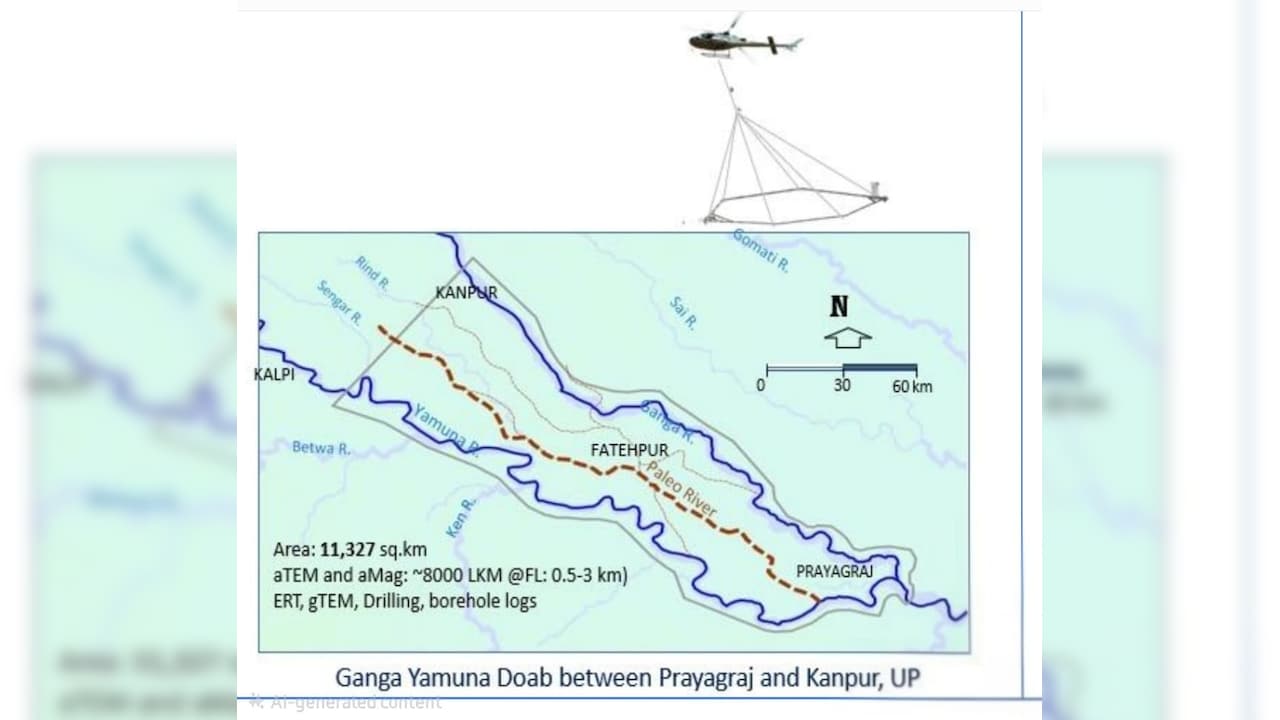
Scientists identified a roughly 200-km-long ancient river channel (paleochannel) beneath the Ganga-Yamuna Doab between Kanpur and Prayagraj. Scientists believe these paleochannels still act as natural pathways for subterranean water flow.
200km Ancient River Course Mapped
Dr Rajesh Kumar Prajapati, Special Secretary for the Namami Gange and Rural Water Supply Department and Director of the Ground Water Department, stated that researchers from the CSIR-National Geophysical Research Institute (NGRI) in Hyderabad identified the system using advanced technologies, including helicopter-borne geophysical surveys and borehole logging.
These tests mapped deep aquifers and ancient river courses beneath the Ganges-Yamuna Doab, revealing subsurface tracks that can actively channel groundwater.
Directing Rainwater to Aquifers
The project aims to catch surface runoff during rains and send it directly into aquifers-the natural rock and sediment layers that supply wells and tubewells. Scientific mapping will pinpoint where rainwater can sink into the ground most easily, guiding the installation of recharge systems.
Pilot Scheme Launched Across Six Locations
Funded by the National Mission for Clean Ganga and implemented by the Uttar Pradesh Ground Water Department, the project will run for three years. Six pilot sites have been chosen for the initial phase, where recharge structures will be built and monitored to evaluate water absorption and table recovery.
Scaling Up Based on Initial Results
Scientists will monitor the six pilot sites to determine which recharge methods work best for different soil and aquifer conditions. Once proven successful, the framework will be expanded to other suitable locations across the Ganges-Yamuna Doab.
Monitoring River-Groundwater Connections
The NGRI study highlights strong hydrogeological links between the Ganges and Yamuna rivers and the deep aquifers beneath them. The ancient paleochannels play a vital role in moving water within these aquifers. The project will map the relationships between rainfall, river flow, groundwater, and these ancient channels to guide future conservation efforts.
Strengthening Water Security Through Science
Prabhash Kumar, Additional Project Director for Namami Gange, noted that technical support from NGRI will ensure rigorous scientific monitoring. Alongside structural work, the state will run public awareness campaigns using Information, Education, and Communication (IEC) activities to encourage local water conservation.
(With inputs from Ajay Dubey)
Track Latest News Live on NDTV.com and get news updates from India and around the world

