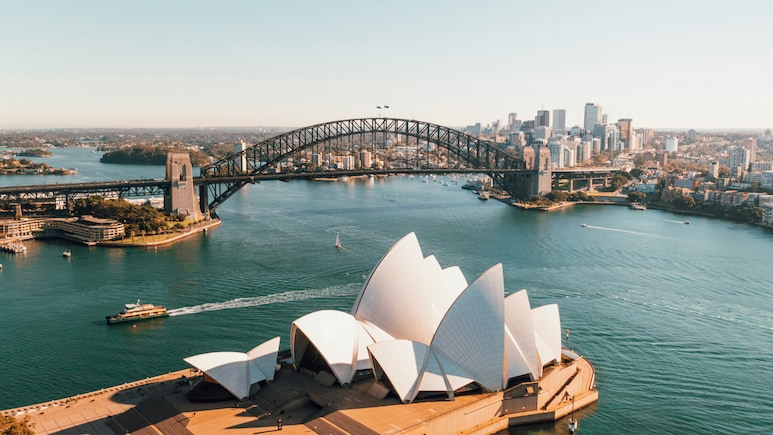
Late at night, as clocks edge toward 11 pm, flight-tracking maps over Sydney often show the same sight – aircraft circling offshore or rushing in, trying to land before time runs out. A social media user on Monday wrote on X, “Always fun to watch all the planes try and beat the curfew into Sydney,” alongside a map crowded with inbound flights. The scramble is driven by one of the strictest airport curfews in the world.
Always fun to watch all the planes try and beat the curfew into Sydney. pic.twitter.com/sKCsCerAxg
— louis (@louis20016) January 12, 2026
Why Sydney Airport Has A Curfew
Sydney Airport operates under a legislated curfew that bans most take-offs and landings between 11 pm and 6 am. The rule is a federal legal restriction designed to manage aircraft noise and protect surrounding residential communities while they sleep.
An airport curfew is defined as a legally enforceable restriction on aircraft operations at a federally leased airport during specific hours. In Sydney's case, the curfew controls both the timing of flights and, in some cases, which runways can be used.
The curfew is regulated by the Department of Infrastructure, Transport, Regional Development, Communications, Sport and the Arts, which has the authority to investigate breaches and prosecute airlines or aircraft operators that violate the rules.
Other Australian Airports With Curfews
Sydney is not alone. A handful of Australian airports in Adelaide, Essendon and the Gold Coast operate under similar night-time restrictions.
Are All Flights Banned During Curfew Hours
A curfew does not completely close an airport. While most regular commercial flights are not allowed, certain aircraft can still operate during curfew hours. These include:
- Emergency flights, such as police aircraft, air ambulances, the Royal Flying Doctor Service, search-and-rescue missions, or any plane facing an in-flight emergency.
- Approved quieter aircraft, including some freight planes, small propeller aircraft and business jets that meet strict noise limits.
- Flights already cleared for departure before the curfew begins.
- Flights given special permission by the federal government in exceptional situations.
Airports may also allow a small number of “shoulder” flights before and after the curfew, typically between 11 pm and midnight, and 5 am to 6 am. These are limited in number and are mainly used to manage international schedules affected by time differences.
Aircraft can still fly over Sydney's airspace during curfew hours, as long as they do not land or take off at the airport. Helicopters using helipads away from the airport are also not covered by the curfew.
How Big Global Airports Manage Night Flights
Sydney's strict curfew contrasts with how some major international hubs handle night operations. London Heathrow, one of the world's busiest airports, does not have a complete shutdown but enforces a tightly controlled night period from 11:30 pm to 6 am.
It uses a Quota Count (QC) system, where noisier aircraft are assigned higher points. Airlines are encouraged to deploy newer, quieter planes, such as those rated QC 0.25, to stay within seasonal noise limits. Heathrow also caps the total number of night-time movements and publishes detailed Noise Action Plans aimed at reducing sleep disturbance.
Switzerland's Zurich Airport enforces a hard curfew from 11:30 pm to 6 am, with a short buffer between 11 pm and 11:30 pm to accommodate delayed flights. Outside that window, operations are effectively shut down.
