





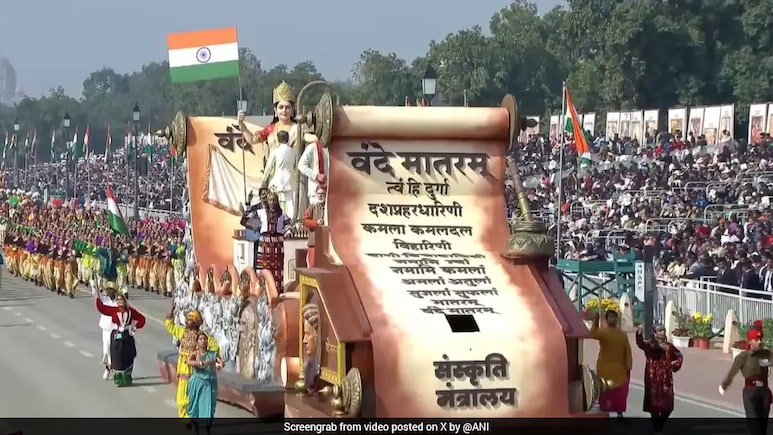
- Vande Mataram must be sung before Jana Gana Mana at all government events and schools, the centre said
- All six stanzas of Vande Mataram, including those removed in 1937, will be played now
- Vande Mataram was written in the 1870s by Bankim Chandra Chatterjee and adopted as national song in 1950
The Union Home Ministry on Wednesday mandated the singing of Vande Mataram before the national anthem, Jana Gana Mana, at all government events and in schools.
All six stanzas of the song, including four that were removed in 1937, will now be played. Attendees must stand in attention while the national song is rendered, the Ministry has said.
The directive also extends to civilian award ceremonies such as the Padma awards and other events attended by the President, where the song will be played during arrival and departure.
The song will also be played in cinema halls and other public spaces, though standing will not be mandatory in such cases.
Written by Bankim Chandra Chatterjee in the 1870s, Vande Mataram was adopted as India's national song in 1950.
History Of The Vande Mataram
Vande Mataram (“I bow to thee, Motherland”) is a patriotic song written by Bankim Chandra Chatterjee in the 1870s. It was first published in 1882 in his novel Anandamath (“The Abbey of Bliss”). The novel is set during the late 18th-century Sannyasi Rebellion against the East India Company and talks about ascetic rebels who worship the motherland as a goddess.
In the narrative, the song is recited by rebels as a devotional hymn to the motherland.
When Was Vande Mataram First Sung?
The song was first sung publicly by Nobel laureate Rabindranath Tagore at the 1896 Indian National Congress session in Calcutta (now Kolkata).
By the early 20th century, especially during the 1905 partition of Bengal, Vande Mataram became a slogan of protest. It was sung at political meetings, marches, and Congress sessions.
British authorities banned public singing in certain contexts.
In Which Language Was Vande Mataram Written?
The text was composed in Sanskritised Bengali, using the Bengali script.
An early English translation was prepared by Aurobindo Ghose (Sri Aurobindo) in the early 20th century. Rabindranath Tagore also translated and performed it.
Why Did The Vande Mataram Become Controversial?
Some Muslim leaders objected to the later stanzas because they refer to Hindu goddess imagery, especially Durga. They argued that such references conflicted with monotheistic beliefs. In 1937, the Indian National Congress adopted only the first two stanzas for official use, as these were considered free of explicit religious references.
When Did Vande Mataram Become The National Song?
On January 24, 1950, the Constituent Assembly of India gave Vande Mataram the status of the national song. This occurred two days before the Constitution of India came into effect on January 26, 1950.
Why Was Vande Mataram Not Made The National Anthem?
During debates on selecting a national anthem, Jana Gana Mana by Rabindranath Tagore was preferred because it was considered more inclusive and free from theological imagery. Vande Mataram was accorded recognition as the national song.
When Did Jana Gana Mana Become The National Anthem?
On January 24, 1950, the Constituent Assembly of India formally adopted Jana Gana Mana as the national anthem. The adoption was made through a presidential statement in the Assembly proceedings.
Who Wrote Jana Gana Mana And When?
Jana Gana Mana was written by Rabindranath Tagore in 1911. The song was first sung publicly on December 27, 1911, at the Calcutta session of the Indian National Congress. Originally composed in a highly Sanskritised form of Bengali, the hymn later went on to be adopted as India's national anthem in 1950.
Why Was Jana Gana Mana Chosen As The National Anthem?
Jana Gana Mana was seen as inclusive and suitable for official use. Unlike Vande Mataram, whose later stanzas contain Hindu religious imagery that drew objections from some groups before Independence, Jana Gana Mana does not depict the nation as a deity and was considered religiously neutral. It was also easier to standardise for formal occasions. The approved version lasts about 52 seconds.
Track Latest News Live on NDTV.com and get news updates from India and around the world

