





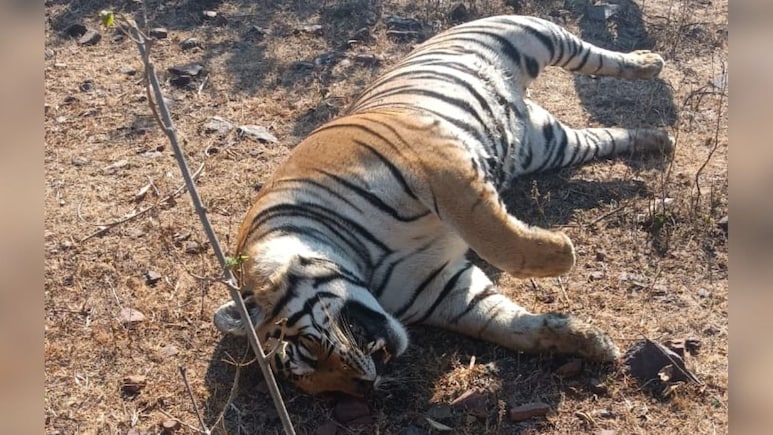
Another tiger death has been reported from Madhya Pradesh, pushing the total number of tiger fatalities in the state this year to 55, the highest ever recorded since the launch of Project Tiger in 1973. The latest case comes from the Bundelkhand region's Sagar district, deepening concerns over the state's failing protection mechanisms even as official narratives continue to celebrate rising tiger numbers.
An adult female tiger aged around ten years was found dead near Hilgan village on the Sagar-Dhana Road on Sunday. The carcass was spotted by villagers who immediately informed the forest department. The tiger was located within the Dhana Forest Range under the Sagar South Forest Division.
A forest department team led by Dhana Range Forest Officer Pratik Srivastava rushed to the spot and began preliminary investigations. While the exact cause of death will be determined only after the necropsy, senior forest officials said there were no visible injury marks or signs of poisoning. However, circumstantial evidence suggests the tigress may have been electrocuted by an illegal electric trap, commonly used by villagers to protect crops from wild boars and antelopes.
Officials are also examining whether the tigress had been residing in the area or had strayed from nearby reserves such as the Veerangana Durgavati Tiger Reserve or Panna Tiger Reserve.
According to data, 11 of the 55 tiger deaths recorded in 2025 have been classified as unnatural, with around eight linked directly to electrocution from illegal electric fencing or bush hunting.
Sharing a video of the dead tiger on social media, wildlife activist Ajay Dubey wrote, "When will this cycle of tiger deaths finally end? 55 tigers lost in Madhya Pradesh this year and there is a complete lack of accountability. Who will answer for this mounting crisis?"
Madhya Pradesh, long celebrated as India's "Tiger State", is now confronting a deeply troubling paradox. In just one week, six tigers have died across the state. On Saturday, another carcass was discovered in the Bandhavgarh Tiger Reserve, one of India's most prominent conservation landscapes. That tiger was found near a power line in the Chandia forest range of Umaria district, immediately raising suspicion of electrocution. Forest officials have said the possibility cannot be ruled out and the case is under investigation.
Official figures show a steady and alarming rise in deaths - 34 in 2021, 43 in 2022, 45 in 2023, 46 in 2024 and already 55 in 2025, with days still left in the year.
While the Forest Department has often attributed many of these deaths to territorial fights between tigers, conservationists argue that poaching, electrocution, weak surveillance and procedural negligence are far more significant factors.
Last year, an internal forest department report accessed by NDTV highlighted serious lapses in the handling of tiger death cases in major reserves like Bandhavgarh, including failures to file preliminary offence reports, post-mortems conducted without videography, incomplete forensic investigations, and routine classification of deaths as "animal fights" without proper examination.
The larger threat of organised wildlife crime was underscored earlier this month with the arrest of Yangchen Lakhungpa, an alleged international wildlife trafficking kingpin wanted under an Interpol Red Corner Notice, in a joint operation by the MP Tiger Strike Force and the Wildlife Crime Control Bureau. Investigators said his network spanned India, Nepal, Tibet and China.
Minister of State for Forests Dilip Ahirwar said the department treats every tiger death seriously and assured that expert teams investigate each case. Conservationists argue that the crisis is systemic not incidental, and that without structural reforms in enforcement, compensation, surveillance and accountability, the deaths will continue.
Track Latest News Live on NDTV.com and get news updates from India and around the world

