






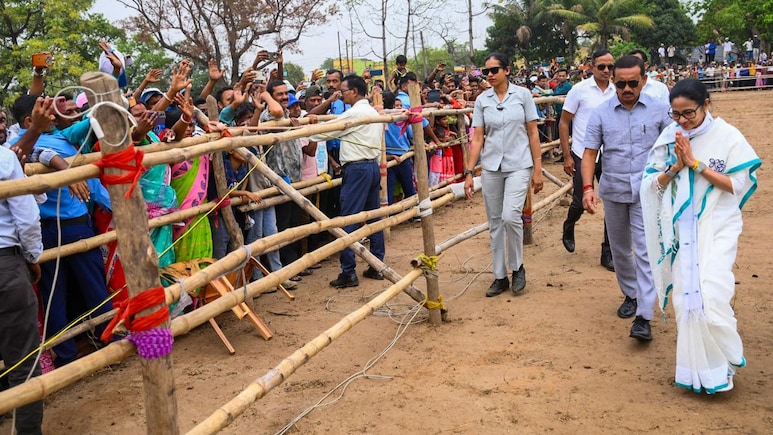
West Bengal politics continues to shock and surprise every day following the historic electoral upset in May, when the BJP secured a massive victory of 208 seats, ending the 15-year Trinamool Congress rule. The Trinamool has since fragmented. On June 14, 20 of its 28 Lok Sabha MPs led by Kakoli Ghosh Dastidar rebelled and sought to merge with the NCPI (Nationalist Citizens Party of India) to support the NDA.
Several Rajya Sabha members too have resigned from the Trinamool.
Earlier, soon after the results, around 58 to 60 of the party's 80 MLAs submitted letters to the Assembly Speaker supporting expelled leader Ritabrata Banerjee. Reports suggest more than 100 Trinamool councillors left municipal bodies across the state. So, the disintegration is across all levels.
The dramatic collapse of the Trinamool in West Bengal following the poll defeat has reignited a debate - was the party's collapse inevitable because it never possessed a coherent ideological foundation of its own?
The answer is partly yes, but not entirely. The Trinamool's current crisis appears to be the consequence of a political model built more around cult leadership, welfare populism and anti-Left sentiment than around a durable ideological framework. Such a model can deliver electoral victories for years, but it becomes vulnerable once power is lost. There is also a lesson for other regional parties.
Fragility of slogans
The slogan 'Maa, Maati, Manush' was one of the most powerful political slogans in modern Indian politics. It helped the Trinamool mobilise public anger against the Left Front over Singur, Nandigram, land acquisition and perceived political arrogance. The slogan became synonymous with grassroots empowerment and ultimately helped bring the Trinamool to power in 2011.
To be fair to the Trinamool, the party did cultivate a distinctive political identity based on Bengali regional pride, welfare-oriented governance and opposition to what it portrayed as excessive centralisation from New Delhi. Alas, simultaneously, Trinamool local strongmen and goons established a parallel governance structure in West Bengal by controlling local economies through extortion rackets.
They enforced a system where citizens and businesses were forced to pay unofficial 'taxes', fundamentally looting public funds and resources.
After fifteen years in power, the Trinamool faced the same challenge that every long-ruling party faces - perceptions of arrogance, factionalism and distance from ordinary citizens. The anti-establishment movement gradually became the establishment itself. Besides, the majority of Trinamool cadre were political turncoats from CPM and other parties, thus loyalty factor was missing.
A slogan succeeds when people believe it represents a mission.
A slogan fails when people begin to see a gap between the promise and reality.
People eventually became more concerned about jobs, industrial investment and youth migration than about symbolic political battles. When young people feel compelled to seek opportunities elsewhere, emotional appeals about regional pride become less persuasive.
Core ideological pillars
A party held together by ideology can survive electoral defeats because members remain committed to a larger cause. The BJP survived decades on the margins in the states and at national level before coming to power. The Left in Bengal survived several electoral setbacks because cadres remained ideologically motivated.
Many regional parties in India are built around charismatic leaders. The Trinamool's experience resembles that of the BRS (Bharat Rashtra Samithi) in Telangana.
The BRS dominated Telangana politics for nearly a decade. Its central narrative was statehood and regional pride. Once that mission was accomplished and governance issues became dominant, the party's aura weakened considerably. A movement can win power. Ultimately, the government must deliver.
Contrarily, the DMK offers an interesting contrast. Whether one agrees with its ideology or not, it possesses a clear ideological framework rooted in the Dravidian movement, social justice and Tamil identity.
As a result, the party often survives setbacks because supporters see it as more than an election machine. This is why ideology matters. Not because ideology wins every election, but because it helps parties survive defeats.
In Maharashtra, the continuing friction in the Shiv Sena UBT is a classic example of ideological shifts and controversial leadership decisions. There are sparking rumours of 'Trinamool -style' rebellion and potential crossovers to the rival Eknath Shinde Sena.
The recent mass defection of 7 out of 10 AAP (Aam Aadmi Party) Rajya Sabha MPs, who merged with the BJP, is another example of vanishing ideology. Defecting leaders openly cited toxic work environments, suppression of hard work, and a departure from the party's core founding principles as the primary reasons for their exit.
The regional parties in north India like Janata Dal United and Rashtriya Janata Dal in Bihar and Samajwadi Party in Uttar Pradesh have survived because of their core ideology rooted in socialism, secularism, and social justice.
Over years, through various social coalitions, they have managed to develop their traditional vote banks.
The events of 2026 may ultimately be remembered as a lesson for regional parties across India. Charismatic leadership can build a movement. Welfare schemes can create a voter base. Electoral victories can sustain unity. But when defeat arrives, only strong institutions and a shared ideological commitment can keep a party together. Indian voters are among the most politically aware in the world. And no party is invincible.
The Trinamool's implosion suggests that for many within the organisation, power was the glue. Many of those who later rebelled had previously benefited from the Trinamool's expansive coalition-building strategy. Once the party lost power, the incentives that had united disparate factions weakened dramatically. Once that glue called 'power' dissolved, the structure collapsed like a pack of cards.
(The author is Contributing Editor, NDTV)
Disclaimer: These are the personal opinions of the author

