





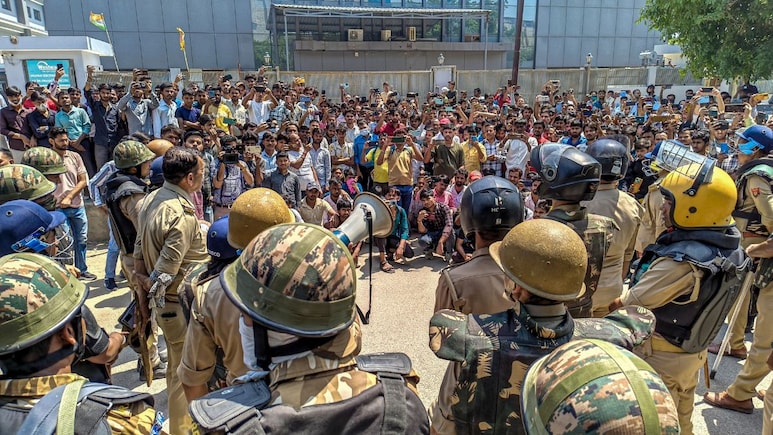
- Rising fuel and logistics costs strain Noida factories amid Strait of Hormuz crisis
- India's blue-collar workforce participation fell 5.6% from Q1 2025 to Q1 2026
- India imports 87% of crude, making economy vulnerable to supply disruptions
What's breaking in the Strait of Hormuz may first surface in a place like Noida, not on trading screens but on factory floors where the pressure is already building.
As crude flows face disruption around Hormuz, manufacturers in the National Capital Region are being hit by rising fuel and logistics costs at the same time as wage pressures intensify.
The result is a slow squeeze that is beginning to show up in production lines.
The stress is landing on a workforce that is already losing momentum. India's blue collar base, estimated at around 300 million by Apna, a job portal, has seen a sharp reversal in participation trends on its platform, swinging from a 2.5 percent increase in the first quarter of 2025 to a 5.6 percent decline over the same period in 2026, according to data cited by the platform's chief executive in an Economic Times report.
That shift is now colliding with higher input costs, making it harder for factories to absorb shocks.
Also read: Pay Hike Demand, 300 Arrests, Pak Link Under Probe: The Violent Noida Protest
India's exposure is structural. It imports up to 87 percent of its crude, leaving the economy highly sensitive to global supply disruptions. As oil prices rise and the rupee remains under pressure, the current account deficit widens quickly.
Inflation risks stay elevated, limiting the ability of policymakers to respond without triggering further instability. The stress is no longer just theoretical.
Analysts say the market is already short by as much as 10 to 12 million barrels per day, a gap that cannot be easily filled. "No country can fulfil that 10 per cent loss," says Abhishek Kumar of Sparta Commodities, warning that unless demand drops sharply, benchmark prices near 150 dollars a barrel are well within reach.
India is also likely to see below average annual monsoon rains for the first time in three years, stoking concerns over farm output.
"March inflation numbers were modestly higher, signalling the first round of price pressures in wake of the Middle East crisis," Radhika Rao, economist at DBS Bank, said in a note.
In Europe, the messaging has already turned stark. Ursula von der Leyen warned, "Stay home, don't drive, don't use electricity." The remark reflects how few immediate levers governments have as the crisis deepens.
The scale of disruption is historic. The International Energy Agency has cautioned that "oil prices don't yet reflect the severity" of the crisis. Executive Director Fatih Birol said about 13 million barrels per day of supply has been shut in, with more than 80 energy facilities damaged and recovery timelines stretching up to two years.
Markets are still lagging the reality on the ground.
PIMCO warned, "It's not the oil spike that breaks risk appetite, it's how long it sticks around." The firm noted that current price trends resemble the early phase of the 1990 Gulf War, when the deeper financial shock only came later as disruption persisted.
"Time is not your friend," the report added.
In the physical market, the strain is already visible.
Analyst Vinod Sreenivasan in an X post says, "Pre war deliveries into Asia stopped around April 1," adding that current cargoes were loaded before February 28 and "once that clears, refineries start cutting runs."
He pointed to a widening gap between paper and physical markets. "Brent futures: about 100 dollars. Forties Blend spot: about 149 dollars. That gap is refiners fighting each other for whatever physical barrel exists right now," he wrote, adding, "Futures price risk. Spot prices desperation."
There are buffers, but they are finite. "IEA members have committed 400 million barrels of emergency reserves," Sreenivasan noted, while warning the system is "under strain." He added, "If the blockade lasts more than three months, jet fuel gets rationed. Then diesel."
Track Latest News Live on NDTV.com and get news updates from India and around the world

