





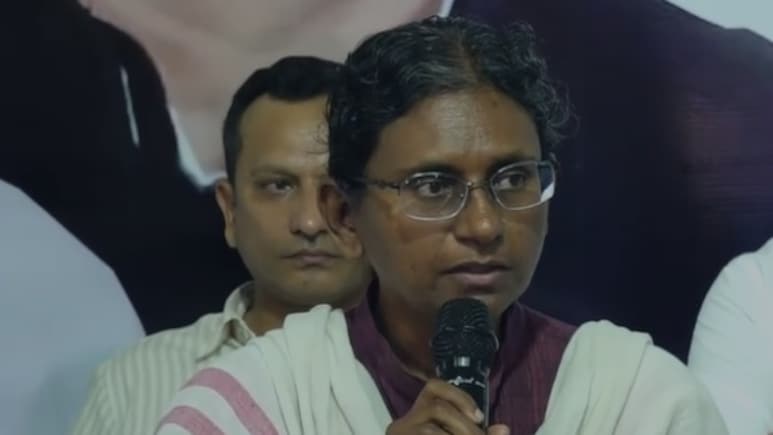
The controversy surrounding the rejection of Congress leader Meenakshi Natarajan's Rajya Sabha nomination from Madhya Pradesh has now reached the Election Commission (EC), with the Congress demanding that the poll body use its constitutional powers under Article 324 to overturn the Returning Officer's (RO) decision.
The development has triggered a legal and constitutional debate over the scope of the Election Commission's powers and whether it can intervene in a nomination dispute before the election process is completed.
What Is The Dispute?
Meenakshi Natarajan's nomination papers for the Rajya Sabha election were rejected by the Returning Officer on Tuesday. According to the RO, the Congress candidate failed to disclose details of a pending court case in Telangana in her election affidavit, a mandatory document filed during the nomination process.
Congress has strongly contested the rejection, arguing that the alleged omission does not attract disqualification under election laws.
After meeting Election Commission officials on Wednesday, senior Congress leader and lawyer Abhishek Manu Singhvi said the Returning Officer had misapplied the law.
"The EC's own law under Section 33A requires disclosure only in cases where charges have been framed by a court and where the offence carries a punishment of two years or more," Singhvi argued.
He maintained that merely filing a private complaint or the existence of a case at a preliminary stage does not automatically require disclosure.
Why Is Congress Invoking Article 324?
Congress has urged the Election Commission to exercise its powers under Article 324 of the Constitution and provide immediate corrective relief.
Article 324 vests the Election Commission with the power of "superintendence, direction and control" over elections in India. The provision is often described as the constitutional foundation of the EC's authority to ensure free and fair elections.
According to Singhvi, if a Returning Officer has wrongly rejected a nomination, the Commission has sufficient powers to intervene rather than forcing a candidate to wait until after the election process is over.
He argued that Article 324 allows the EC to take corrective action when an election official's decision undermines the fairness of the electoral process.
What Have Courts Said About Article 324?
The Supreme Court has repeatedly held that Article 324 gives the Election Commission broad powers, but not unlimited powers.
In the landmark case of Union of India vs Association for Democratic Reforms (2002), the Supreme Court described Article 324 as a "reservoir of power" that enables the Election Commission to act when existing laws are silent and when intervention is necessary to ensure free and fair elections.
However, the Court also made it clear that these powers cannot be used to override specific legal provisions or to perform functions assigned to other institutions.
Legal experts point out that Article 324 is generally invoked to fill gaps in election law, not to replace statutory remedies that already exist.
Why Experts Say EC May Be Reluctant
Supreme Court Advocate Prateek Kumar believes the Congress faces a legal hurdle in seeking relief through Article 324.
According to him, Article 324 is typically used when there is a vacuum or absence of legal provisions governing a particular situation. In the present case, election law already provides a remedy through an Election Petition.
Under the Representation of the People Act, a candidate can challenge the rejection of a nomination before the High Court through an Election Petition after the election process concludes.
"The law already provides a mechanism to challenge a Returning Officer's decision. Therefore, it may be difficult to argue that there is a legal vacuum requiring Article 324 to be invoked," Kumar said.
He added that if the Election Commission routinely overturned Returning Officers' decisions under Article 324, political parties and candidates across the country could begin approaching the Commission in every nomination dispute, potentially disrupting the established legal framework.
Has The EC Used Article 324 Before?
Yes, though such instances are rare.
One of the most prominent examples came during the 2017 Rajya Sabha election in Gujarat, when the Election Commission invoked Article 324 to invalidate votes cast by two Congress MLAs after finding that election rules had been violated.
That election saw late Congress leader Ahmed Patel secure victory, while BJP candidates Amit Shah and Smriti Irani were also elected.
The case is now being cited by Congress as an example of the Election Commission exercising its extraordinary constitutional powers to correct what it viewed as an electoral irregularity.
What Happens Next?
The Election Commission is examining the Congress representation and seek the Returning Officer's report before taking any decision.
However, legal experts say that unless the Commission finds extraordinary circumstances warranting intervention, it may choose to uphold the Returning Officer's decision and leave the matter to judicial review through an Election Petition.
Track Latest News Live on NDTV.com and get news updates from India and around the world

