





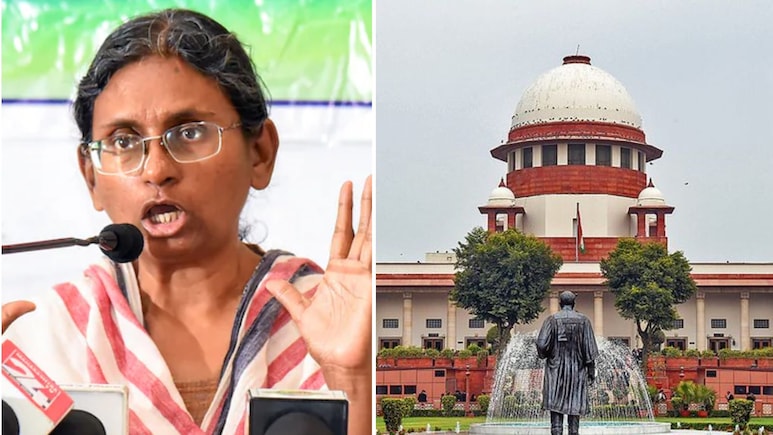
The rejection of Congress leader Meenakshi Natarajan's Rajya Sabha nomination from Madhya Pradesh has turned into a test case on how far a Returning Officer can go while scrutinising nomination papers. What defects are substantial, and whether the "benefit of doubt" should have gone to the candidate?
The Supreme Court, while rejecting Natarajan's petition, said that courts usually do not interfere once the election process has begun. In such cases, the court indicated the remedy lies in filing an election petition before the concerned High Court.
What Is An Election Petition?
An election petition is the legal process through which the validity of the result of a Parliament, Assembly or local body election is examined. In simple terms, it is the statutory way to challenge the election of a returned candidate.
Under the Representation of the People Act (RP Act), 1951, Section 80 provides that no election shall be called in question except by an election petition. Section 80A gives the High Court the jurisdiction to try such petitions. Section 81 provides that an election petition has to be filed within 45 days from the date of election of the returned candidate.
Section 100 (1)(c) of the RP Act, 1951 states that if any nomination has been improperly or wrongfully rejected, the election of the returned candidate can be declared void by the court.
This is why, despite the Supreme Court setback, the Congress still has one legal option open - an election petition before the Madhya Pradesh High Court.
The Case Of Meenakshi Natarajan
BJP candidates Tarun Chugh, Rajneesh Aggarwal and Mahesh Kewat have already been declared elected unopposed on all three Rajya Sabha seats from Madhya Pradesh after Natarajan's nomination was rejected.
The controversy began with a complaint filed by BJP State General Secretary Rahul Kothari before the Returning Officer. The complaint alleged that Meenakshi Natarajan had been named as accused number four in a private complaint pending before a Hyderabad court and that she had not disclosed this information in Form 26 filed along with her nomination papers.
After hearing the objection, Returning Officer and Principal Secretary of the Madhya Pradesh Legislative Assembly Arvind Sharma rejected Natarajan's nomination. In his order, he said that the available records showed that the court had taken cognizance of the concerned case, summons had been issued to the candidate and she herself had also filed a reply in that case.
But now the Election Commission handbook and its scrutiny guidelines have become central to the argument.
What Do The Rules Say
Bhagwandev Israni, the former Principal Secretary of the Legislative Assembly who also served as Secretary of the Chhattisgarh Legislative Assembly, has conducted several elections and served as Returning Officer on many occasions. Israni says the rejection of a nomination paper is not supposed to be mechanical or casual.
According to Israni, the handbook is not a decorative manual. It is meant to guide the Returning Officer through every stage of nomination scrutiny.
"The handbook provides detailed information on every aspect. Regarding the judgment in question, it was delivered under Section 10(13) of Chapter 6. However, in my view, it was incorrect to consider the matter based on that provision alone. Sections 12 and 13 concerning affidavits are interconnected and should be read together. The rules stipulate that if a discrepancy is noted, a reminder should be issued," Israni said.
The provision which appears to have weighed against Natarajan is Chapter 6, para 10(13) of the handbook. It states that incomplete affidavits are liable to be rejected, leading to rejection of the nomination paper, if all columns in the affidavit are not filled even after reminders. The provision draws strength from the Supreme Court's view that voters have a right to know full particulars of a candidate.
But Israni argues that para 10(13) cannot be read in isolation. According to him, the handbook also contains safeguards against wrongful rejection of nomination papers.
He points to another provision dealing with defective affidavits. Para 10(12) says that where the prescribed affidavit has not been filled at all, or where the affidavit has been filed but is found or considered defective or containing false information, the nomination should not be rejected on that ground alone.
This, Israni argues, means the Returning Officer must examine whether the defect is substantial, whether it is curable, whether a reminder was issued, and whether the candidate was given a fair chance.
The former officer also refers to para 9(1) of the handbook, which cautions Returning Officers against rejecting nomination papers for minor or technical defects.
"There are significant errors here. In my 40-year career, having conducted numerous elections and served as a Returning Officer many times, I have never rejected a single nomination paper. Para 9(1) says do not reject any nomination paper on ground of any defect which is not of substantial character. Any mistake or error of technical or clerical nature should therefore be ignored," Israni points out.
He further cites para 6(6), which lays down one of the most important principles in nomination scrutiny - every nomination paper is presumed to be valid unless the contrary is obvious.
"Para 6(6) says there is a presumption that every nomination paper is valid unless the contrary is prima facie obvious or has been made out. In case of a reasonable doubt as to the validity of a nomination paper, the benefit of such doubt must go to the candidate concerned," Israni said.
Rule On Declaring Criminal Case
The legal issue also revolves around Section 33A of the Representation of the People Act, 1951. Section 33A deals with disclosure of criminal antecedents by a candidate. Broadly, a candidate is required to disclose information where he or she is accused of an offence punishable with imprisonment of two years or more and where charges have been framed by a competent court, or where the candidate has been convicted and sentenced to imprisonment of one year or more.
Israni says this provision is critical. "Based on the documents I have reviewed and the provisions of Section 33A of the RP Act, 1951, disclosure is mandatory only if a person has committed an offense punishable by more than two years of imprisonment where a chargesheet has been filed and charges framed or if they have been convicted and sentenced to one year or more in a criminal case. Otherwise, disclosure is not required. Yet, in this instance, the issue is being raised despite the fact that cognizance of the alleged offence was never taken," he said.
Another legal point raised by Israni relates to Section 223 of the Bharatiya Nagarik Suraksha Sanhita. According to him, the notice received in the Hyderabad matter was based on Section 223, which itself says that a Magistrate cannot take cognizance of an offence without first giving the accused an opportunity of being heard.
"Yet, in this case, cognizance was taken without such an opportunity. The judgment fails to specify the grounds upon which that cognizance was based."
According to Israni, if the very stage of cognizance is legally disputed, then the matter could not have been used as a clear ground to reject the nomination.
Vivek Tankha Vs Vinod Gotia Example
Israni also recalls his own experience from a previous Rajya Sabha election involving BJP candidate Vinod Gotia and Congress candidate Vivek Tankha.
"I conducted the final election involving Vinod Gotia against Vivek Tankha. There were heated arguments involving prominent lawyers. If Vinod Gotia's form had been rejected, Vivek Tankha would have won unopposed. However, we allowed the contest despite minor errors in Gotia's form. We did not reject the nomination," he recalled.
He says the only legal remedy for Natarajan now is an election petition.
The Congress' Case
Senior lawyer Ajay Gupta, associated with the Congress, also says that the document relied upon against Natarajan did not describe her as an accused.
Gupta says that they had presented a detailed legal argument before the Returning Officer. According to him, the document in question uses the term "Respondent," whereas words like "Accused" are used in criminal cases.
"This fact alone demonstrates that characterizing the matter as a criminal case is both factually and legally incorrect," Gupta argues.
The Congress maintains that Natarajan was not required to disclose the Hyderabad matter in Form 26 because it did not fall within the disclosure requirement under Section 33A of the RP Act, 1951.
BJP Defends The Rejection
Madhya Pradesh Chief Minister Dr Mohan Yadav has defended the process and accused the Congress of attacking constitutional institutions after its defeat.
Dr Yadav reiterated that following its defeat, the Congress is leveling allegations against the Election Commission and the judiciary. "The party needs to introspect and respect democratic processes". He has maintained that in a democratic system, the seriousness and transparency of the election process are supreme. According to him, if a candidate deliberately conceals important facts, it is not in keeping with democratic values.
NDTV tried to meet Principal Secretary of the Madhya Pradesh Legislative Assembly and Returning Officer Arvind Sharma, both by phone and at his office several times over the last three days. However, he did not speak to NDTV.
Track Latest News Live on NDTV.com and get news updates from India and around the world

