







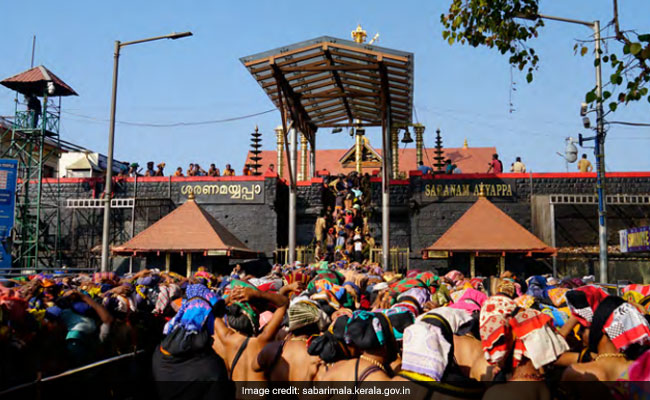
On a hill in Kerala, a centuries-old tradition recognised as a customary law barred women of menstruating age from entering a temple. In 2018, the Supreme Court struck it down. The country was convulsed. Review petitions soon flooded the Supreme Court. A nine-judge bench was constituted to look at larger questions of law and religion. Seven years later those nine judges are examining questions that reach far beyond one shrine, one community, and one set of beliefs.
One of the critical questions that the court has framed for arguments is its own power of judicial review. It is a power that the Constitution gave to the judiciary and that no subsequent parliament has been able to take away. Understanding that power, what it is, why it exists, and why it is especially indispensable when religion is involved is essential to understanding what the nine-judge bench is truly doing.
What Is Judicial Review?
Judicial review is the authority of the Supreme Court and high courts to examine whether a law enacted by parliament or a state legislature, or an action taken by the executive, is consistent with the Constitution. If it is not, the court may strike it down. The law ceases to exist, not because a new law was passed against it, but because the Constitution rendered it void.
The phrase itself does not appear anywhere in the Constitution. It does not need to. It is embedded in the document's architecture. Article 13 declares that any law inconsistent with or in derogation of fundamental rights shall be void. Articles 32 and 226 give the Supreme Court and high courts the authority to enforce fundamental rights. The Supreme Court can exercise its special plenary powers under Article 142 to take any action to impart "complete justice" in any matter.
In the decades after Independence, parliament and the Supreme Court were engaged in a sustained tug-of-war. Parliament repeatedly amended the Constitution to override court decisions, particularly on property rights and land reform. The court pushed back.
In 1973, in Kesavananda Bharati v State of Kerala, a 13-judge bench settled the matter in terms that have never since been disturbed: Parliament may amend the Constitution, but it may not damage its basic structure. Judicial review, the court held, is part of that basic structure. No legislature can remove it. No executive can override it.
That verdict is the floor beneath all of constitutional law. Everything that has followed: Shah Bano, Shayara Bano, Sabarimala, and now the nine-judge bench, adjudicates on the limits judicial review rests upon.
Can Courts Interfere In Religion?
Ever since the nine-judge bench hearing began at the Supreme Court, we have heard it repeatedly from the Centre represented by Solicitor General Tushar Mehta that the court should not interfere in any matter that is to do with religion. In other words, he argued that there should be a hands-off approach by the judiciary when it comes to religions and religious practices. With that in mind, the Supreme Court would have never struck down "triple talaq" or given Shah Bano her right to maintenance in 1985, and with that approach Mary Roy as a Syrian Christian woman would have never got an equal share in inheritance.
Many judges on the bench have argued that they cannot look at every religious practice with a judicial lens and religion must be understood by the eyes of a devotee. And one agrees, religion can only be judged, understood and reformed by a devotee or the state. But judicial review ought to be understood in its own context. There is already a line that the courts have drawn for themselves; it's called the Essential Religious Practice Test which originated in the famous case of Shirur Mutt and has been used ever since.
The Essential Religious Practices Doctrine
The ERP doctrine was not born of a petition challenging discrimination or gender exclusion but from a dispute about money and management. When Shirur Mutt challenged a legislation regulating Hindu religious endowments in the early 1950s, the question before the court was whether that legislative intervention violated the denomination's rights under Article 26. It was the then Attorney General, defending the government's legislation, who introduced the ERP doctrine. His purpose then was to give the court a principled basis on which it could uphold what the state legislature had done and not to open a new avenue of judicial supervision over religious life.

The test he proposed was simple and bounded: distinguish between the genuinely religious activities of a denomination and its essentially secular activities such as the administration of property and funds. The ERP doctrine was the line between those two categories. It was designed to save legislative reform from being challenged under Article 26. That was its purpose and its limit.
The pattern across the post-Independence decades confirms this. In Devaru, the court upheld the Madras Temple Entry Authorisation Act, finding that the state's power of social reform under Article 25(2)(b) could override a denomination's claim to manage its own affairs. In Ratilal, careful lines were drawn between protected religious administration and regulable secular management. Across a dozen such disputes, the court consistently used the ERP test to uphold legislative intervention, not to resist it.
What these cases share is a common structure. A religious institution challenged that action and the court adjudicated the boundary between what the state could and could not regulate. The individual devotee, the woman denied entry, the community member facing expulsion, was nowhere in this picture. The doctrine was forged in litigation between the state and religious institutions. Its application to claims brought by individuals against discriminatory practices is a later development, and one that requires far more justification than has typically been offered.
The Drift And Its Consequences
Over time, the ERP test migrated from its original institutional context into a broader role. Courts began applying it as a threshold inquiry in all religious practice cases, not merely those involving legislative challenge. A practice found to be essential came to be treated, in some formulations, as though it were insulated from further fundamental rights scrutiny. The doctrine designed to protect reform gradually acquired the character of a defence against it.
By the time Sabarimala came before the court in 2018, the ERP test was being asked to resolve a dispute it was never designed for: not between the state and a religious institution over the reach of legislation, but between individual women devotees and a denomination that denied them entry. No legislature had acted. No statute was under challenge. The test was carrying weight it was not built to bear.

The concern about the use of public interest litigation to challenge religious practices is not without foundation, and the court is right to apply careful scrutiny to the standing and bona fides of petitioners. A petition brought by someone with no genuine connection to the faith, no personal stake in the practice, and no authentic claim of harm raises real questions about the appropriate role of constitutional litigation. The court has the tools to filter such petitions, and should use them. But this caution goes to the manner of engagement, not its legitimacy.
A genuine constitutional question does not disappear because it was imperfectly framed or brought by a petitioner of doubtful standing. However, before the court, the question stands on its own and the court's obligation to address it remains.
Plainly speaking, all religious practices are in principle subject to constitutional challenge. Article 25 says so in its own text, through its express limitations of public order, morality, health, and the other fundamental rights under Part III of the Constitution of India.
The court has exercised that jurisdiction, with consistent restraint, and should continue to do so. The ERP doctrine is a useful instrument within its proper domain. It is not and was never intended to be a general immunity from constitutional scrutiny. Treating it as one would turn a tool built to advance reform into a device for resisting it.

