






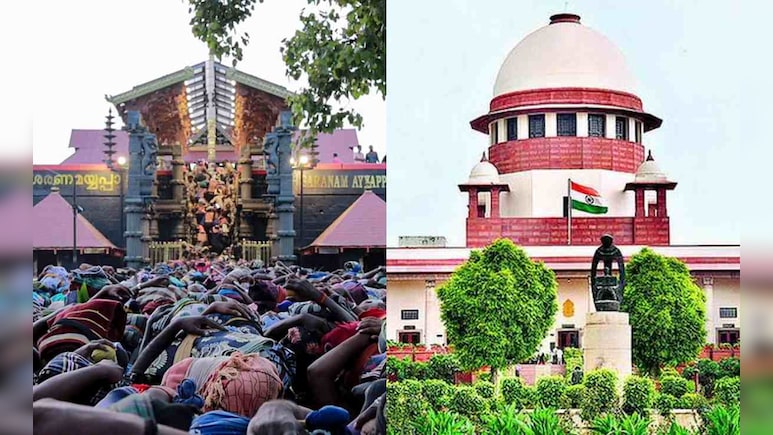
At a critical juncture in India's constitutional journey, the proceedings before the Supreme Court of India signal far more than a continuation of the controversy surrounding the Sabarimala Temple. What is presently in progress before nine judges is a deeper judicial interrogation of the constitutional boundaries itself.
It seeks to delineate the contours of religious freedom while testing its limits against the guarantees of equality, dignity, and individual autonomy.
While engaging with these questions, the Supreme Court is not merely revisiting a prior judgment, but is poised to clarify enduring tensions that have historically remained unresolved in the evolution of India's rights-based jurisprudence.
The proceedings before the nine-judge bench, though triggered by the review of the Sabarimala Temple verdict, are in substance a far-reaching constitutional inquiry into the relationship between religious freedom and fundamental rights. As the seven framed questions are examined, the court is not merely revisiting temple entry but is effectively setting the doctrinal boundaries that will govern a range of pending and future disputes involving gender justice across communities.
This includes challenges to practices affecting wmen of the Dawoodi Bohra community (such as excommunication and female genital mutilation), the rights of Parsi community women who marry outside the faith, and broader questions concerning equality within Muslim personal law impacting women.
The constitutional framework will determine whether claims of denominational autonomy can continue to shield discriminatory practices, or whether constitutional morality and equality will prevail, thereby giving this hearing consequences that extend well beyond Sabarimala and into the core of gender rights jurisprudence in India.
This article marks the opening of a special five-part series that seeks to closely examine the constitutional significance of the ongoing nine-judge bench proceedings before the Supreme Court of India.
The series will systematically unpack how the Supreme Court's determination on the seven questions is poised to recalibrate the delicate balance between religious freedom and fundamental rights across diverse communities. Each subsequent part will analyse specific fault lines, ranging from denominational autonomy to the extent of judicial review over personal laws and trace their implications for questions of gender justice, equality, and reform.
In doing so, the series aims to situate the present hearing within the larger constitutional trajectory, demonstrating that what is at stake is not merely the resolution of a single dispute, but the shaping of a jurisprudential framework that will govern the interface between faith and rights in the years to come.
The seven substantive questions of law that the Supreme Court nine judge bench is hearing presently seek to clarify the scope of religious freedom and conscience under the Constitution of India, rights of denominations, and how religious freedom interacts with the other rights under Part III of the Constitution. The questions emanated from the Sabarimala review petitions that challenged the judgment of the Supreme Court allowing the entry of women at the Sabarimala shrine.
A cursory look at the questions would give us an impression that these questions do not affect the rights of women. To put it accurately, none of these questions directly refer to the rights of women. After all, women enjoy right to equality as enshrined in Article 14 of the Constitution. One would assume that the debate that women should have equal rights is settled and over. But dig a little deeper and one would realise that the present debate will have huge implications for women as they negotiate their rights within society and religion.
It is one thing to say that the Constitution protects the right to equality of women in civil and administrative affairs. But a deeply religious society like India held on to customary beliefs and practises believe that women can never occupy places of leadership within religious institutions.
A woman cannot be a Shankaracharya of a math, she can never be a Shahi Imam, can never be a Pope and so on. While clothed differently, the reason for inequality of women is because they menstruate.
Menstruation aside, even some customary laws like Muslim personal laws or the Shariat laws that are protected under the Constitution are highly discriminatory.
All communities and religions protect these laws and customs under Article 25 of the Constitution which imparts them freedom to practise their faith, and under Article 26 that allows denominations to manage their own religious affairs.
Post-independence, the Union and state government brought in a series of legislations that sought to regulate the affairs of the religious institutions like Hindu mutts, dargahs, among others. All these legislative interventions were challenged before the Supreme Court by the temple administration. In almost all instances, the Supreme Court upheld the intervention of the government and upheld the reform brought in by the government. The reform was sweeping in many cases.
Take the example of the famous case of Devaru (Sri Venkatarama Devaru and Others V State of Mysore and Others,1958). In this case the legislation allowed the entry of all "Hindus" to the temple (earlier the right was restricted).
If the religious denomination's right would have been protected in toto, then the Constitutional mandate that allowed the entry of all Hindus to the temples would have been defeated.
The Supreme Court upheld that Madras Temple Entry Authorisation Act that allowed the entry of all Hindus to the temple. In about a dozen such cases before the Supreme Court, the top court upheld the legislation of the state to give way to the reformist agenda.
Post-independence, the clash was between the state's intent to reform versus the religious institutions which asserted their rights to manage their own affairs. In this clash, it was reform that won, echoing the spirit of the constitution.
The Woman Question
The case of Shah Bano (1985), Shayara Bano or the triple talaq case (2017), Sabarimala Judgment (2018) are some rare instances where the Constitutional courts were directly confronted with the 'woman question'.
Will the Constitution protect such customs or practises that treat a woman as a second-class citizen? Are religions and denominations allowed to discriminate against women based on their gender? Can customary laws triumph over fundamental rights? Are fundamental rights limited for women, which means that fundamental rights can be asserted only in secular affairs but not in religious or social affairs?
So when the Supreme Court decides on scope and ambit of freedom of religion, it must be reminded that it is also dealing with the woman question. The social, educational and cultural development of women in the last five decades has ensured greater participation of women in all walks of life. However, religious institutions and customary practises continue to be violative of the right to equality and the reformist agenda has not touched that nerve of society.
Hence polygamy is allowed under Shariah law and is legally protected, Female Genital Mutilation is still in practice in certain communities, women can be excommunicated if they marry outside the community.
But the same logic does not apply to men. The sphere of religion and society is far away from equality.
So when the Supreme Court decides on the scope and ambit of freedom of religion and the right of denominations to manage its own affairs, it will inevitably lay down the foundations of law on which the future battles shall be fought. Right now, multiple petitions are pending before the Supreme Court where women have challenged discriminatory practices. Whether those practices shall be protected by Constitution, or the law will clear the way for reform is up to the nine judges to decide.
The present hearing by nine judges of the Supreme Court on the seven questions shall go much beyond Sabarimala.
(This is Part 1 of a 5-Part Series)
(The author is Contributing Editor, NDTV)

