





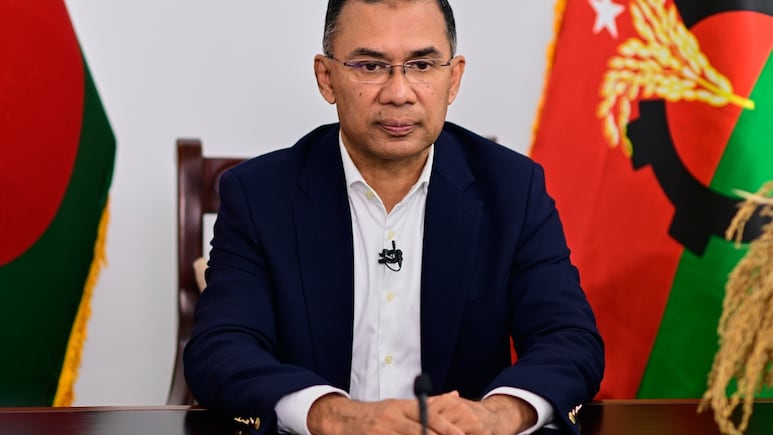
- Sources have told NDTV that Beijing is planning a bilateral visit by Rahman in late June
- PM Narendra Modi was among the first world leaders to congratulate Rahman and invite him to visit India
- Even if China hosts the first visit, an India trip may not be far behind
Bangladesh Prime Minister Tarique Rahman is preparing for his first official foreign visit since taking office in February, and the destination is already drawing strategic attention in both New Delhi and Beijing.
Sources in Bangladesh have told NDTV that Rahman's first overseas trip will be to an Asian country, with China and India emerging as the two most likely destinations. The choice carries significance, with both countries having invited the Bangladesh Prime Minister soon after he assumed office.
Sources have also told NDTV that Beijing is planning a bilateral visit by Rahman in late June. No visit to India has been announced so far.
Why The First Visit Matters
To put it in perspective, first visits often carry symbolic weight.
The diplomatic choices of the new government are also being compared with the previous interim administration led by Muhammad Yunus. Between 2024 and 2026, Yunus visited at least 13 countries, with China being his first major Asian stop.
Given the strained ties between India and Bangladesh, a visit by Yunus to India was never on the table, even though PM Narendra Modi and Chief Adviser Muhammad Yunus did meet on the sidelines of the BIMSTEC summit in Bangkok. But the situation is different now.
For Bangladesh, the decision will be closely watched as an early indicator of how the new government intends to balance ties with its two most important regional partners.
India moved quickly after the election result, with Prime Minister Narendra Modi among the first world leaders to congratulate Rahman and invite him to visit India.
Relations between the two neighbours, which had faced strain in recent years, have shown signs of improvement.
Bangladesh Foreign Minister Khalilur Rahman visited India in April, describing the atmosphere in New Delhi as one of convergence, with both sides “willing to engage, talk and take initiatives”.
He said bilateral ties were moving towards normalisation and that rebuilding trust would require patience rather than forcing the pace.
China has also stepped up engagement with the new political leadership in Dhaka. In April, BNP Secretary-General Mirza Fakhrul Islam Alamgir, widely seen as one of the most senior figures in the government, led a delegation to Beijing.
Bangladesh Foreign Minister Khalilur Rahman also travelled to China soon after.
China remains one of Bangladesh's largest development partners, with deep involvement in infrastructure projects and broader regional connectivity plans.
The Teesta Factor
One issue being watched closely from India's perspective is the Teesta River Comprehensive Management and Restoration Project.
During Foreign Minister Khalilur Rahman's recent visit to China, Bangladesh sought Beijing's involvement in the project.
India had earlier shown interest in partnering with Bangladesh on Teesta, but progress remained stalled for years because of opposition from the Mamata Banerjee-led West Bengal government.
With the BJP now in power in West Bengal, that political obstacle has changed. But Dhaka's outreach to China has added a fresh layer of complexity.
Speaking to NDTV, former Foreign Secretary and BJP Rajya Sabha MP Harsh Vardhan Shringla said, “The state of West Bengal under the Chief Ministership of Mamata Banerjee has consistently prevented the Centre from concluding the Teesta Agreement. I was the Joint Secretary dealing with Bangladesh and our neighbouring countries in 2011 when Dr Manmohan Singh was undertaking his historic visit to Bangladesh.”
“At that time, at the last moment, Mamata Banerjee refused to approve or be party to the Teesta Agreement. And keep in mind, water is also a concurrent subject in the constitution, and the state government has to be on board,” he added.
“In any case, the state government has to cooperate in implementing the treaty. She refused to do that and has consistently refused to do that since then. And there are no good substantive reasons for that,” Shringla said.
If Tarique Rahman visits China, there is likely to be a formal announcement on the Teesta River Comprehensive Management and Restoration Project (TRCMRP), and that would be closely watched in India, particularly because of the project's geographical proximity to the Siliguri Corridor.
Even if China hosts the first visit, an India trip may not be far behind.
In an exclusive interview with NDTV in April, indicating a clear willingness to hit a reset in ties, Bangladesh's foreign minister signalled that Dhaka does not see its diplomacy through a binary lens. Referring to China, he said Bangladesh did not view foreign policy as “a zero-sum game” and expressed hope that others would take the same view.
“Our relationship with other countries is not a problem,” he said, adding that trade imbalances were shaped by market forces rather than strategic alignment.
Track Latest News Live on NDTV.com and get news updates from India and around the world

