The Missile Is Dead. Long Live The Map: How Iran Invented 'Future Of War'
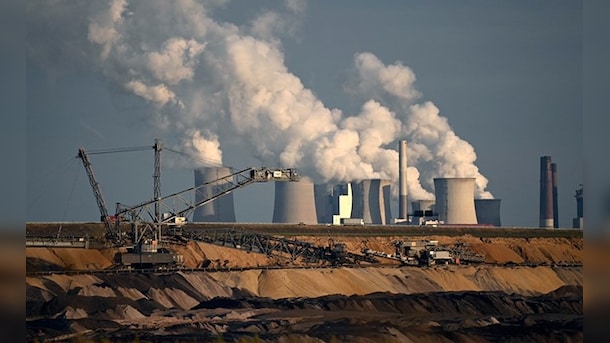
Iran's weaponisation of the Strait of Hormuz - squeezing energy flows and simultaneously threatening subsea cables - has re-introduced the world to structural leverage warfare and marked it as the future of conflict.
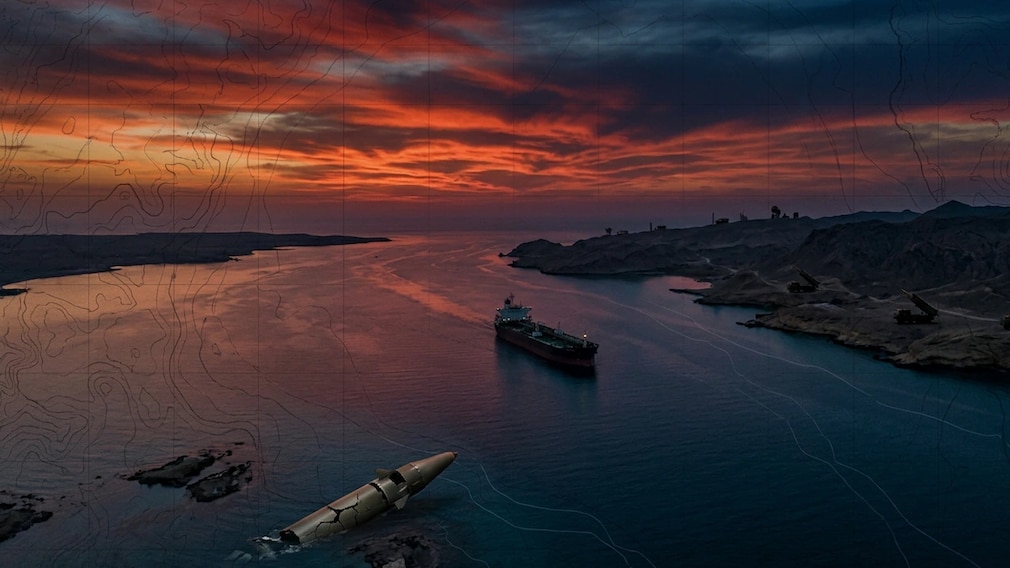
Iran's decision to tax the use of fibre-optic cables under the Strait of Hormuz - which transmit roughly 500,000 gigabytes of data an hour to ensure cross-continental internet links - reinforces a shift in the architecture and grammar of modern warfare.
Observers asking if Iran can legally charge for use of undersea digital cables, or demand a transit tax for oil and gas tankers sailing through the Hormuz, are asking the wrong question.
The right question is what Sparta's Leonidas already knew when he battled Xerxes at Thermopylae - it is not about the right to hold a chokepoint, only if you have the power - and the will.
That is because from a doctrinal perspective enforcing collections is secondary to Tehran having confirmed the ability to weaponise its geography and use it to hold two of the world's most critical streams - energy and data - simultaneously to ransom.
Taken together - squeezing oil and gas flow to create an energy crisis and threatening to disrupt global digital networks to cause hundreds of billions of dollars in damage - these underpin an evolving playbook on modern structural leverage warfare.
Weaponisation of position
This isn't new.
To understand what structural leverage warfare is, think of the Battle of Thermopylae in 480BC - how a small force, led by Leonidas of Sparta, held a mountain pass against the Persian Army.
The Greeks were outnumbered but used geography to multiply the effectiveness of superior armour and close-combat skills.
But by setting up at a physical chokepoint they funnelled the Persians into a tight space that neutralised Xerxes' forces' numerical superiority, archers, and cavalry.
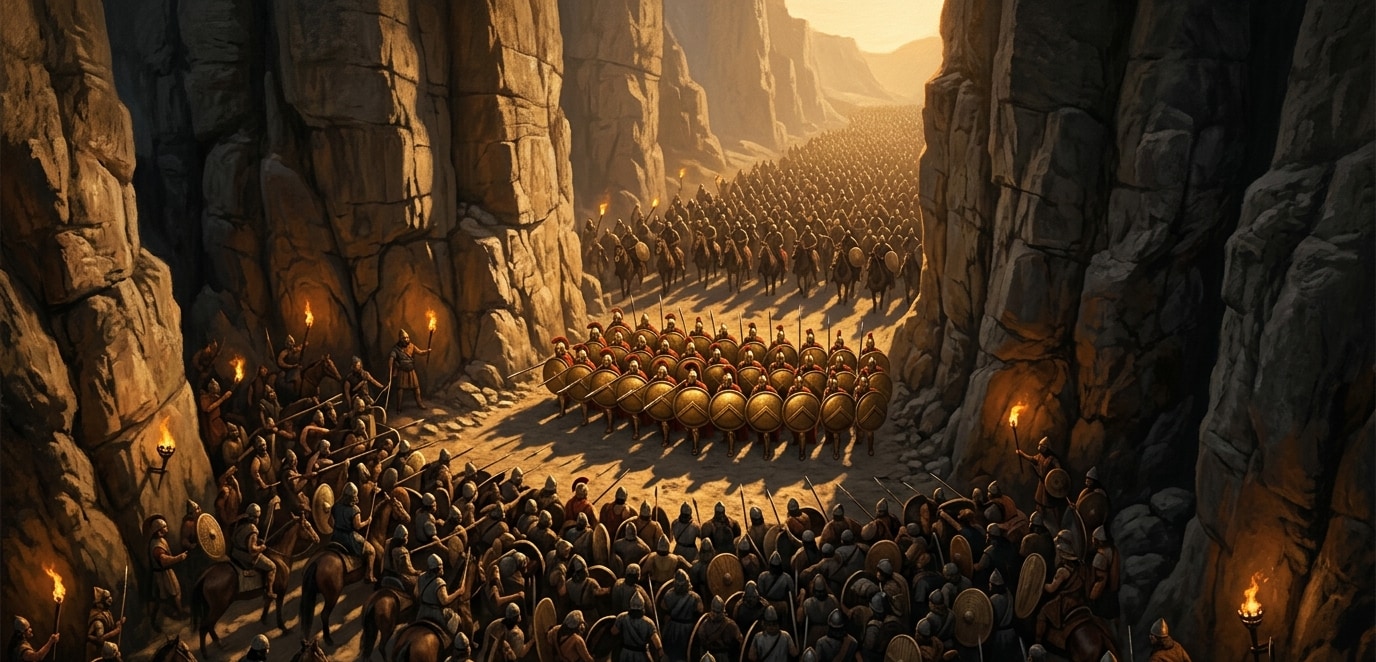
The Greeks vs the Persians at Thermopylae (Image generated by AI)
"This is Sparta!" Leonidas thundered in a cinematic re-telling of the battle, and so might the Ayatollah and his officials have shouted: "This is the Hormuz. And it belongs to Iran!"
The Romans served up another example in the Punic Wars, when they reportedly salted fields outside Carthage to destroy its economy and assert economic superiority in the Mediterranean.
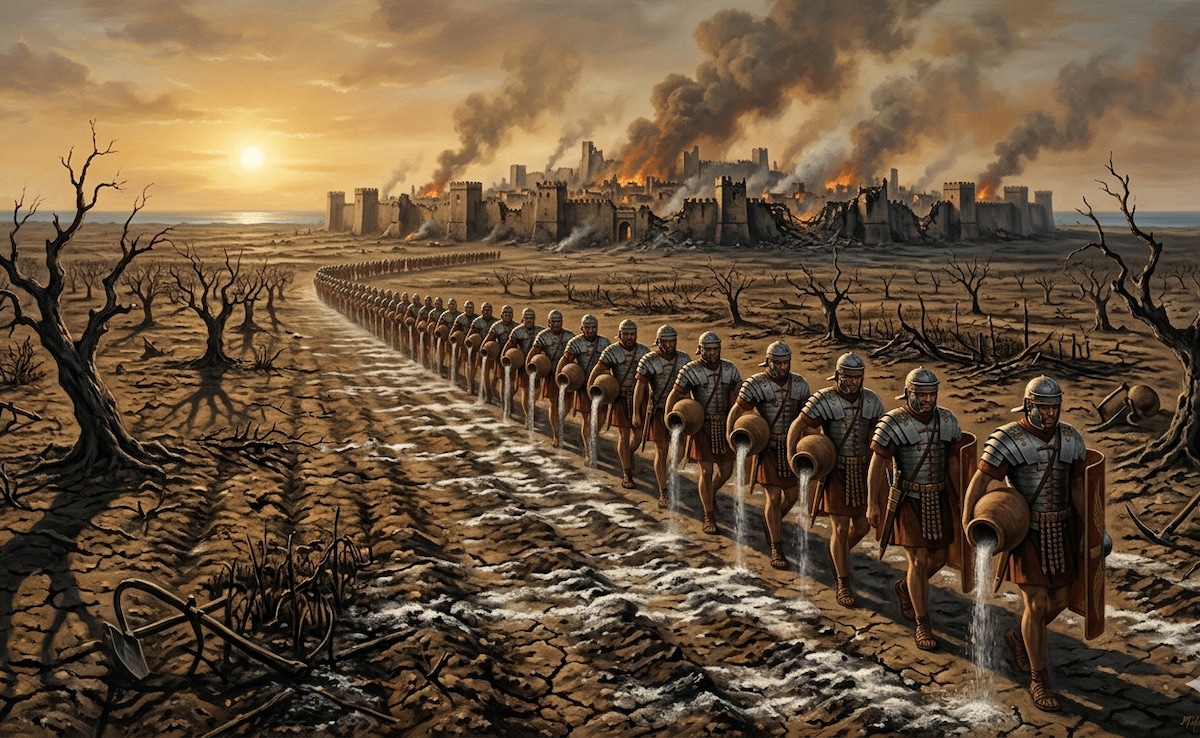
The Romans reportedly salted the fields at Carthage (Image generated by AI)
In the 19th century Napoleon I weaponised trade by forbidding mainland Europe from trading with Great Britain, a tactic not unlike the US today sanctioning countries. And cyber warfare - the Stuxnet worm, for example - could also be seen as structural, or at least non-kinetic, warfare.
But what Iran did with Hormuz and now the undersea cables is different because, unlike these examples, its playbook is multi-dimensional - targeting both shipping traffic and digital connectivity.
It is sitting simultaneously on two chokepoints - in real time, under threat of military attack - with significant damage multiplier effects on the whole world, and not just its attackers.
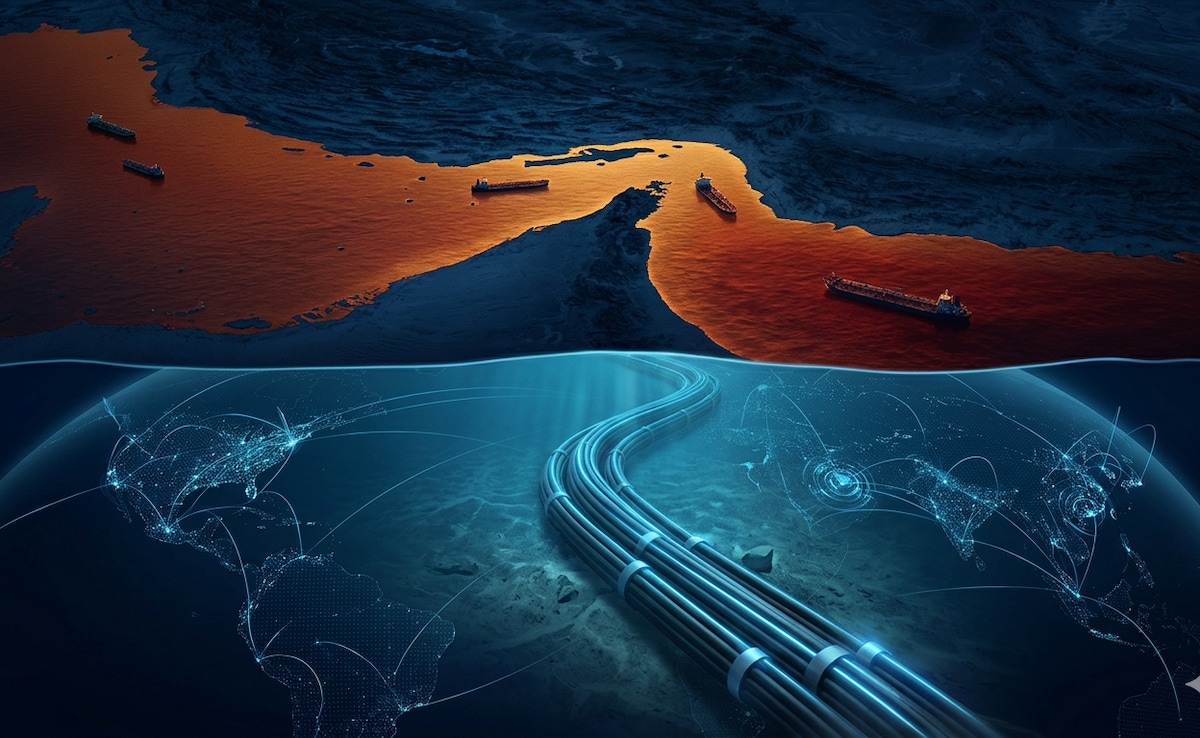
Above and under the Hormuz, Iran tries to exert control (Image generated by AI)
Cutting undersea cables, for example, impacts internet and data traffic worldwide, causing blips and delays in banking systems and financial transactions that could cost billions.
Second, what Iran has done is rewrite the rules on how an economically weaker and militarily outmatched country might keep a stronger, more powerful nation at bay. And these rules are almost certainly being studied by countries like North Korea.
READ | China Is Mining Iran War For Lessons On US Military Power
They are certainly being studied by superpowers like China to assess US military capabilities and gaps - defensive and offensive - in different combat scenarios in the event of a future war.
'You cannot beat geography'
When the war began the headlines were about 'asymmetric warfare'.
Tehran's use of cheaply-made, mass-produced 'suicide' drones - the Shahed series in particular - was meant to saturate American air defences and force them to burn through stocks of expensive interceptor missiles. The endgame, experts surmised, was to leave the Americans and Israelis with fewer intercept options when Iran fired more advanced missiles.
But then Tehran threatened shipping through the Hormuz - which carries a fifth of the world's seaborne oil and over which it has geographic control - and suddenly a switch flipped.
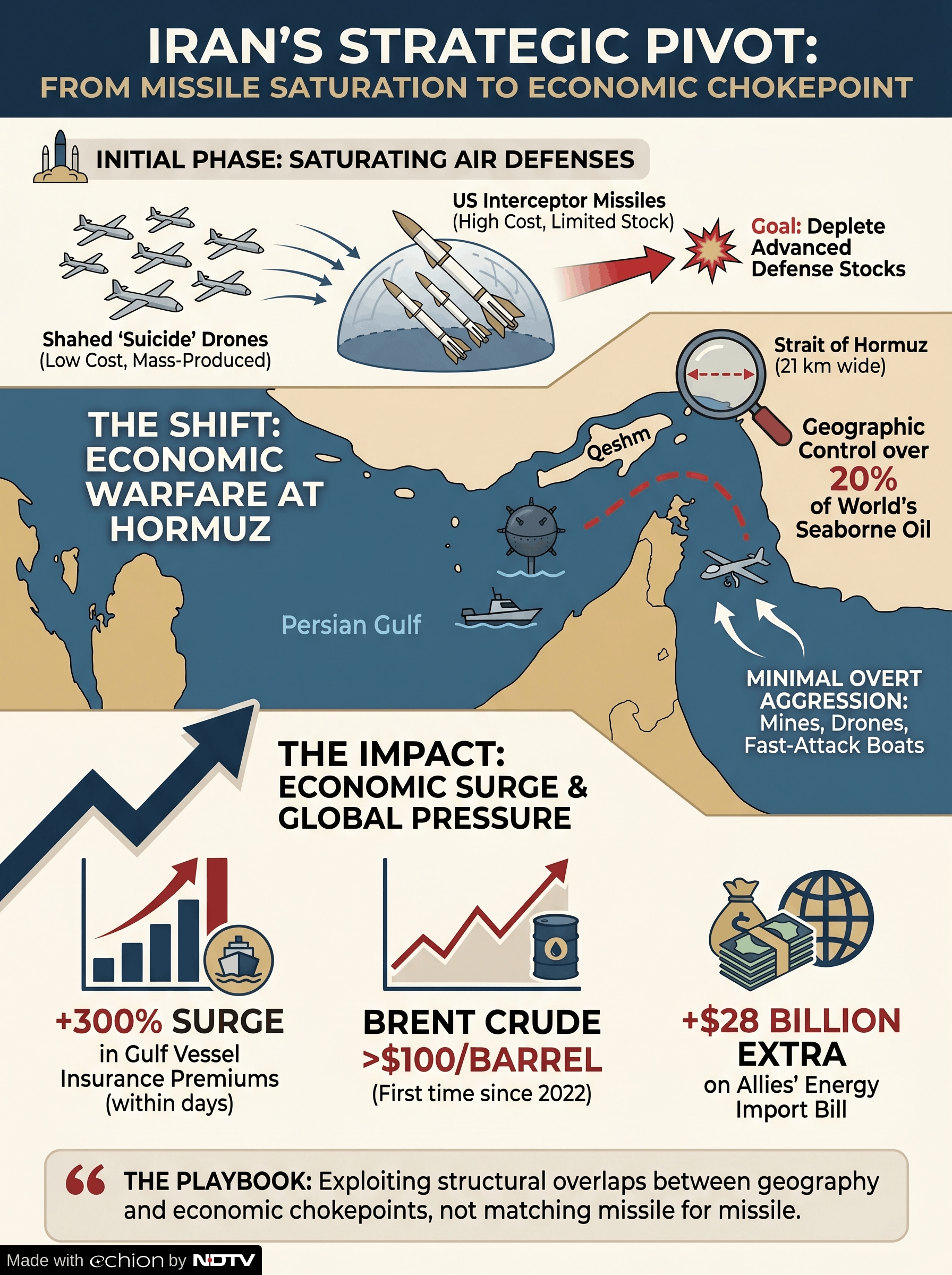
Iran shut down a channel through which 100-150 ships passed daily with minimal overt military aggression, relying mostly on a three-level deterrent - mines, drones, and fast-attack boats.
No tankers were sunk. None needed to be. Iran only needed to drive up insurance costs and charter rates to make shipping unaffordable within the existing calculus of global crude.
And it did just that; insurance premiums for Gulf vessels surged by over 300 per cent within days and benchmark Brent crude crossed the $100-a-barrel mark for the first time since 2022.
Suddenly the Iran war was not about missiles and Shahed drones; it was about oil.
And the pressure built steadily on Donald Trump and the White House, as allies in Europe and elsewhere shifted uncomfortably in their seats watching fuel prices skyrocket and add an extra $28 billion to their energy import bill.
In this playbook, the key is not about matching air strike for air strike or missile for missile, but recognising and exploiting structural overlaps between geography and economic chokepoints.
The Hormuz narrows to 21 km - barely enough for two shipping lanes - as it winds past Iran's western coast, and anti-ship missiles, sea mines, and fast-attack boats stationed at Qeshm Island allow Tehran near-total control over vessels entering and exiting the Persian Gulf.
Hormuz's importance to the world's energy trade amplifies the impact of that control.
And it also means Iran has stress-tested a deterrent to shield against future attacks, whether by the US or any other country.
Of course, the counter is that the world is now aware of the Hormuz chokehold, as well as the vulnerability of subsea digital cables, and is pivoting away from these. But any pivot, even if successful, will require years and millions of dollars invested in building new pipelines and oil export architecture outside Iran's reach, and re-routing submarine cables.
Till then these chokepoints will continue to offer Iran significant structural leverage.
It wasn't supposed to be like this
The US came to Iran hunting nuclear weapons - over 400 kg of uranium enriched to 60 per cent, short of the 90 per cent weaponisation threshold but enough to potentially make eight to 12 bombs.
It was supposed to be a swift and decisive campaign - a 'shock and awe' exercise to showcase US military prowess and hand Donald Trump a major political win before the November mid-term election.
The US was not supposed to get bogged down in a stand-off over a shipping channel.
From a traditional military perspective, Washington will argue it is winning the war against Iran.
This is the argument Trump and senior White House officials, including Secretary of Defense Pete Hegseth, have made repeatedly over the past three months - that Iran's military has been beaten.
But the irony is Washington went to war to stop Iran from building nuclear bombs and instead may have helped it discover an even more powerful weapon, one it always possessed - its geography.
-
Opinion | Slurs, Threats, Now A Temple Attack Plot: When Did America Become So Hostile Indians?

The rising tide of anti-India, anti-Hindu, and racist attacks serves as a stark reminder that economic prosperity does not automatically guarantee social immunity from bigotry.
-
Opinion | Imran Khan, And The Perils Of Having An 'Opinion' In Bollywood
The reality of the industry is quite grimy. More often than not, its inhabitants have been fairweather friends, happy to sing the praises of whoever is in a position of authority.
-
Exclusive: India's Food Safety Problem Goes Beyond Just Dirty Kitchens - By Tukaram Mundhe
On World Food Day, Maharashtra's Commissioner of Food Safety explains why instead of taking stopgap measures, the entire supply chain in India needs to be held accountable and made transparent.
-
Opinion | India Has Enough Coal. So Why Are Power Plants Running Short? A 76 Million 'Crunch'
As of October 5, as many as 82 of the 191 thermal plants monitored by the Central Electricity Authority were in the 'critical' category
-
A Step Behind Neha Bora: What Rahul Gandhi's Gesture Says About Congress' Gen-Z Pitch
At INDIA bloc's march to Supreme Court, Rahul Gandhi placed himself a step behind two women, hands resting on their shoulders. One was his sister Priyanka. The one on his right was Neha Bora. Here's what the image means for the protest wave now, and for Rahul's politics in general.
-
Opinion | Starlink, India, And Why Elon Musk Must Know His Billionaire Tantrums Won't Work
India should neither be intimidated by Musk's global influence nor distracted by his theatrics.
-
Blog | 'Baap Da Brat': Kerala Mini Cooper Crash, And Why 'Daddy' Can't Keep Saving You
There are three things you should never underestimate in India: the power of 'jugaad', the elasticity of the law, and the confidence of a 'Baap da Brat' who believes his Papa Posh can fix absolutely anything.
-
Opinion | 'Say Our Name': Why A Tiny Island Nation Wants The World To Get Its Name Right
Standing before the UN hall of nations, Naoero President David Adeang asked the world to unlearn its comfortable habits and speak a restored truth.
-
TVS Succession Row Explained: Why Venu Srinivasan's Family Is Divided Over Wealth
TVS Family Dispute: TVS Holdings is a key entity because it owns a controlling stake in TVS Motor Company. It owns 50.26% of TVS Motor.
-
Opinion | The US Is Showing India Just How Cheap Its 'Friendship' Is
Can local talent fully replace Indian contribution? Why is the US leading in setting up Global Capability Centres in India - over 60% - and pocketing the IP?