





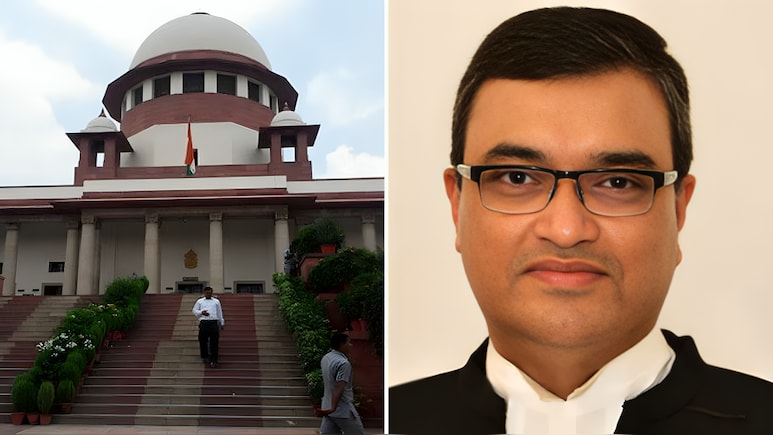
Justice Dipankar Datta of the Supreme Court used a cricket analogy on Wednesday to make a point about who should, and who should not, appoint the "umpire" -- in this case, the Election Commissioners. During a hearing on whether the 2023 law on the appointments is free of government influence, he said there was scope for doubt, as the three-member selection committee includes the Prime Minister and a minister nominated by the PM, besides the Leader of the Opposition (Lok Sabha) or LOP.
An umpire selected by the batting team, even if he gives the correct decision, will always be under a shadow of doubt because he will be perceived as loyal to that team, he remarked. The analogy, deployed to make a legal point, also reflected Justice Datta's love for the sport: he is an opening batter of the Chief Justice of India XI, the judges' cricket team, which often plays teams of other judges, advocates and journalists. Justice Datta is known for being an explosive hitter on the cricket field.
On Minister In Place Of Chief Justice
On the two-judge bench on Wednesday, Justice Datta observed prima facie that the law does not appear to ensure an independent selection process.
He specifically pointed to the provision of a minister being nominated by the PM. Such a nominee "cannot be expected to defy his own nominator and risk his continuation", he remarked.
This nominated-minister provision came in as the Narendra Modi government made a new law to replace the Chief Justice of India on the panel.
"The minister nominated by the Prime Minister to function as the third member of the selection committee, chaired by the Prime Minister, cannot be expected to defy his own nominator and risk his continuation as such nominated member on the committee for all practical purposes. Even otherwise, the collective responsibility doctrine would preclude the minister [from opposing] his Prime Minister," Justice Datta said.
"In such a circumstance, the inclusion of a Cabinet Minister in the selection committee fails to provide the independent counterweight that a neutral selector could, and the Cabinet Minister would merely echo the voice of his leader, and consequently, the presence of the Leader of Opposition in the selection committee becomes largely ornamental, without furthering the purpose of his inclusion," he added.
During earlier hearings, the court had questioned the absence of an independent member on the committee. It also asked whether the Leader of Opposition had any meaningful role when the government side could command a 2:1 majority on the panel.
Split Verdict On Who'll Decide
"Free and fair elections depend on a truly independent ECI (Election Commission of India). It is not enough for the ECI to be independent; it must appear to be independent," Justice Datta said on Wednesday.
He made the remarks while delivering a split verdict with Justice Satish Chandra Sharma on whether petitions challenging the Chief Election Commissioner and other Election Commissioners (Appointment, Conditions of Service and Term of Office) Act, 2023, should be referred to a Constitution Bench.
Justice Datta opined that the issue could be addressed by applying some already settled principles. Justice Sharma favoured sending it to a larger bench. Unable to agree, the two-judge bench thus directed that the papers be placed before the Chief Justice of India (CJI), Surya Kant, to consider constituting a Constitution Bench of appropriate strength. The disagreement, therefore, was on whether a larger bench was required to decide the matter.
Settled Principles Cited
Justice Dutta, however, held that the Constitution Bench judgment in 'Anoop Baranwal vs Union of India' (2023) had already settled two principles. One, that free and fair elections are a basic feature of the Constitution; plus, that the ECI must be insulated from exclusive executive control in appointments.
Justice Datta noted that the Anoop Baranwal judgment said the committee of the PM, LOP and CJI was "transient in nature" and was to operate only until Parliament enacted a law. "If the Constitution Bench intended for the inclusion of the CJI in the selection committee to be binding, it would have said so," he said, though he pointed towards apparent issues with the law made thereafter. He said the principles of that 2023 judgment needed to be applied in any case.
Justice Sharma, however, held that whether Parliament was justified in excluding the neutral selector (the CJI) from the committee was a constitutional question arising for the first time before the SC. That's why, he said, it needed a larger, Constitutional Bench. He held that Article 145 of the Constitution and Supreme Court Rules do not permit a two-judge bench to decide such a question.
While referring it to the CJI to now decide on a larger bench, Justices Datta and Sharma also flagged the prolonged pendency of references before Constitution Benches. "[It] does not reflect well on the institution," the two-judge bench said.
In March 2023, the Constitution Bench directed that the President appoint the CEC and ECs on the recommendation of a committee of the Prime Minister, the Leader of Opposition in the Lok Sabha and the CJI. This was an interim arrangement, to last until Parliament enacted a law. That law removed the CJI and placed a minister instead.
Track Latest News Live on NDTV.com and get news updates from India and around the world

