





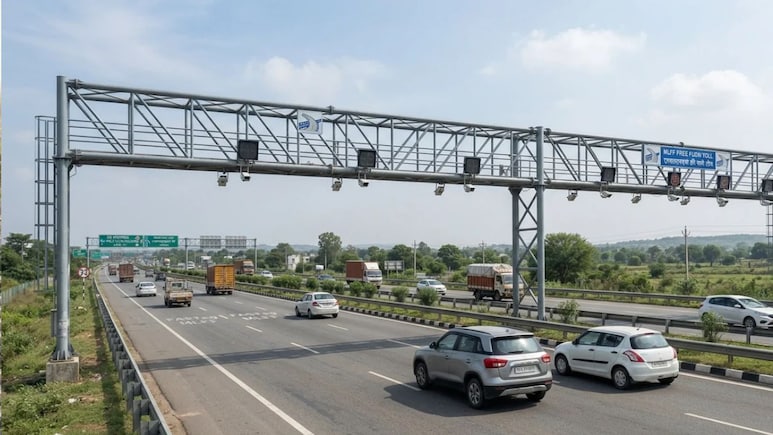
The National Highways Authority of India (NHAI) is turning to artificial intelligence (AI) to catch motorists who conceal or tamper with their number plates to evade toll payments. But the technology could also help police trace vehicles involved in hit-and-run cases, road safety expert Prince Singhal told NDTV.
The technology, called 'Vehicle Fingerprinting', seeks to identify vehicles without relying solely on their registration plates.
"AI-powered vehicle fingerprinting could help investigators trace vehicles through distinctive characteristics such as make, model, colour and body structure. When integrated with highway cameras and toll plaza surveillance, it could help reconstruct vehicle movements and narrow down the search for offenders," Singhal said.
Identifying the vehicle, however, is only one part of the investigation. Effective investigation and prosecution remain crucial, he added.
How Do You Identify A Vehicle Without Its Number Plate?
India's transition to barrier-free tolling through the Multi-Lane Free Flow (MLFF) system allows vehicles to pass through toll plazas without stopping. The system uses FASTags and cameras that read registration plates.
Some motorists, however, have been concealing or tampering with their number plates to avoid paying toll.
In a statement, NHAI said it was deploying vehicle fingerprinting and using VAHAN, the government's vehicle registration database, to identify such vehicles and trace their registered owners.
Police checkposts have also come up at some barrier-free toll plazas, including Gharaunda in Haryana, where offending vehicles are being intercepted and challaned.
Abhijeet Sinha, Program Director, National Highway for Electric Vehicles (NHEV), who spoke to NDTV, said those looking to exploit barrier-free tolling had little idea of how rigorously the technologies had been tested before implementation.
"Eventually, strictness through technical and electronic enforcement shall increase. This use of AI is just the start," he said.
Double Toll, Blacklisted FASTags: What The Rules Say
Under the amended National Highways Fee Rules, which came into effect on March 17 this year, registered vehicle owners are issued electronic notices (e-notices) for unpaid tolls.
Pay within 72 hours of the notice being issued and you owe only the original toll amount. Beyond that, the amount doubles.
If the dues remain unpaid beyond 15 days and no grievance is pending, they are recorded in the VAHAN database.
Apart from possible FASTag blacklisting, an unpaid toll could come in the way of obtaining a No Objection Certificate (NOC) for vehicle transfer, renewing a fitness certificate or getting a national permit for a commercial vehicle.
And you need not be a deliberate toll evader to receive an e-notice. Insufficient FASTag balance or a non-functional tag could also invite one.
What If AI Mistakes Another Car For Yours?
How accurately can AI distinguish between two similar-looking cars? How reliably will it work in dense winter fog or heavy monsoon rain?
With motorists facing more than just financial penalties, Singhal called for human verification before penalties are issued on the basis of AI-powered identification. He also stressed the need for periodic testing, independent audits and safeguards against misuse of vehicle data.
Motorists have 72 hours from the issuance of an e-notice to challenge it at nhfeenotice.parivahan.gov.in. If the grievance is not resolved within five days, the claim for unpaid toll lapses.
"A genuine technology failure should not result in a motorist being penalised or denied passage on a highway," Singhal said.
Toll Revenue Is Up. But Can AI Help Prevent Crashes?
Since India's first Multi-Lane Free Flow (MLFF) toll plaza became operational at Choryasi in Gujarat on May 1, the system has been extended to eight more locations, including Delhi's Mundka toll plaza on the Urban Extension Road-II (UER-II), where barrier-free tolling began in May this year.
Net toll revenue across seven such plazas has increased by nearly 20 per cent, bringing in an additional Rs 89 crore. Delhi's Mundka toll plaza alone has recorded a 23.55 per cent increase in net revenue, according to NHAI.
But better toll collection does not necessarily mean safer roads.
"We must distinguish between technology that helps identify vehicles and technology that actually prevents crashes," Singhal said.
India lost over 1.83 lakh lives to road crashes in 2025, up 3.5 per cent from the previous year, according to government data presented in Parliament.
While barrier-free tolling could reduce congestion and the risks associated with sudden braking and frequent lane-changing, Singhal said safer highways would require better road engineering, traffic management and timely intervention.
For Singhal, the bigger challenge is moving from reactive to preventive road safety.
"The objective should not merely be to identify what went wrong after a crash, but to anticipate what could go wrong and take corrective action before a life is lost," he said.
Track Latest News Live on NDTV.com and get news updates from India and around the world

