





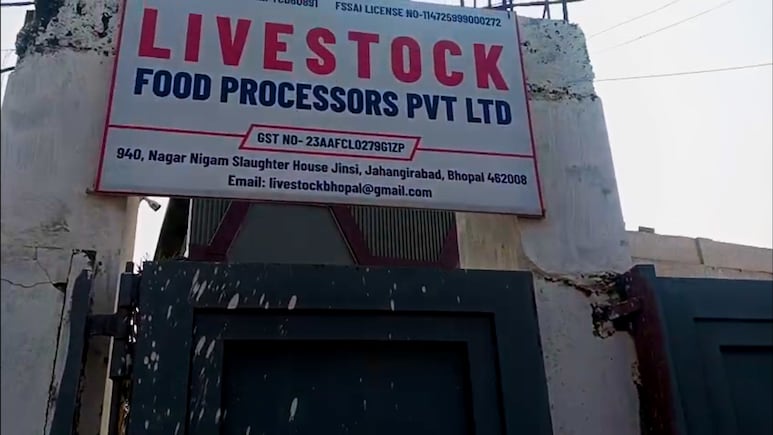
Madhya Pradesh has long claimed to have the toughest cow-protection laws in India, with a ban on cow slaughter in place since 2004. The current 2024-25 period was even officially declared the "Cow Protection Year." However, a disturbing scandal has emerged just two kilometres from the Mantralaya, the state's seat of power.
More than 260 cows were allegedly slaughtered inside a government-approved slaughterhouse, revealing a deeply entrenched operation that local activists say was shielded by municipal approvals and administrative silence.
-

-
 Who Is Rajiv Mehta? Lilavati Hospital Trustee To Speak At NDTV World Summit 2026
 -
 Ex-CIA Director To Decode 'War In Times Of AI' At NDTV World Summit
 -
 From Call Centre To Billion-Dollar Disruptor: Nikhil Kamath At NDTV World Summit
 -
 'Every 5 Years, You'll See A New India': Swami Sarvapriyananda Ahead Of NDTV World Summit
 -
 AI Can Think, But Can It Be Conscious? Swami Sarvapriyananda Weighs In
 -
 Alain Ebobisse, Africa50 CEO, To Attend NDTV World Summit 2026. All About Him
 -
 Kriti Sanon At NDTV World Summit: A Look At Her Career And Business Ventures
 -
 Ex-CIA Director To Decode 'War In Times Of AI' At NDTV World Summit
 -
 Who Is Vikram Rai, CEO, South Asia GE Aerospace, Set To Attend The NDTV World Summit 2026
 -
 Rahul Kanwal: The World Is Changing. What Comes Next? | NDTV World Summit 2026
The matter came to light on December 17, 2025, when Hindu organisations intercepted a container carrying 26.5 tonnes of meat near the Jinsi slaughterhouse complex. The sheer volume raised immediate red flags; the facility was permitted to slaughter only 85 buffaloes, which would typically yield about 12.75 tonnes of meat.
The seized consignment was more than double that amount. While a laboratory in Mathura confirmed the samples tested positive for beef on January 7, the investigation has been marred by what critics call "suspicious haste." The operator, Aslam Qureshi, and a driver were quietly arrested and sent to jail without custodial interrogation or public disclosure, effectively stalling any chance of uncovering a wider network.
Bhanu Hindu, an activist who helped intercept the truck, described the day of the seizure as a "dark day in Bhopal's history." He alleged that despite their warnings, municipal officials initially produced certificates claiming the meat was buffalo.
"The police and municipal officials used legal loopholes to release the truck," he claimed, adding that by the time the Mathura report confirmed the meat was beef, the container had already reached Mumbai and was shipped abroad.
The role of government veterinarians is also under fire. A three-doctor panel initially cleared the meat as buffalo, which allowed the container to leave the city. Furthermore, police sources now suggest that healthy, milk-producing animals aged 4 to 8 years were being slaughtered instead of the older buffaloes permitted by law.
While Municipal Commissioner Sanskriti Jain has suspended one doctor and promised strict action, the opposition is calling for the resignation of the Mayor-in-Council, questioning how stay orders were repeatedly vacated to keep the facility running.
At the centre of the storm is Aslam Qureshi, also known as "Aslam Chamda." Investigators allege that Qureshi leveraged municipal and forest department contracts to build a sprawling meat empire.
His firm held the contract for collecting dead animals across Bhopal, which sources say gave him direct access to carcasses, mostly cows, that were diverted for slaughter instead of being scientifically disposed of.
Qureshi also held the sensitive contract to supply meat to the wild animals at Van Vihar, a government wildlife sanctuary. Over the years, this influence reportedly allowed him to amass more than 35 properties and multiple luxury bungalows in prime locations.
Priyank Kanoongo, a member of the National Human Rights Commission (NHRC), has publicly held the Bhopal Municipal Corporation accountable, noting that since the corporation is the official operator of the slaughterhouse, the responsibility lies with the institution itself rather than just individual employees.
The incident has triggered a political firestorm. Jitu Patwari, President of the Madhya Pradesh Congress, attacked Chief Minister Mohan Yadav, accusing the government of hypocrisy. "The Chief Minister gets reels made of himself feeding cows, but cow slaughter is taking place under the protection of his own government," Patwari said.
Within the BJP, councillors and Bhopal MP Alok Sharma have expressed deep distress, admitting that such a large-scale operation would have been impossible without the connivance of police and municipal employees.
Despite the arrests, core questions remain: Why was CCTV footage from the slaughterhouse not seized immediately? Why is the administration resisting a DNA test that could provide final, indisputable proof? As the NHRC investigates allegations of illegal labour being used at the site, the state's "zero tolerance" policy is under its most significant test to date. In the heart of Bhopal, the law did not fail quietly-it appears it was made to look the other way.
Track Latest News Live on NDTV.com and get news updates from India and around the world

