





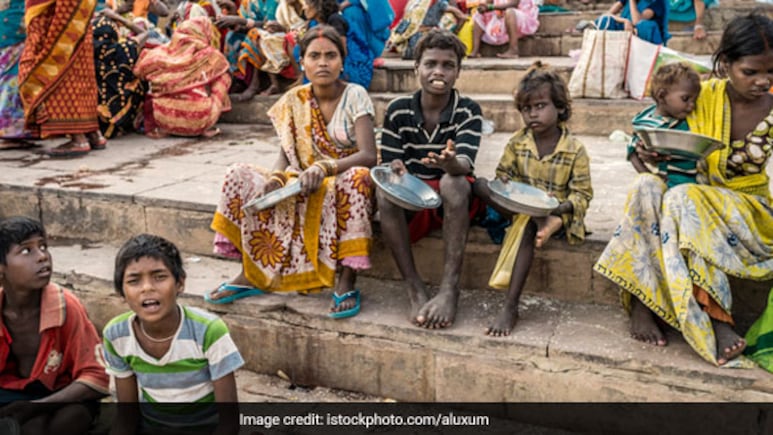
The G RAM G bill cleared Parliament shortly after midnight Friday to the tune of vociferous objections by opposition lawmakers angry about the name – which invokes the name of Lord Ram over that of Mahatma Gandhi – and provisions they called "feudal" and said "kills" job guarantees for the rural poor. The opposition also protested a revised funding structure that requires most states to pay 40 per cent of wages under a critical social welfare scheme. That requirement, it argued, cripples the scheme in most states since most lack the financial resources to take on an estimated Rs 56 crore wage bill.
Congress MP P Chidambaram said the bill strikes at the very heart of the guarantee it is supposed to provide. "It kills livelihood… kills security. Why do you call it a 'guarantee-ingrained' bill? There is no guarantee. It doesn't assure livelihood for the rural poor. It has no security…"
The new bill – which cleared Parliament in 48 hours and will likely become law later today, after the formality of President Droupadi Murmu signing off – replaces the Mahatma Gandhi National Rural Employment Guarantee scheme enacted by the Congress-led UPA government in 2005.
READ | 'G Ram G' Bill, To Replace MGNREGA, Clears Parliament, Opposition Stages Protest
The government has defended its new scheme by stressing the need to update a 20-year-old scheme, it argued, was inefficient and riddled with corruption. It has also pointed to an increased minimum number of workdays – from 100 under MNREGA to 125 under G RAM G.
READ | "'Ram' On Lips, Dagger In Heart": Shivraj Chouhan Slams Congress On G Ram G
On the name change row Agriculture Minister Shivraj Chouhan, who tabled the bill in the Lok Sabha, pointed out the Congress had only added Gandhi's name to the bill in 2009.
What is the G RAM G bill?
The Viksit Bharat-Guarantee for Rozgar and Ajeevika Mission (Gramin), or the VB-G RAM G legislation, shortened even further to G RAM G, takes over the MNREGA's role of creating statutory job guarantees – the minimum being 125 man-days of work – per rural household.
These jobs are to be created and assigned by the respective states and union territories, each of which will now share the wage burden – a 40:60 split – with the federal government.
READ | "Mahatma Not From My Family, But...": Priyanka Gandhi Leads G Ram G Protest
And an allowance is to be paid – funded fully by the state – if no job is made available within 15 days of it being sought. Also a 60-day 'no work' window has been written into the scheme.
G RAM G bill explained
The main points (at least the ones most discussed by lawmakers) of the new legislation are the guaranteed workdays, the funding structure, and increased federal control over fund allocation, which the government described as "normative" rather than "demand-based", i.e., the centre will determine how much each state gets every year based on "objective parameters".
Guaranteed workdays: G RAM G offers an increased minimum number – 125 over 100 by MNREGA – but there are conditions, including notification of a 'rural area' by the centre.
READ | "Swear By My Mother, This Isn't Good For The Poor": M Kharge On G RAM G Bill
That is, employment guarantees under G RAM G will not extend to areas not listed as 'rural' by the central government. This point is carried over from MNREGA. In practice, though, employment then was offered across all rural districts, making it a pan-India scheme.
Funding logic: Under the MNREGA the centre paid around 90 per cent of all expenses, including wages and raw materials. That changes under G RAM G, with states required to pay 40 per cent of that amount, although hill states and those from the northeast need pay only 10 per cent.
Union territories will continue to receive 100 per cent funding in this regard.
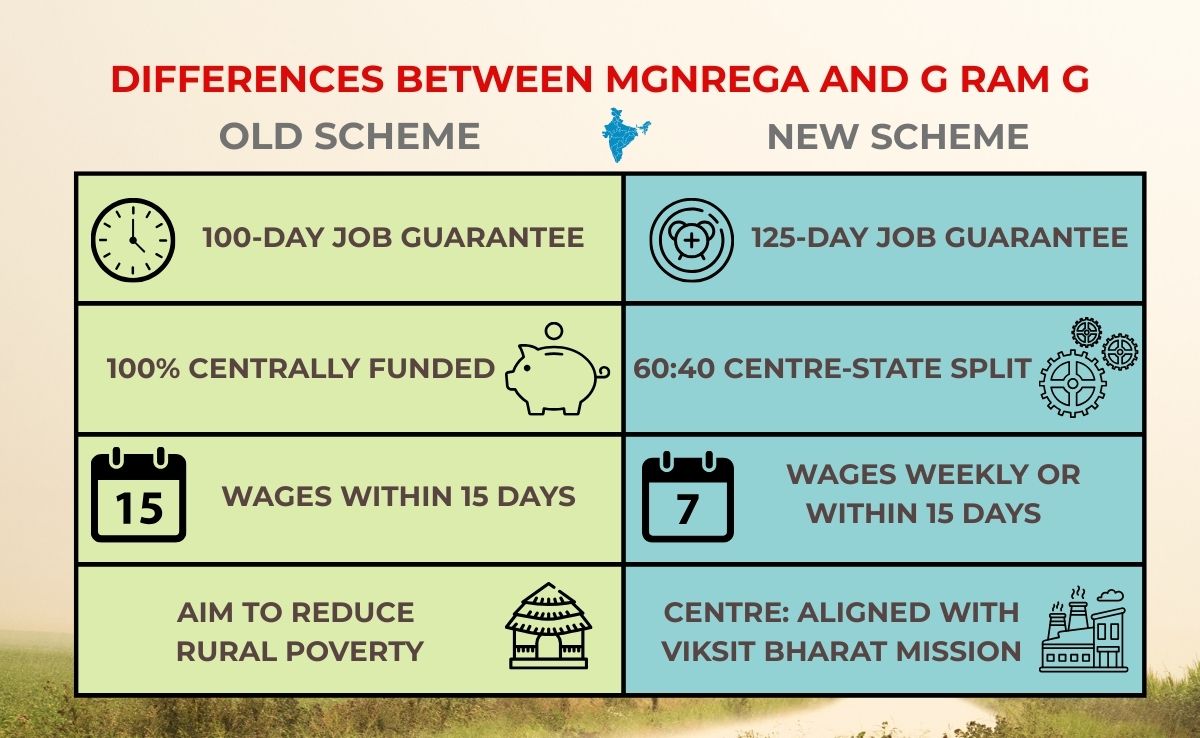
Differences between the old and new rural employment guarantee schemes.
The change in the financing architecture, the government has argued, will encourage each state to take up financial ownership of the scheme in its territories. The opposition, though, argued this would further stress already fragile state-level finances, effectively reducing the scope of the scheme by limiting the amount of work available; the Congress called G RAM G "anti-poor".
The government has stressed this will not "impose an undue financial burden" and that the funding structure has been calibrated according to each state's fiscal capabilities.
The funding architecture is a flashpoint because it constrains – based on the centre's "normative allocation" – the amount of work each state can offer under the programme. It also means the centre can, if it chooses to, suspend funds "where serious irregularities are detected, and direct corrective or remedial measures to address deficiencies".
Work basket and who assigns it: At the ground level nothing changes. Work will continue to offered by the panchayat and/or programme officer at the grassroots.
What does change, however, is that under G RAM G the centre will set the standards, which includes regulating, in the case of construction work, for example, materials and designs, and limiting the nature of work 'approved' for payout from the bill's allocated finances.
Also, the G RAM G bill divides work into four categories – water security, core rural infrastructure, livelihood-related assets, and climate resilience. Critics said this curtails the scope of the work, which was earlier decided by panchayats according to local needs.
NDTV is now available on WhatsApp channels. Click on the link to get all the latest updates from NDTV on your chat.
Track Latest News Live on NDTV.com and get news updates from India and around the world

