





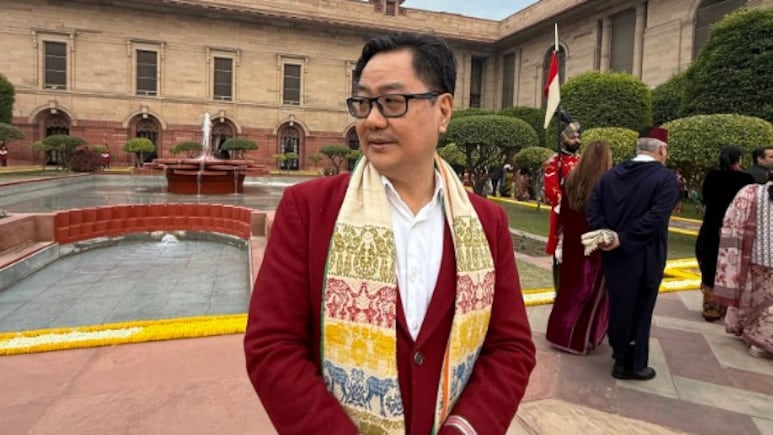
The government will not go into "reverse gear" and roll back the contentious VB G-RAM-G rural jobs guarantee scheme, Parliamentary Affairs Minister Kiren Rijiju said Tuesday afternoon the opposition ramped up protests against the employment programme. "Once the law is before the country we have to follow it… we cannot reverse gear and go back to the past. It cannot happen," he asserted.
The minister also responded to the opposition's complaint that the legislative agenda for next week's Parliament session – which will discuss the union budget – had not been shared. "Government business is shared after the President's address in the first session of the year," he said.
The G-RAM-G – which replaced the 20-year-old Congress-era Mahatma Gandhi-labelled MNREGA employment guarantee scheme – was cleared by Parliament during last month's winter session.
The scheme cleared Parliament amid fierce protests from opposition lawmakers unhappy with the name – which invokes the name of Lord Ram over Mahatma Gandhi – and provisions they slammed as "feudal" and which, they argued, would "kill" job guarantees or assurances for the rural poor.
The government defended its new scheme by stressing the need to update an 'inefficient and riddled with corruption' MNREGA, and also pointed to the increase in minimum workdays – from 100 to 125.
Protests against the welfare scheme have ramped up in recent weeks as the opposition preps to corner the government on this issue in the budget session. Three opposition-ruled states – Telangana, where the Congress is in power; Punjab, where the AAP holds the government; and Tamil Nadu, where Congress ally DMK rules – have passed anti-G-RAM-G resolutions.
A fourth, Karnataka, where too the Congress is in power, is expected to do so shortly.
On that note, there was high drama in the Karnataka Assembly last week after Governor Thawaarchand Gehlot refused to read out a speech prepared by the state government for the opening joint session of the legislature.
RECAP | Governor vs Congress In Karnataka Over G-RAM-G, Special Session, Speech
Gehlot pointed to 11 sections in the speech that, he said, criticised the G-RAM-G bill and demanded they be deleted. The state refused to do so, setting up a showdown between the two that led to the Governor walking out of the House.
The BJP responded by demanding action against Congress lawmakers who, they said, had pushed and heckled the Governor, and even tried to physically block him leaving the building.
G RAM G explained
The main points (at least the ones most discussed by lawmakers) of the new legislation are the guaranteed workdays, the funding structure, and increased federal control over fund allocation, which the government described as "normative" rather than "demand-based", i.e., the centre will determine how much each state gets every year based on "objective parameters".
Guaranteed workdays: G-RAM-G offers an increased minimum number – 125 over 100 by MNREGA – but there are conditions, including notification of a 'rural area' by the centre.
RECAP | "Swear By My Mother, This Isn't Good For The Poor": M Kharge On G-RAM-G
That is, employment guarantees under G-RAM-G will not extend to areas not listed as 'rural' by the central government. This point is carried over from MNREGA. In practice, though, employment then was offered across all rural districts, making it a pan-India scheme.
Funding logic: Under the MNREGA the centre paid around 90 per cent of all expenses, including wages and raw materials. That changes under G-RAM-G, with states required to pay 40 per cent of that amount, although hill states and those from the northeast need pay only 10 per cent.
Union territories will continue to receive 100 per cent funding in this regard.
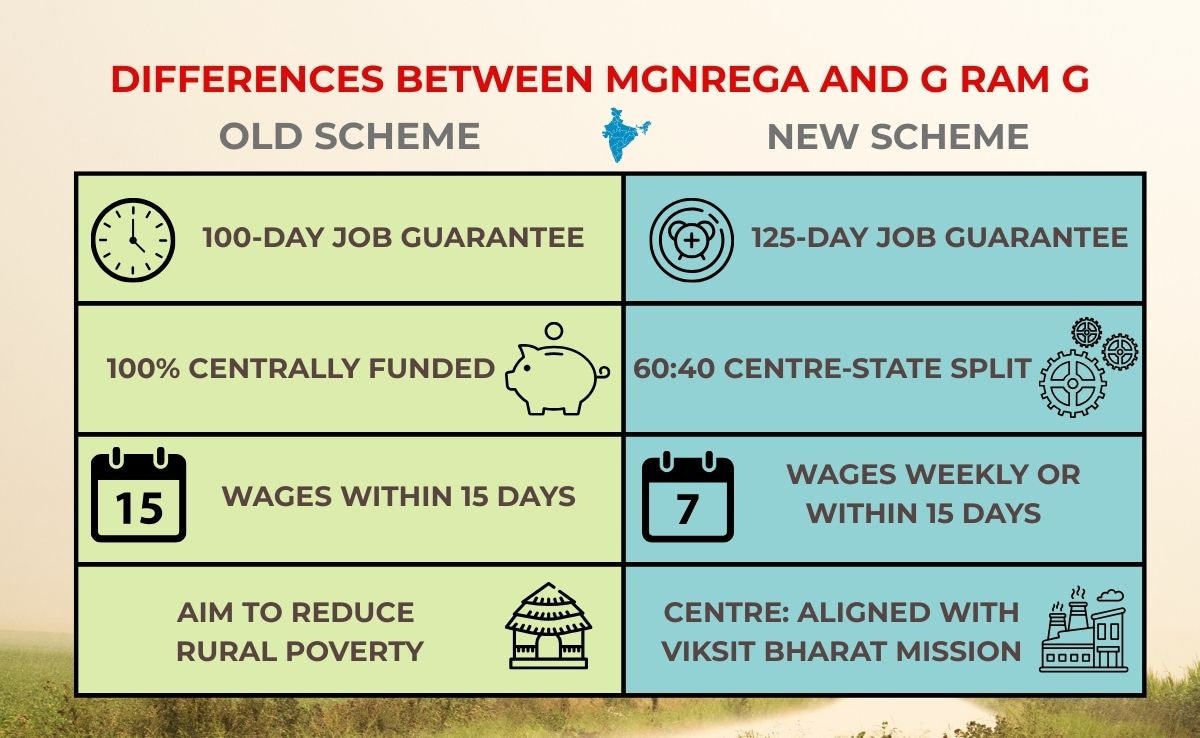
The change in the financing architecture, the government has argued, will encourage each state to take up financial ownership of the scheme in its territories. The opposition, though, argued this would further stress already fragile state-level finances, effectively reducing the scope of the scheme by limiting the amount of work available; the Congress called G-RAM-G "anti-poor".
The government has stressed this will not "impose an undue financial burden" and that the funding structure has been calibrated according to each state's fiscal capabilities.
EXPLAINED | G RAM G Clears Parliament, To Replace MNREGA. What Is The Bill?
The funding architecture is a flashpoint because it constrains – based on the centre's "normative allocation" – the amount of work each state can offer under the programme. It also means the centre can, if it chooses to, suspend funds "where serious irregularities are detected, and direct corrective or remedial measures to address deficiencies".
Work basket and who assigns it: At the ground level nothing changes. Work will continue to offered by the panchayat and/or programme officer at the grassroots.
What does change, however, is that under G-RAM-G the centre will set the standards, which includes regulating, in the case of construction work, for example, materials and designs, and limiting the nature of work 'approved' for payout from the allocated finances.
Also, the G-RAM-G scheme divides work into four categories – water security, core rural infrastructure, livelihood-related assets, and climate resilience. Critics said this curtails the scope of the work, which was earlier decided by panchayats according to local needs.
NDTV is now available on WhatsApp channels. Click on the link to get all the latest updates from NDTV on your chat.
Track Latest News Live on NDTV.com and get news updates from India and around the world

