





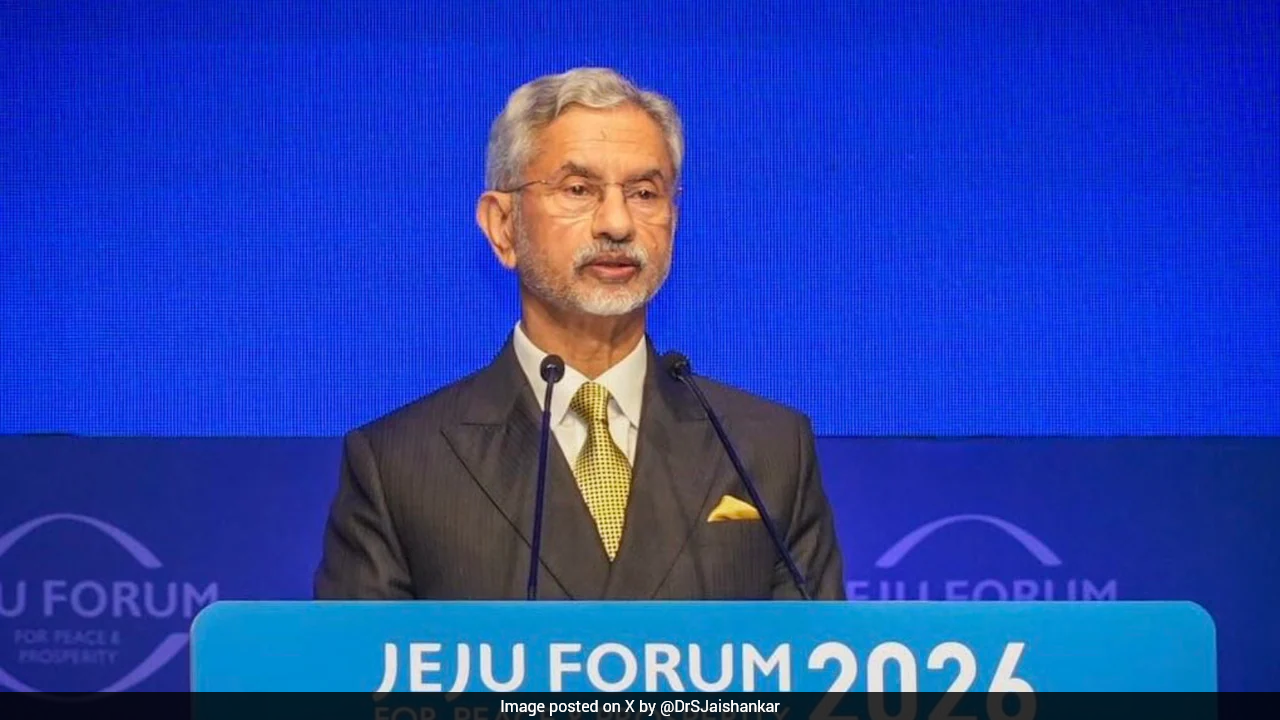
External Affairs Minister Dr S Jaishankar on Thursday argued that a fragmented world is not necessarily a negative development, asserting that the future of global stability depends on deeper cooperation among nations rather than a return to old power structures.
Delivering the keynote address at the Jeju Forum for Peace and Prosperity 2026 in South Korea, Jaishankar said the international community must accept that fragmentation has become a permanent feature of global affairs. While acknowledging its challenges, he suggested that it has also opened space for greater democratisation and reduced dominance by a handful of powers.
"The Forum is discussing a fragmented world as a problem and reinventing cooperation as a solution. I agree with both the diagnosis and the treatment," he said. However, he added that "fragmentation is here to stay" and, in some respects, has positive consequences by creating "less dominance, more space and greater democratisation".
Jaishankar noted that the world has always been a mix of globalisation and fragmentation, but the forces shaping both trends have become far more complex. Economic integration, resilient supply chains, technology, logistics networks and the movement of talent have emerged as powerful forces binding countries together.
"The world is increasingly about supply chains, their efficiency and their resilience," he said, emphasising that technology and artificial intelligence are accelerating cross-border integration. "The advent of AI will only accelerate these trends, since the capture of data and deployment of models are inherently trans-national."
At the same time, he warned that strategic competition is intensifying. Nations are increasingly leveraging financial strength, production capabilities, technological advantages and control over resources for geopolitical purposes. As a result, economic activity is becoming more closely tied to national security calculations.
"The natural play of commerce is increasingly influenced by the calculations of strategy," Jaishankar said, pointing to growing technology rivalries and geopolitical competition.
Pleased to deliver the keynote address at the Jeju Forum for Peace and Prosperity, 2026.
— Dr. S. Jaishankar (@DrSJaishankar) June 25, 2026
The world today is undergoing a complex rebalancing - economic, political and cultural. While economic interdependence, connectivity and a global workplace have brought it closer;… pic.twitter.com/tYqTxiDtZw
The minister also criticised what he described as selective approaches to major global challenges. He cited the Covid-19 pandemic, terrorism and climate change as examples where responses have often been driven by national interests rather than collective responsibility.
"Challenges confronting the world may be manifestly global, but the responses are definitely more national," he said. On terrorism, he argued that the world has witnessed "double standards," while climate action has often been marked by "empty promises."
Jaishankar further expressed concern that developing countries are facing obstacles in their economic growth. He argued that non-market factors and restrictions on market access are limiting opportunities for industrialisation in parts of the Global South.
Summing up the international landscape, the minister said the world is experiencing "greater weaponisation, higher risk-taking and a politics suited to the social media era." In such an environment, cooperation among a broader range of countries is essential to counterbalance narrow national interests.
To reinvent cooperation in a fragmented world, Jaishankar proposed a five-point framework. This includes diversifying supply chains, building closer partnerships among influential nations, strengthening respect for international law, expanding opportunities for the Global South and pursuing reformed multilateralism to provide global public goods.
He highlighted the importance of institutions and legal frameworks such as the United Nations Convention on the Law of the Sea (UNCLOS), saying they must be collectively protected and promoted.
Concluding his remarks, Jaishankar made a strong case for deeper collaboration between India and the Republic of Korea. He pointed to opportunities in shipbuilding, digital technologies, healthcare, infrastructure and defence, arguing that stronger bilateral ties could contribute not only to mutual prosperity but also to a more stable global order.
"The world must take more control over its own future," he said, underscoring the need for broader participation in shaping international norms and institutions.
Track Latest News Live on NDTV.com and get news updates from India and around the world

