Opinion | Three Adversaries Become 4: Why The Saudi-Turkey-Pak Deal Is A Headache For India
With Turkey already in Islamabad's corner and Saudi Arabia now signing up to a mutual-defence pact, Pakistan's bilateral rivalry with India may now become a much wider strategic equation.
On July 4, 2025, less than two months after hostilities between India and Pakistan ended following Operation Sindoor, Lieutenant General Rahul R Singh, the Indian Army's Deputy Chief, said India had effectively faced three adversaries on a single border. Pakistan was the active frontline combatant, China shared real-time satellite intelligence, and Turkey, a partner of Islamabad, had been a source of tactical and kamikaze drones that had been used against India.
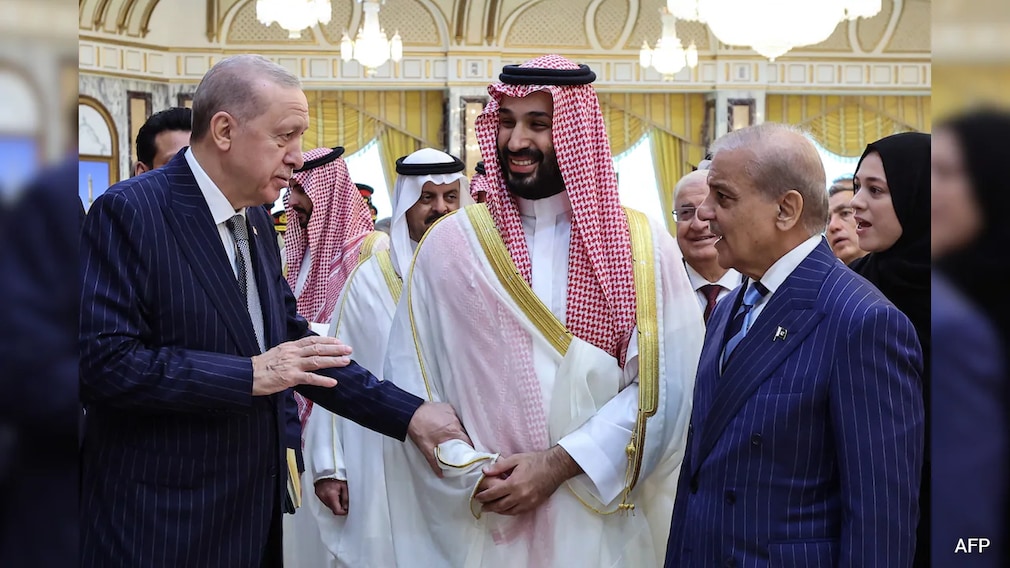
Now, if the Mecca Joint Defence Agreement signed between Pakistan, Turkey and Saudi Arabia on August 7 is implemented in letter and spirit, it could theoretically mean that a fourth nation - Saudi Arabia - would be treaty-bound to oppose New Delhi in the event of armed hostilities in the subcontinent. A joint statement issued post the signing of the agreement states that an armed attack against any of the three would be regarded as an attack on all.
A Snub To India?
While Pakistan's Foreign Minister, Ishaq Dar, has described the agreement as being "purely defensive in nature", New Delhi would not be pleased with Saudi Arabia signing on, given the extremely close ties between Delhi and Riyadh.
India and Saudi Arabia define their relationship as a strategic partnership anchored by a joint council that steers ties that have grown to include oil, security, investment and culture. Trade stands at $43 billion, with Saudi Arabia supplying around 14% of India's crude oil.
Saudi Arabia Is A Lifeline For Pakistan
At the same time, Saudi Arabia and Pakistan have already operationalised a bilateral security pact that predates the Mecca Joint Defence agreement. Between April and May this year, Pakistan sent roughly 8,000 soldiers and a full squadron (approximately 16 jets) of JF-17 Thunder fighter jets to Saudia Arabia. Some reports also indicate that Islamabad transferred two squadrons of drones and a Chinese-built air defence system as part of the Strategic Mutual Defence Agreement that it signed with Saudia Arabia in September 2025. The scale of this deployment was hardly for 'advisory and training purposes', and could be described as a form of military repayment by Islamabad at a time when Saudi Arabia found itself at the receiving end of Iranian drone attacks during the ongoing war between Israel, the United States and Iran.
The Pakistan-Saudi Arabia association is not new - Saudi Arabia has been a financial lifeline for Pakistan for decades and has helped Islamabad deal with balance-of-payments crises. Since 2018, Riyadh has repeatedly extended multibillion-dollar deposits and deferred oil-payment facilities - including $6 billion in 2018, $4.2 billion in 2021, roughly $8 billion in 2022, and continued deposit rollovers through 2026 - often tied to IMF bailout conditions.
Militarily, Saudi Arabia has backed Pakistan against India since 1965 with money and diplomatic support. In 1971, Riyadh condemned India's actions and support continued during the 1999 Kargil conflict, through cash and lobbying. Reports on the direct transfer of Saudi weaponry - including the loan of military aircraft in 1971 - have, however, not been backed with substantial evidence.
On the other hand, Pakistani forces have been deeply embedded in Saudi Arabia's military since the 1960s. Cooperation began under King Faisal and President Ayub Khan, with a formal 1967 agreement with Pakistani pilots reportedly flying Saudi jets against a 1969 Yemeni incursion. Through the 1970s-80s, up to 15,000 Pakistani troops were stationed in the Kingdom at various points, including in border-defence roles. A 1982 Protocol Agreement formalised the framework for these ongoing troop deployments. Separately, during the 1991 Gulf War, about 13,000 Pakistani personnel were deployed to Saudi Arabia. Over the decades, Pakistan has also trained an estimated 8,000-10,000 Saudi military personnel; more recently, Pakistan's former Army Chief, Gen. Raheel Sharif, took command of the Saudi-led Islamic Military Counter Terrorism Coalition in 2017, and joint army, naval and air force exercises have since become a regular fixture.
What Turkey Brings To The Pact
Pakistan's military association with Turkey is more directly linked to arms imports - Islamabad has historically benefited from Turkish platforms, including Bayraktar TB2 drones, MILGEM-class corvettes valued at around $1.5 billion, and modernisation support for its US-built F-16 fleet.
Pakistan acquired four Turkish-designed MILGEM-class corvettes for its Navy among its most technologically advanced surface platforms, with the final vessel, PNS Tariq, delivered in August 2023. Turkey has also been involved in the modernisation of Pakistan's French-designed Agosta 90B-class submarines. Pakistan received its first batch of Bayraktar Akinci high-altitude combat drones in 2023, adding to earlier TB2 acquisitions with the relationship progressing towards local production. Turkey's KAAN stealth jet made its first flight on February 21, 2024. Development of prototypes is ongoing, with Turkey expected to begin receiving deliveries of the fighter between 2028-2030. Pakistan is seen to be a strong prospective customer; talks began around 2023, with the Pakistan Aeronautical Complex potentially co-producing rather than just buying the jet. There is, however, no contract that has been signed, with Islamabad believed to be closer to acquiring the Chinese J-35A stealth fighter, a more mature platform.
After Pakistan used Turkish drones during the 88-hour war (Operation Sindoor) in May last year, India retaliated by revoking Turkish firm Celebi Aviation's security clearance. E-commerce platforms Ajio and Myntra dropped Turkish brands, and tourism took a big hit, with travel platforms cutting Turkey promotions. Indian arrivals fell upto 38% over the summer season.
India Will Have To Watch Out
With no signs of Islamabad moving away from its policy of state-sponsored terrorism, New Delhi will be looking closely at whether the new Turkey-Saudi Arabia-Pakistan pact ends up becoming a major strategic headache in the event of armed conflict. Turkish Foreign Minister Hakan Fidan's remarks that the Mecca Joint Defence Agreement is similar to NATO's Article 5 collective-defence clause sound ominous for New Delhi. For now though, the agreement appears to primarily be a regional hedge against America's declining role as a net security provider - perhaps a political signal of realignment away from US-centric security guarantees in the Middle East.
For now, Delhi can take some comfort in the fact that, rhetoric aside, the Mecca pact currently lacks a joint command and defined triggers for collective action - falling well short of an alliance that could be institutionally compared to NATO. In the long run, though, it is almost certain that Islamabad would not hesitate to invoke the pact's joint-action clauses to deter India from any military action against Pakistan.
(The author is Senior Managing Editor, NDTV)
Disclaimer: These are the personal opinions of the author
-
Opinion | Pakistan's Kashmir 'Story' Is Now Collapsing Under The Weight Of Its Own Contradictions

Pakistan spent decades internationalising the Kashmir issue. With the PoK uprising, that has come back not only to bite it, but to expose its false narratives
-
Opinion | 86 Votes, 1 Warning: Is India Turning Into Collateral Damage In US' War On Russia?
Washington wants to sever Russian energy income, but India could end up paying the price for it
-
Opinion | Saudi Arabia Has Money, Missiles, And America. Why Is It Still So Scared?
What the NATO-like pact essentially points to, under its modest packaging of 'Islamic brotherhood', are growing fears of the Saudi Kingdom.
-
Learning Is Free Online, So Why Are Parents Paying Lakhs For Education?
Homeschooling is likely to grow in urban India, particularly among families frustrated with rote learning, school pressure and the race for marks.
-
Opinion | Age Of The Pink Slip: India's Brutal IT Layoffs Are No Longer About Cost-Cutting
The four biggest IT firms, TCS, Infosys, HCLTech, and Wipro, removed a net 9,100 people in the April-June quarter this year. A year earlier, in the same quarter, they had added 22,622.
-
Opinion | From Punjab To Karnataka, Congress Just Can't Stop Hitting Self-Goals
Congress leaders often speak as though anti-incumbency is a natural resource that will eventually flow towards them. But it doesn't.
-
NDTV Exclusive - Inside Meta's Child Safety: Current Systems Miss Nuance, New AI Under Test
The tech giant disclosed that it is developing a new generation of AI models to strengthen enforcement against child sexual exploitation on Facebook and Instagram.
-
Opinion | The Story Of 'SH-15', Pakistan's New Chinese Guns, Now Along India's Borders
Pakistan has reportedly deployed nearly 250 Chinese-made SH-15 wheeled self-propelled howitzers along sectors facing India.
-
Explained: Why Meta Is Under Fire Over Child Sexual Abuse Content
Meta chief Mark Zuckerberg apologised to the Indian government over child sexual abuse material, deepfake content and operational lapses. Here's what triggered the controversy and why it could reshape the debate over platform accountability and 'safe harbour' protections in India.