





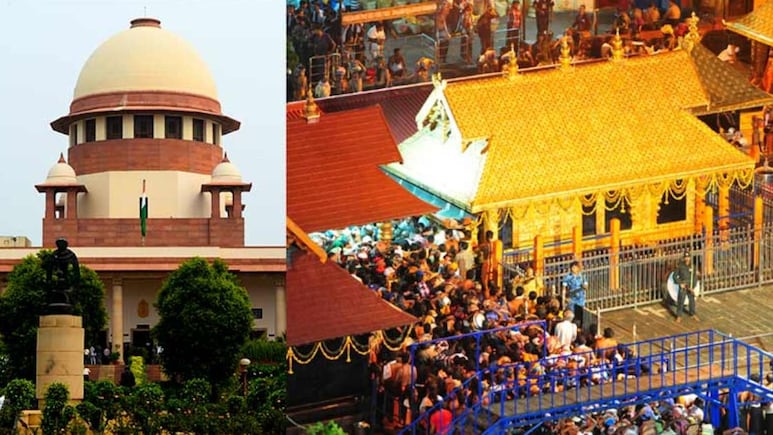
The Supreme Court, while hearing the arguments in Sabarimala issue on Thursday, emphasised the need to unify society noting that the exclusion of other denominations from denominational temples will affect Hinduism.
On the third day of hearing, while clarifying that she is not speaking about the Sabarimala controversy, Justice BV Nagarathna remarked, "If you say it is a matter of religion -- that only my section must attend my temple and no one else, that is not good for Hinduism".
She made this observation while hearing arguments by senior advocate CS Vaidyanathan, who is appearing for the Nair Service Society and religious organisations from Kerala against the 2018 verdict, which allowed women of childbearing age to enter the Lord Ayyappa temple in Sabarimala.
Vaidyanathan argued that Article 26(b) -- which gives a religious denomination the right to manage its own affairs -- would prevail over Article 25(2)(b) which allows the state to make laws for reform within a religion or throw open all Hindu religious institutions of public character to all sections of Hindus.
He argued that the State cannot get into the question of whether a religious practice was essential, and "State" included the judiciary as well
Justice Nagarathna observed: "One apprehension, keep aside the controversy of Sabarimala. If you say the right of entry, in the context of Venkataramana Devaru, where they said anybody other than Gowda Saraswat Brahmin is excluded, it will affect negatively Hinduism. Everybody must have access, keep aside the Sabarimala controversy, to every temple and mutt. If you say it is a matter of religion -- that only my section must attend my temple and no one else, that is not good for Hinduism".
"We will be dividing the society," said Justice Aravind Kumar who is part of the nine-judge bench. "Let the religion not be adversely affected," she added.
Vaidyanathan however pointed out there are private temples, and ancient tharwads in Kerala which have their own family temples, where only their members go.
Justice Nagarathna clarified that she was not referring to such private temples.
Vaidyanathan said denominational temples will not depend on public funds and will sustain based on only on their funds.
Justice Nagarathna said it would be "counter-productive" to the denomination. "That is a matter for them to decide," Vaidyanathnan replied.
Justice Nagarathna replied: "Keep aside Sabarimala. Generally, if you say persons only of Gowda Saraswat Brahmins must only come to a temple, followers of Kanchi Mutt must only go to Kanchi, they should not go to Sringeri, followers of Sringeri must not go elsewhere..."
Vaidyanathan said it was for each denomination to think about that.
Justice Nagarathna, however, asserted that the State can step in under Article 25(2)(b) to ensure access to temple to all sections. She added that Article 25(2)(b) must be understood in light of historical context. Justice Joymalya Bagchi added that Article 25 should be read in conjunction with Article 17, which prohibits untouchability.
While Vaidyanathan acknowledged that public temples must be accessible to everyone, he argued that the same requirement should not apply to denominational temples.
The Chief Justice of India, Surya Kant, intervened, suggesting that this argument may not hold for two reasons: first, it runs contrary to the plain language of Article 25(2)(b); and second, even if Article 25(2)(b) does not override Article 26, the latter is itself subject to considerations of morality, which include the mandate of Article 17.
Justice Nagarathna further observed that restricting access to a particular denomination could itself be seen as contrary to morality under Article 26.
Vaidyanathan acknowledged this as a possible interpretation, to which Justice Nagarathna replied "we need to unify".
The arguments in the matter will resume on April 15.
Track Latest News Live on NDTV.com and get news updates from India and around the world

