





It ended where, in many ways, it had begun. Moments after Union Education Minister Dharmendra Pradhan resigned on Saturday, Abhijeet Dipke, founder of the Cockroach Janata Party (CJP), thanked Chief Justice Surya Kant.
It was Surya Kant's "cockroach" remark during a Supreme Court hearing that had inadvertently given the movement its defining symbol. A word intended to ridicule protesting students was instead embraced by them, becoming an identity around which a nationwide campaign would eventually take shape.
Cockroach emojis flooded social media, memes appeared overnight, artists sketched caricatures, satirical posters circulated on campuses. Dipke transformed the insult into the Cockroach Janata Party, which began as a satirical social media page before emerging as the face of the student movement.
Even when one of its social media accounts was taken down, it returned with another account titled "Cockroach is Back", carrying the tagline, "Cockroaches never die." Unlike many student agitations of the past, this one first gathered momentum online before spilling onto the streets.
The "cockroach" quickly evolved into one of the country's largest digital communities. CJP today has around 26.3 million followers on Instagram, against about 14.8 million for the Congress and 9.5 million for the BJP.
Reels, memes, livestreams and constant updates from the protest site carried the movement far beyond those directly involved in organising it. As its popularity grew, several of its social media handles faced restrictions and takedowns, triggering legal challenges and debates.
The first indication that the online support could translate into public mobilisation came on June 6, when students gathered at Jantar Mantar.
Similar demonstrations soon followed in several cities as campus groups and local volunteers organised solidarity protests, discussions and public meetings.
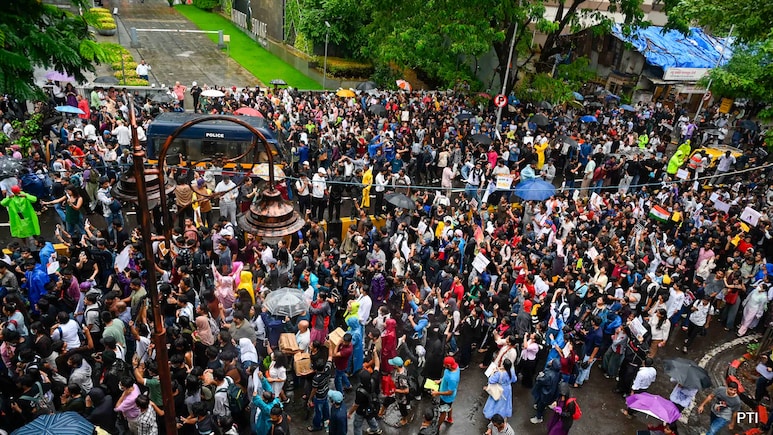
The movement entered a new phase on June 20. Armed with permission for a daylong demonstration, students from across Delhi and other states flocked to Jantar Mantar. When the protest ended, they refused to disperse despite repeated police announcements declaring the gathering illegal. What was meant to be a one-day protest gradually turned into a round-the-clock sit-in that has continued since.
As days passed, student outfits, particularly Left groups such as AISA, AISF, SFI and KYS, joined the sit-in. Food, drinking water and medical assistance was supplied on war-footing. Many came just to spend a day, a night or even a few hours at Jantar Mantar before returning home.
Another turning point came on June 28 when Sonam Wangchuk joined the agitation and began a hunger strike along with six student activists. His arrival widened the movement's appeal beyond campuses.
Parents, teachers, academics, retired civil servants, lawyers, artists and public figures began visiting Jantar Mantar. Daily medical bulletins on Wangchuk and the student hunger strikers became closely followed updates, keeping the agitation in public focus even on days without major demonstrations.
Wangchuk expanded the movement's appeal, and the government's response could hardly contain it.
Visuals of Wangchuk being removed from the protest site, his subsequent hospitalisation and repeated police action against demonstrators spread rapidly across social media. The images drew criticism from opposition parties, civil society groups and public figures, and brought fresh supporters to the protest site.
The July 20 march towards Parliament became another defining moment.
As thousands of students marched despite heavy barricading, forces dispersed the crowd using baton charge and tear gas. Tasers and pellet guns made a show.
Protesters refused to leave the site even after the crackdown. Images and videos of the police excesses circulated widely online.
In the days that followed, protests sprouted in Mumbai, Indore, Nagpur, Kolkata and many other cities. Members of the Indian diaspora held demonstrations abroad.
The protest developed a language distinctly its own.
Students answered criticism with memes, satire and parody. Some asked for selfies with police, others gave them flowers.
Mahatma Gandhi's Dandi March, Dr BR Ambedkar, Bhagat Singh and the Constitution were heroised. The National Anthem was sung before police barricades, poetry was recited, and Bollywood songs were danced to.
By the final week of the agitation, the movement was virtually on automatic mode, beyond the sway of any single leader. Many of those coming to Jantar Mantar had never interacted with Dipke or CJP before. They came after watching videos online, following Wangchuk's health updates, and witnessing the police action.
Individuals acting independently rather than any single organisation sustained the movement.
Those who could not travel supported the agitation by ordering food and other essentials online for protesters. Content creators, independent YouTubers and social media influencers amplified developments from the site, introducing the movement to audiences far removed from Delhi.
Although Pradhan has resigned, the movement has travelled far beyond its humble origins now.
Whether that momentum survives beyond its first major political victory remains to be seen. But in the weeks between the "cockroach" remark and Pradhan's resignation, the movement demonstrated how an online campaign could evolve into a mass mobilisation that ultimately became larger than the organisation that first set it in motion.
(Except for the headline, this story has not been edited by NDTV staff and is published from a syndicated feed.)
Track Latest News Live on NDTV.com and get news updates from India and around the world

