





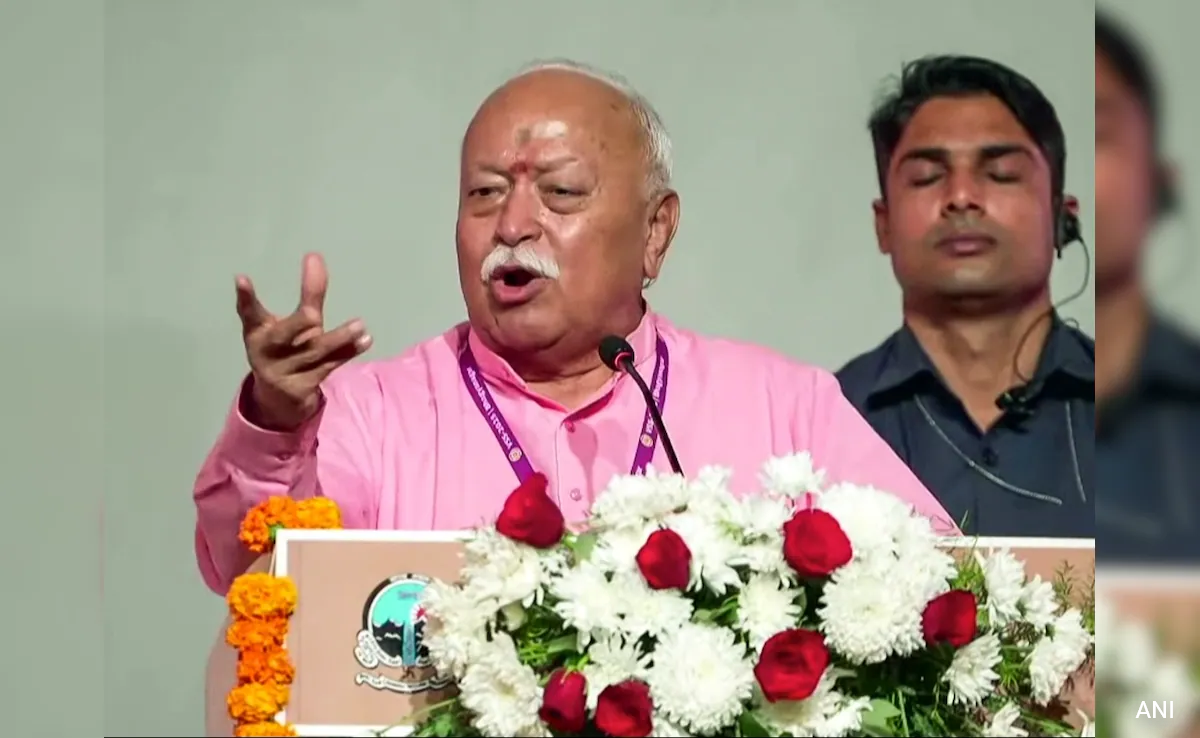
Rashtriya Swayamsevak Sangh (RSS) chief Mohan Bhagwat on Friday asserted that organisations such as the Bharatiya Janata Party (BJP), Vishva Hindu Parishad (VHP) and Vidya Bharti function independently and are not controlled by the Sangh.
“Don't try to understand RSS through the BJP or VHP; they work independently and are not remote controlled by the Sangh,” Bhagwat said, adding that those attempting to understand the RSS through its affiliated organisations were making a fundamental mistake.
Explaining the Sangh's position, he said, “While the Sangh develops Swayamsevaks, it never remote controls them.” Elaborating further, Bhagwat said, “The RSS develops Swayamsevaks and also ingrains values, thoughts and goals to work for Bharat's "Param Vaibhav". But those Swayamsevaks aren't remotely controlled by the Sangh. The BJP, VHP, and Vidya Bharti, being run by our Swayamsevaks, function with an independent identity and as per their constitution, but their vision of working for India's absolute glory is common.”
He said these organisations take their own decisions and work with people from different backgrounds. “They make their own decisions and work with people, including non Swayamsevaks in different areas and in varied ways. When we told this to people 40 years back, they mocked us, saying we were indulging in a game of words, but now people have started realizing what we actually meant to say,” Bhagwat said while addressing a gathering of prominent citizens in Bhopal.
The RSS chief said the organisation has long been subjected to misinformation and misunderstanding. “Since the beginning and till now, the RSS has had to face false narratives about it, not just from those opposed to it, but also those who aren't critical of it. The entire world knows RSS, but very few know about it in totality,” he said.
Stating that the RSS has no parallel globally, Bhagwat said, “No parallels can be drawn between the RSS and any other organization in the world. Its functioning is unique; however, it needs to be acknowledged that it draws inspiration from Tathagat Buddha (Gautam Buddha).”
Addressing criticism that labels the RSS as a paramilitary organisation, he said, “Because we perform Path Sanchalan and perform tasks with lathis, RSS should never be mistaken as a paramilitary force.” At the same time, he clarified that social work alone does not define the Sangh. “It carries out service activities, but this shouldn't lead one to believe that the Sangh is merely a social service organization.”
Bhagwat said misconceptions about the RSS have been spread by both supporters and critics. “Both Sangh's supporters and opponents have spread many misconceptions and false narratives about the Sangh in society.
He said, “For understanding RSS, you'll have to come and be with the RSS, rather than searching about it in Wikipedia.”
He said the RSS had consciously chosen not to function as a pressure group. Instead, its aim was to organise Hindu society.
Reflecting on the organisation's century-long journey, Bhagwat said the RSS had faced unprecedented opposition. “While maintaining that in the 100 years of its journey, the RSS has had to face opposition and difficulties, which no other organization has faced in the world, he said. "We only work with the sole motive of the absolute glory of our Hindu Rashtra".
He said opposition to the RSS began during British rule and continued after Independence. “First it was the British government that worked against the RSS, but even after independence, the Sangh had to face extreme opposition, pressures, attacks, and even assassinations. The efforts to pressurize and crush us still happen, but they are now fading.”
Commenting on language and cultural identity, Bhagwat appealed to citizens to take pride in Indian languages. “While at home, speak in your mother tongue. But everyone who lives in a particular state should know and understand the indigenous language of that state, besides knowing their own mother tongue. All languages in India are national languages. If I live in Bengal, irrespective of my mother tongue, I should also know Bengali.”
He also stressed cultural self-confidence, saying, “Only when you perform your own bhajans with children in your home will no one try to put a cross on your child's neck.”
Calling for Swadeshi and self-reliance, Bhagwat said, “For becoming Atmanirbhar (self-reliant), you need to have Atma Gaurav (self-pride). Only buy and use what is made in your land and which renders employment to people of your country.” He clarified that Swadeshi does not mean isolation. “However, being Swadeshi doesn't mean that you cut trading with the world and import only essentials (like medicines) that aren't produced in India, but the trade should never take place under any pressure or fear of tariffs. It should only happen on our own terms.”
Bhagwat is on a two-day visit to Bhopal as part of the RSS's centenary-related activities across the country. He is scheduled to address and interact with women and people from different communities in two separate sessions on Saturday.
Track Latest News Live on NDTV.com and get news updates from India and around the world

